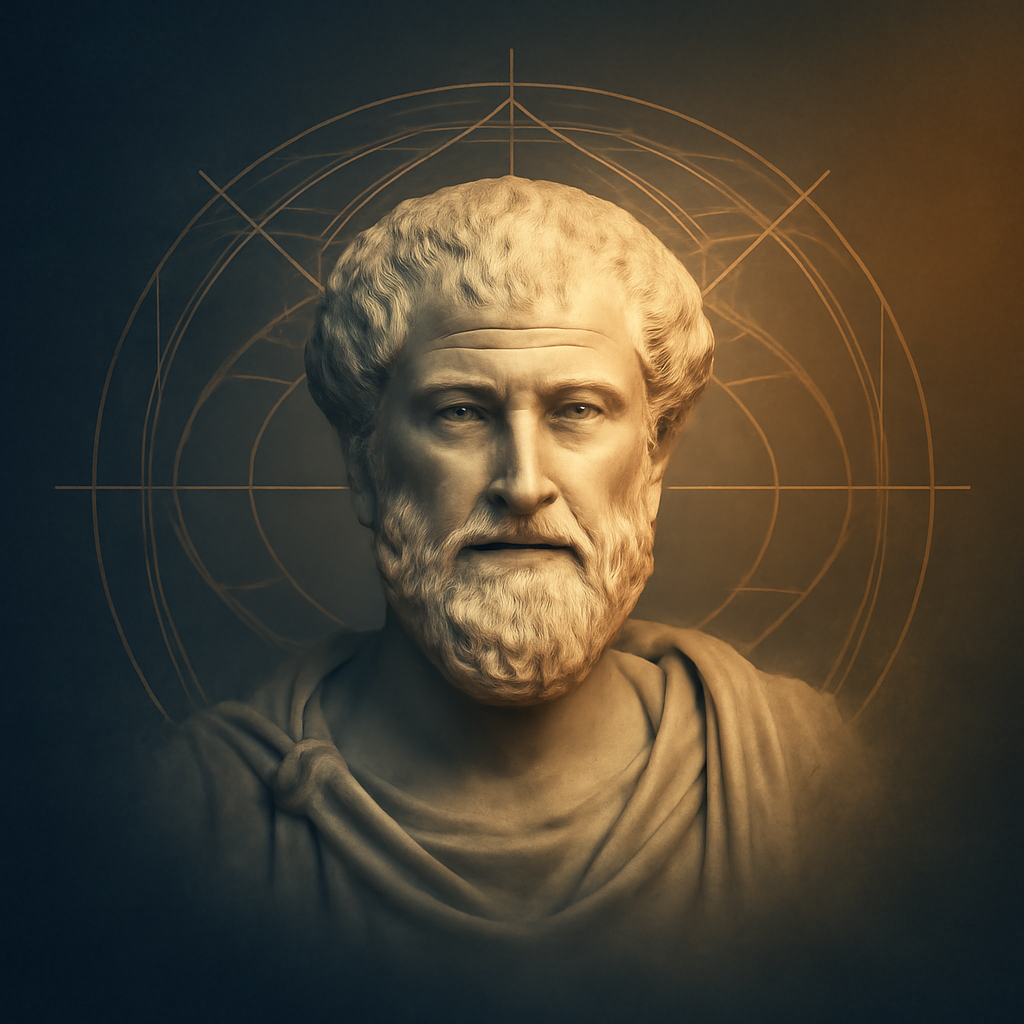
The Political Animal: Ethics in Action and the Legacy of Reason
Aristotle: The Architect of Reality and Reason

Transcript
Imagine a bustling marketplace in ancient Athens. Merchants haggle, citizens debate, and children play. This vibrant scene is more than just a collection of individuals; it's a community, a polis. For Aristotle, this is where human potential truly unfolds. He famously described humans as "political animals," not because we crave power, but because we naturally form communities. These communities allow us to express justice, injustice, and everything in between. Now, Manu, let's connect this to our previous discussion on virtue. Aristotle believed that ethics and politics are intertwined. Ethics explores the good life for an individual, while politics organizes society so that citizens can achieve that life together. The polis, or city-state, exists not just for survival, but for living well. It's the most complete community, aiming at the highest human good. Think of the polis as a layered cake. At the base, you have the household, fulfilling basic needs. Next, the village, offering mutual support. Finally, the city-state, where justice and governance flourish. Aristotle argued that a person living entirely outside this structure would be either a beast or a god, because true human flourishing requires political association. Aristotle also emphasized the role of friendship, or philia, in civic life. It's not just personal affection; it's a bond that holds the community together. He identified three kinds of friendship: utility, pleasure, and virtue. Friendships of virtue, based on mutual respect and shared values, are the highest form. They contribute to the stability and harmony of the polis. Now, let's explore Aristotle's views on political responsibility. He argued that moral education is a political responsibility, where legislators should cultivate good character in citizens through laws and institutions. The polis shapes who you become, embedding justice as an element of the state itself. The takeaway here, Manu, is profound. Aristotle's vision of humans as political animals underscores the importance of community in achieving our full potential. His systematic approach to logic and ethics has shaped Western thought for centuries, reminding us that reason and community are the cornerstones of a flourishing life. Aristotle also emphasized the role of friendship, or philia, in civic life. It's not just personal affection; it's a bond that holds the community together. Friendships of virtue, based on mutual respect and shared values, are the highest form and contribute to the stability and harmony of the polis. Now, the key idea that amplifies this legacy is what Aristotle did with knowledge itself. He sorted it. Biology, ethics, politics, logic, metaphysics — each became a distinct field of inquiry with its own methods and questions. That act of classification shaped how universities were organized for centuries. Think of it as the original curriculum design. Every modern academic department owes something to Aristotle's instinct to separate and name the domains of human understanding. Here is where Aristotle's difference from Plato becomes most consequential. Plato trusted transcendent Forms — abstract ideals existing beyond the physical world. Aristotle trusted observation. He studied constitutions, cataloged animals, and analyzed existing political systems rather than constructing ideal ones from scratch. That empirical habit, grounding conclusions in what you can actually examine, is one of the earliest recognizable ancestors of the scientific method. Aristotle also argued that moral education is a political responsibility. Legislators, he said, should cultivate good character in citizens through laws and institutions. The polis does not just protect you. It shapes who you become. That means justice is not merely a legal concept — it is an element of the state itself, embedded in how communities govern shared life. [short pause] So here is where all three lectures converge, Manu. Aristotle began by pointing at the ground — at observable reality. He built an ethics grounded in habit and character. And he completed the arc by insisting that character only fully develops inside a community. You are not diminished by needing others. That need is precisely what makes you human. His logic gave the West its tools for reasoning. His ethics gave it a goal. And his politics gave it a place to pursue that goal together. That, Manu, is the architecture of a life well-reasoned and well-lived.