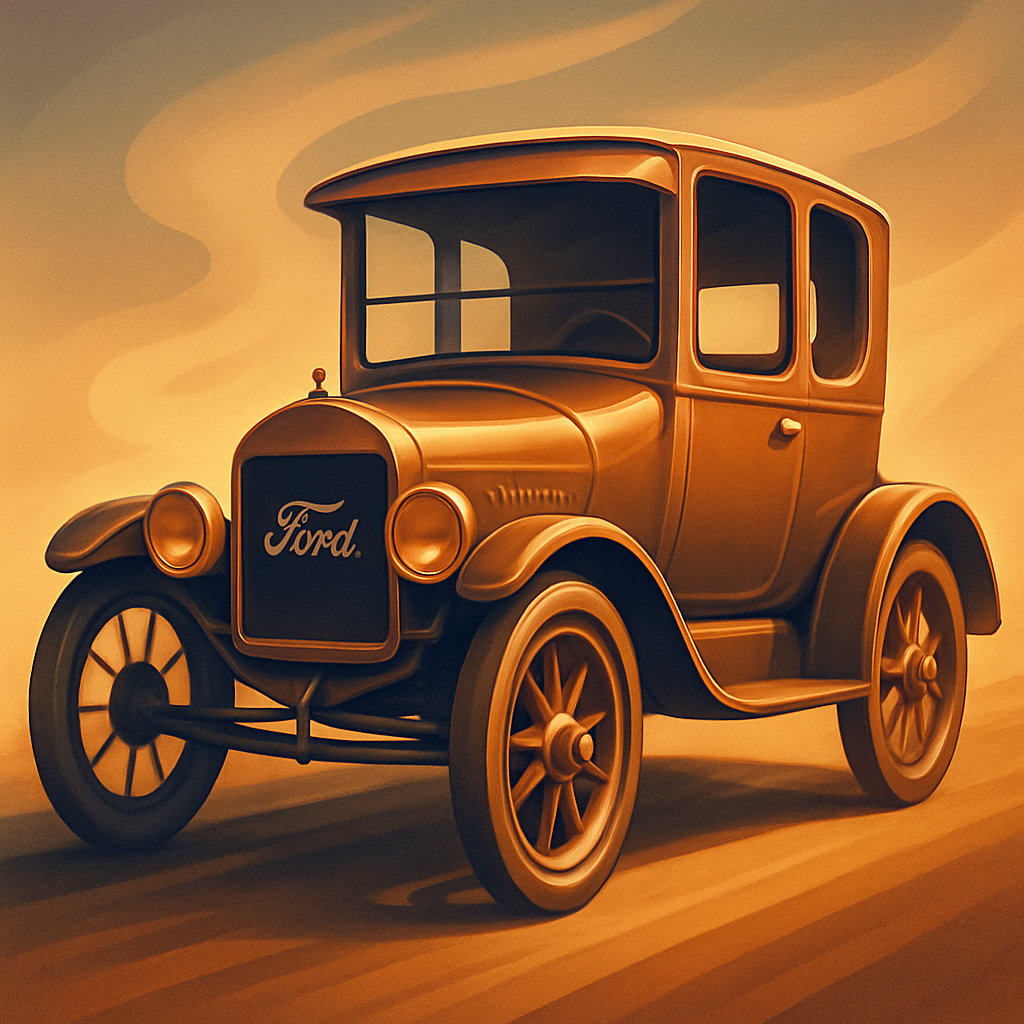
The Spark of Change: Henry Ford's Vision
The Universal Car: Designing the Model T
Highland Park and the Moving Assembly Line
The Five-Dollar Day: A Social Experiment
Vertical Integration: The River Rouge Giant
The End of the Model T and the Legacy of Fordism

Transcript
A car that cost more than four years of your salary. That was the reality for most Americans in the early 1900s. Luxury automobiles routinely sold for over two thousand dollars, while the average annual wage across the United States sat at roughly four hundred and eighty-nine dollars. Cars were handmade curiosities, assembled one at a time by skilled craftsmen, and owned almost exclusively by the wealthy. They were status symbols, not tools. Henry Ford looked at that gap and saw something nobody else did — not a market for the rich, but a machine waiting to serve everyone. Ford did not arrive at that vision overnight, Michael. Before he ever built a car company, he worked as chief engineer for the Edison Illuminating Company in Detroit. That job gave him deep technical discipline and a precise understanding of how machines and systems interact. When he finally turned his full attention to automobiles, he brought an engineer's obsession with quality and efficiency. His first attempt, the Detroit Automobile Company, collapsed hard. It produced only twenty vehicles before dissolving in 1901, undone by low quality and prices that still priced out ordinary buyers. That failure was not just a setback. It was a lesson that permanently shaped his thinking. Precision mattered. Scale mattered. And cost had to come down dramatically. Now, think of the difference between a tailor-made suit and a factory-sewn shirt. One is crafted for a single person; the other fits thousands. Before Ford, every automobile was closer to that bespoke suit — built to order, inconsistent, expensive. Ford's radical belief was that a car should be the factory-sewn shirt. He wanted every part interchangeable, every process repeatable, every vehicle identical in quality. That meant universal standardization had to sit at the core of his entire operation. Not as a cost-cutting trick, but as the philosophical foundation of democratization. If parts were standardized, production could scale. If production scaled, prices could fall. If prices fell, the car could reach the family that had never dreamed of owning one. Between 1903 and 1908, Ford tested that philosophy relentlessly. The company produced a series of lettered models — the Model A, B, C, F, K, N, R, and S — each one a step in refining the formula. Some were heavier, some lighter, some aimed at buyers with more money. Ford was not just building cars during those years, Michael. He was running experiments. Each model taught his team something about what worked, what failed, and what the market actually needed. The key idea here is that Ford treated early production as a learning system, not a finished product. He was willing to scrap a direction entirely if it did not move toward his core goal — a reliable, affordable vehicle that an ordinary working family could buy and use. That relentless iteration, grounded in real production data, is what separated Ford from competitors who were content to sell expensive machines to wealthy customers. The takeaway from Ford's early story is this: his genius was not mechanical alone. It was philosophical. He redefined what a car was supposed to be. Not a luxury object. Not a custom project for the privileged. A utility. A tool. Something as practical and accessible as a plow or a sewing machine. Remember, the gap between a two-thousand-dollar car and a four-hundred-dollar annual wage was not just a pricing problem — it was a social barrier. Ford's vision of mass production and universal standardization was his answer to that barrier. Every decision he made, from the collapse of the Detroit Automobile Company through years of lettered model experiments, pointed toward one destination. A car built for everyone. That conviction, Michael, is the spark that set everything in motion — and it is the foundation every subsequent chapter of Ford's production story is built on.