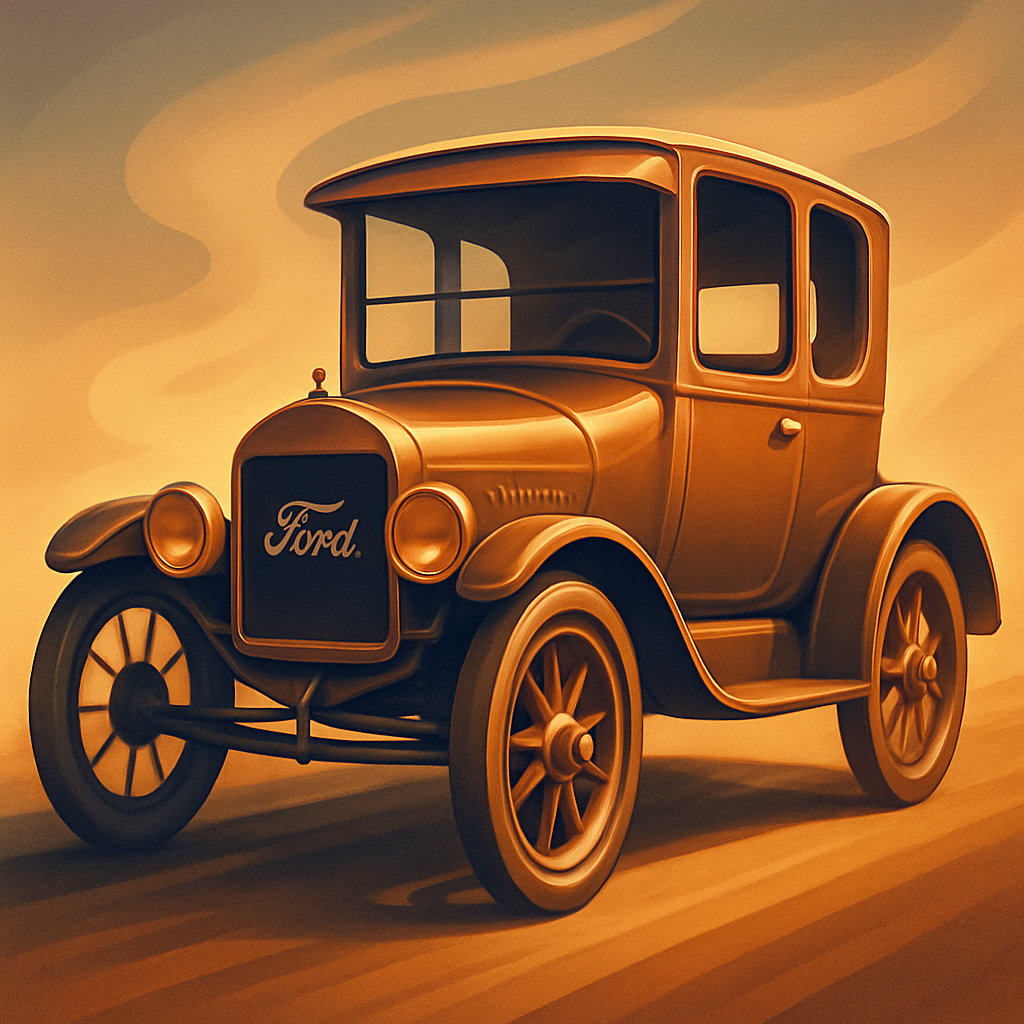
The Spark of Change: Henry Ford's Vision
The Universal Car: Designing the Model T
Highland Park and the Moving Assembly Line
The Five-Dollar Day: A Social Experiment
Vertical Integration: The River Rouge Giant
The End of the Model T and the Legacy of Fordism

Transcript
October 7, 1913. A rope is tied to a Model T chassis. A winch pulls it slowly across a factory floor. One hundred and forty workers stand in a line, each doing one small task as the chassis slides past. That is it. No sophisticated machinery. No gleaming conveyor belt. Just a rope, a winch, and a 150-foot line. Before that day, workers walked from car to car on stationary stands. Teams crowded around each vehicle, bumping into each other, waiting on parts. It was slow. It was congested. And it was about to become obsolete. Previously, we explored the Model T's engineering, focusing on its durability and simplicity. Today, we delve into the innovation of the moving assembly line, a pivotal development in manufacturing. But designing a great car and building millions of them are two very different problems. That second problem is what Highland Park solved. Ford moved Model T production to the Highland Park plant in Michigan around 1910 to 1911. It became the proving ground for something that would reshape manufacturing far beyond automobiles. Think of a meatpacking plant. Carcasses move along an overhead rail. Each butcher makes one cut, then the carcass moves on. Ford's engineers looked at that system — and at flour mills, bakeries, and canning operations — and asked a simple question. Why can't a car be assembled the same way? The insight was not Henry Ford's alone. Historians emphasize this was a team effort, with Ford engineers and managers experimenting with part flows and task sequences over several years. The conceptual leap mattered more than any single invention. Here is the core shift, Michael. Before the moving line, workers traveled to the product. After it, the product traveled to the workers. Each person on the line owned one small, standardized task. Dozens of discrete steps, repeated continuously. By early 1914, the crude rope-and-winch system was replaced by an endless-chain, power-driven conveyor flush with the factory floor. That meant the line was designed to keep moving continuously. Parts arrived at the right moment. Workers could remain at their stations as the product came past. The whole factory became one synchronized machine. The results were staggering, Michael. That first rope-driven line cut chassis assembly time from about 12.5 hours down to roughly 5 hours and 50 minutes in a single day. Continuous refinements pushed it further. By 1914, assembly time per Model T had dropped to around 93 minutes. This innovation not only revolutionized car production but also set a precedent for efficiency in various industries, influencing how products like appliances and electronics were manufactured. Speed came with a cost. The relentless pace of the moving line was exhausting. Turnover at Highland Park surged. Workers quit faster than Ford could replace them. Shortly after the line's debut, Ford announced the five-dollar workday, more than doubling typical base daily pay and cutting the shift from nine hours to eight. It was partly a production decision. Stable workers meant a stable line. That combination — high-volume assembly paired with relatively high wages — became known as Fordism. It linked mass production directly to mass consumption. The moving assembly line was not a polished invention handed down from a lone genius. It started as a rope dragging a chassis across a floor. The idea — bring the work to the worker, break the work into small, repeatable tasks — was what mattered. That idea cut chassis production time from twelve hours to ninety-three minutes. It slashed the price of the Model T by more than half. And it spread far beyond cars, reshaping how appliances, phonographs, and refrigerators were built across the twentieth century. The takeaway is simple: the most transformative innovations are often the ones that change the sequence, not the parts.