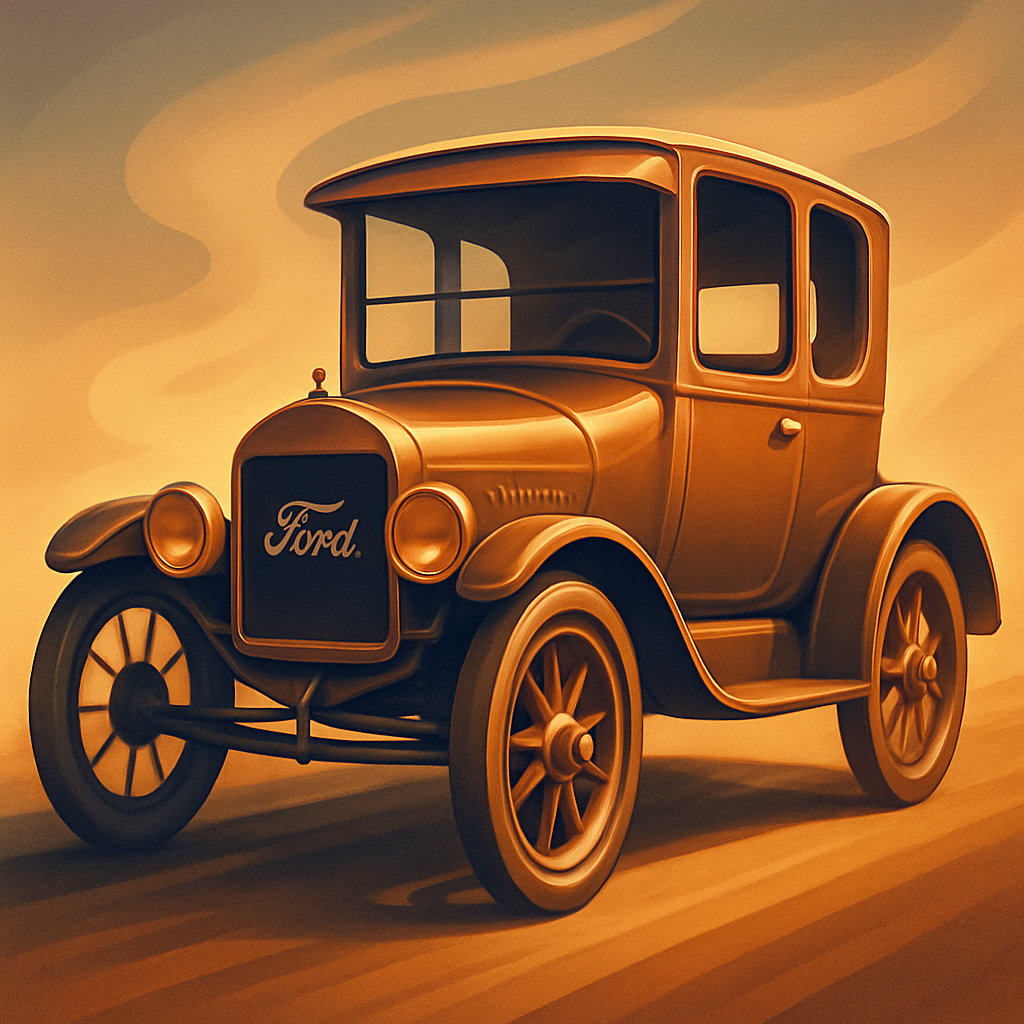
The Spark of Change: Henry Ford's Vision
The Universal Car: Designing the Model T
Highland Park and the Moving Assembly Line
The Five-Dollar Day: A Social Experiment
Vertical Integration: The River Rouge Giant
The End of the Model T and the Legacy of Fordism

Transcript
Iron ore arrives by ship. Forty-eight hours later, it rolls out of the factory as a finished automobile. Not a component. Not a frame. A complete car. That was the operating reality at the River Rouge complex. Ford's stated vision was a continuous, nonstop process from raw material to finished product, with no pause even for warehousing or storage. Most manufacturers of the era bought parts from dozens of outside suppliers, stitched them together, and hoped the timing worked. Ford wanted to reduce that dependency. He wanted to bring the major steps under his own control. While workforce stability was crucial, the focus here shifts to the operational strategy at the River Rouge complex. Ford began buying land along the Rouge River, eventually assembling roughly 2,000 acres of bottomland near Dearborn, Michigan. Construction of the core facilities ran mainly during the 1920s. By 1927, Ford had shifted final automobile assembly away from Highland Park entirely, moving it to the Rouge. The numbers here are almost hard to absorb. At its peak, the Rouge encompassed more than 90 buildings and over 15 million square feet of floor space. Commentators have noted that figure is several times larger than the Boeing Everett factory's enclosed area. More than 100,000 people worked there at its employment peak. By the late 1920s it was recognized as the largest integrated factory complex in the world. That is not a marketing claim, Michael. It was an international symbol of what mass-production industrialization could become. Think of a restaurant that grows its own vegetables, mills its own flour, generates its own electricity, and delivers its own meals. The Rouge worked on that principle, but at industrial scale. It included a steel mill, foundry, glass plant, power plant, ore docks, and assembly buildings. Great Lakes freighters delivered iron ore and coal directly to on-site docks. The power plant burned that coal to generate Ford's own electricity and steam. Because the Rouge had its own steelmaking, Ford could bypass independent steel producers entirely and negotiate raw materials directly with mining and shipping concerns. That strengthened Ford's bargaining position across the whole industrial economy. Vertical integration allowed Ford to control production costs and quality, ensuring efficiency and consistency. However, it also meant that any disruption could affect the entire operation. The major stages were interdependent. That made coordination and labor relations at the Rouge critically important. The same integration that eliminated outside suppliers also eliminated outside buffers. The River Rouge complex was not just a factory. It was a philosophy made physical. Raw iron ore arrived by ship. Finished cars rolled out the other end at a peak rate of around 4,000 vehicles per day. The entire supply chain — materials, energy, steel, glass, assembly — lived under one roof and one strategy. That is the pinnacle of vertical integration. Over time, production strategy evolved away from extreme vertical integration toward more conventional supplier networks, and many heavy industrial operations at the Rouge were reduced or modernized. But the model it demonstrated — that controlling major inputs can give a company tighter command over production — became a reference point for industrial thinking far beyond automobiles.