The Spark of Change: Henry Ford's Vision
The Universal Car: Designing the Model T
Highland Park and the Moving Assembly Line
The Five-Dollar Day: A Social Experiment
Vertical Integration: The River Rouge Giant
The End of the Model T and the Legacy of Fordism

Transcript
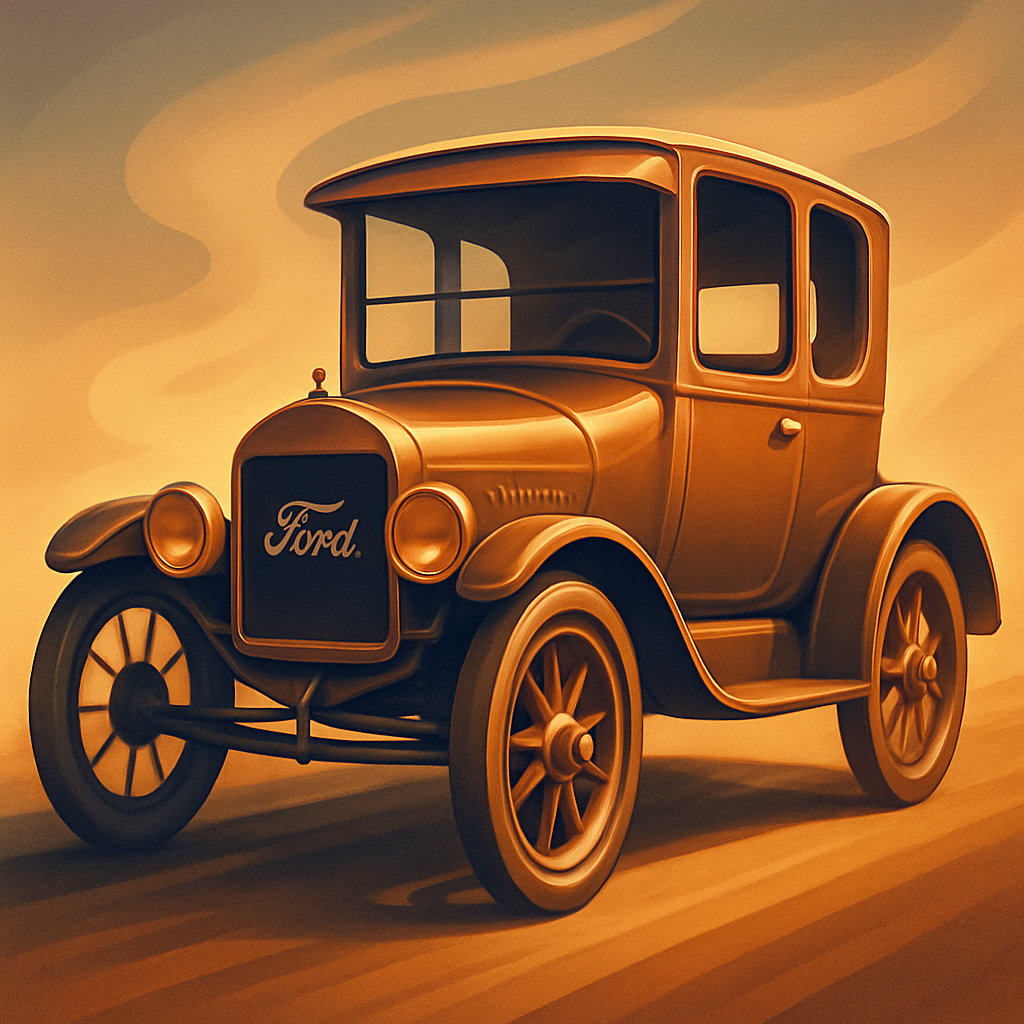
SPEAKER_1: Let's explore how market dynamics and consumer preferences began to challenge Ford's dominance, leading to the end of the Model T era. Now I want to talk about what happened when that whole system started to crack. SPEAKER_2: Right, and the crack didn't come from inside the factory. It came from the market. The Model T ran from 1908 all the way to 1927 — nearly two decades on a single design. Over that run, Ford built more than 15 million of them. That record stood for decades. SPEAKER_1: So what actually went wrong? Because by the early 1920s the T still dominated domestic sales. SPEAKER_2: It did. The T hit peak U.S. market share in the early 1920s. But consumer preferences were shifting underneath that dominance. Buyers increasingly wanted closed bodies, more comfort, better styling, color options. The T's aging design couldn't deliver any of that. SPEAKER_1: And Ford's response was basically... to not respond. SPEAKER_2: That's the key idea. Ford's rigid standardization philosophy, epitomized by his famous line about car color, became a limitation as consumer preferences evolved. That wasn't just a quip. It reflected a genuine operating philosophy. Standardization above all. SPEAKER_1: So who stepped into that gap? SPEAKER_2: General Motors, specifically under Alfred P. Sloan. Sloan promoted annual model changes and what he called a car for every purse and purpose — a range of models at different price points, updated styling every year. Historians argue that approach helped GM surpass Ford in sales by the late 1920s. SPEAKER_1: Think of it like a restaurant that only serves one dish, perfectly made, while the place next door keeps updating the menu. Eventually people want something new. SPEAKER_2: That's exactly the dynamic. By the mid-1920s, Ford's insistence on keeping the T largely unchanged left the company exposed. Competitors responded faster to closed bodies, colors, and better performance. The T's strengths — simplicity, low cost — stopped outweighing its limitations. SPEAKER_1: So what did Ford actually do when the T finally ended? SPEAKER_2: In 1927, Ford responded to market pressures by halting Model T production to introduce the Model A, which featured modern styling and more options. The Model A offered more modern styling, more power, and real color choices. SPEAKER_1: So the T's decline illustrates a real tension — the same standardization that made Ford dominant eventually made the company rigid. SPEAKER_2: Exactly. That's the core limitation scholars point to in classical Fordism: an overemphasis on cost reduction and standardization at the expense of product differentiation. The system that built 15 million identical cars couldn't easily pivot when consumers wanted something different. SPEAKER_1: Now, Fordism gets used as a term well beyond cars. What does it actually mean in that broader sense? SPEAKER_2: In economic and sociological literature, Fordism describes a whole regime — standardized large-scale production, stable employment, rising wages, and expanding consumer markets. The five-dollar day is central to that idea: better-paid workers become consumers of the goods they produce. That linkage is what made it a model for entire economies. SPEAKER_1: And it spread far beyond auto plants. SPEAKER_2: Ford's moving assembly line and specialized machine tools were widely imitated — appliances, agriculture, armaments. In post-World War II Europe, the term Fordism was often invoked to describe reconstruction strategies that combined American-style mass production with welfare state policies and collective bargaining. The template traveled. SPEAKER_1: So what eventually replaced it? Because Fordism clearly didn't last forever either. SPEAKER_2: Scholars contrast it with what they call post-Fordism — flexible specialization, just-in-time production, more fragmented labor markets. That shift accelerated from the 1970s onward. The rigid, high-volume, single-product model gave way to systems that could adapt faster to changing demand. SPEAKER_1: The takeaway is that Ford's early loss of market dominance exposed the limits of strict standardization, but the methods associated with Fordism kept shaping manufacturing long after the Model T ended. SPEAKER_2: That's it exactly. The T ended in 1927. But standardized assembly, productivity-driven wages, and the idea that mass production and mass consumption reinforce each other — those principles shaped global manufacturing and labor relations through most of the 20th century. Ford built more than cars. He built the template the industrial world ran on.