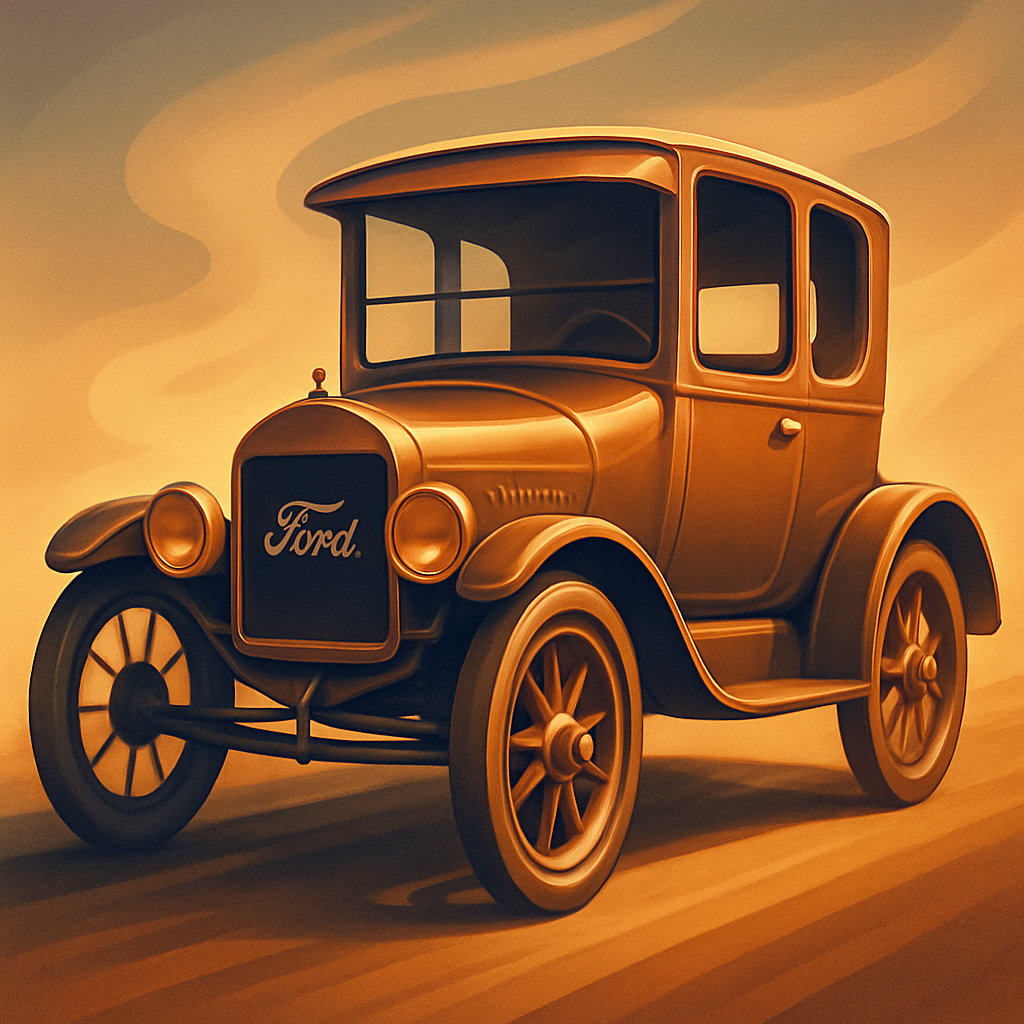
The Spark of Change: Henry Ford's Vision
The Universal Car: Designing the Model T
Highland Park and the Moving Assembly Line
The Five-Dollar Day: A Social Experiment
Vertical Integration: The River Rouge Giant
The End of the Model T and the Legacy of Fordism

Transcript
SPEAKER_1: Last time we established the basic idea: the Model T framed the car as a practical utility, not a luxury. Now I want to get into the actual machine. The Model T. SPEAKER_2: Good place to pick up. The T arrived in 1908 — the first one built for sale was completed on September 27, 1908. Ford had spent years on those lettered model experiments, and the T is where everything converged into one deliberate design. SPEAKER_1: So what made the design itself different? Plenty of cars existed by 1908. SPEAKER_2: The key idea is that Ford engineered the T around three commitments: simplicity, durability, and affordability. Many choices traced back to those three things. Not speed, not prestige — a working family had to be able to buy it, drive it, and fix it themselves. SPEAKER_1: Durability stands out to me. Rural American roads in 1908 were not smooth highways. SPEAKER_2: Exactly, and that's why materials mattered so much. Ford used vanadium steel in the T's construction. Think of it like the difference between cast iron and carbon steel — one is heavy and brittle under stress, the other flexes and holds. Vanadium steel is significantly tougher and lighter than what most manufacturers were using. SPEAKER_1: So the vanadium steel was specifically chosen because the roads would punish anything weaker. SPEAKER_2: Right. Rutted dirt roads, creek crossings, farm tracks — the T had to survive all of that. The vanadium steel gave the frame the strength to absorb those shocks without cracking. That durability is a big reason the T earned its reputation as genuinely reliable transportation. SPEAKER_1: What about the engine? What was actually under the hood? SPEAKER_2: A four-cylinder engine, about 177 cubic inches — roughly 2.9 liters. It produced around 20 horsepower. Modest, but remember, the goal wasn't racing. It was reliable, consistent power for everyday use. The design was also intentionally simple so owners could maintain it without specialized tools. SPEAKER_1: That simplicity theme keeps coming back. Even the gearbox was stripped down, right? SPEAKER_2: Ford reduced it to a planetary gearbox — two forward speeds and a reverse. Fewer moving parts meant fewer things to break. And it made the car easier to operate for first-time drivers, which mattered enormously when many buyers were new to driving. SPEAKER_1: What did it actually cost? Because affordability was the whole point. SPEAKER_2: One early 1908 listing put the price at $850. That's still real money for the era, but compare it to luxury automobiles running well over two thousand dollars — it was a dramatic difference. And that price kept falling as production scaled up. SPEAKER_1: So what Michael and everyone listening might be wondering — did the T come in just one version? One look? SPEAKER_2: Actually, no. The T was offered in multiple body styles — touring cars, runabouts, town cars. And here's something that surprises people: it originally appeared in colors other than black. The all-black policy came later, tied directly to production efficiency as the assembly line accelerated. SPEAKER_1: The black car thing is almost mythological at this point. And the earliest T didn't even have a speedometer, right? SPEAKER_2: Correct — no speedometer from the start. For everyone listening, that tells you something about the priorities. Ford wasn't building a performance machine. He was building a tool. The nickname 'Tin Lizzie' captured that perfectly — affectionate, but honest. A plain, no-frills workhorse. SPEAKER_1: Tin Lizzie. There's something almost endearing about that name for a car that changed everything. SPEAKER_2: The numbers back up just how much it changed things. By 1917, more than 40 percent of all cars in the United States were Model Ts. The T ran in production all the way through 1927 — nearly two decades for a single model. That's extraordinary by any standard. SPEAKER_1: So the takeaway here is that the Model T wasn't just a product — it was a carefully engineered answer to a specific problem. SPEAKER_2: That's exactly it. Ford set out to build a universal car, and the T delivered through deliberate choices — vanadium steel for durability, a simple maintainable engine, and a price point within reach of working families. It transformed the automobile from a rich person's novelty into something millions of ordinary Americans actually owned and used.