The Starting Block: Kennedy's Impossible Challenge
Building the Behemoth: Engineering the Saturn V
The Crew: Three Men in a Tin Can
The Invisible Network: Mission Control
The Long Road: From Liftoff to Lunar Orbit
The Eagle Has Landed: The Final Descent
One Giant Leap: Exploring the Surface
The Return and the Legacy of Apollo

Transcript
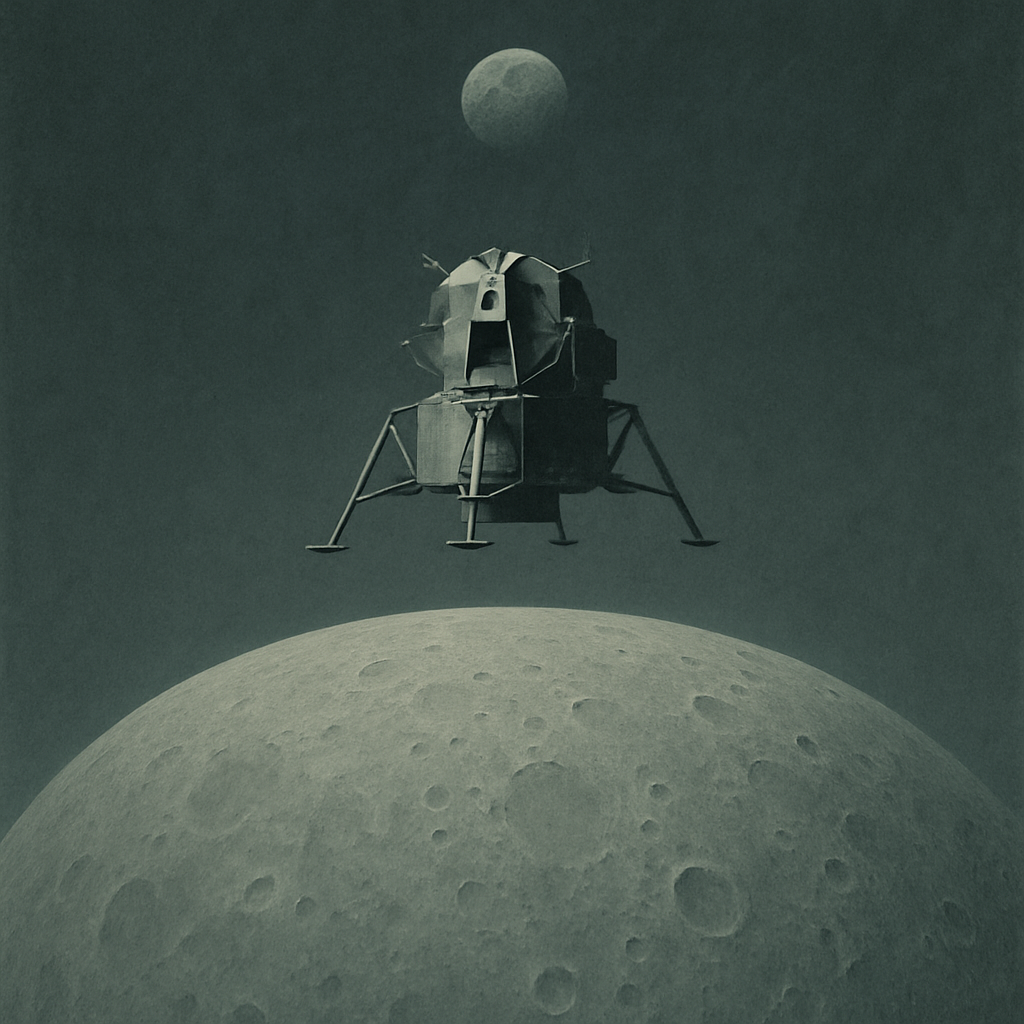
Welcome to your first step into one of history's most audacious achievements, the Apollo 11 mission. When John F. Kennedy stood before Congress on May 25, 1961, the United States had accumulated a grand total of fifteen minutes of human spaceflight experience — Alan Shepard's brief suborbital arc, completed just three weeks earlier. Fifteen minutes. That was the entire foundation on which Kennedy proposed landing humans on the Moon before the decade ended. Historian Douglas Brinkley, who spent years studying the Apollo archives, has called it "the most galvanizing political gamble in the history of science." The gap between what America could do and what Kennedy demanded was not a stretch — it was a chasm. The pressure behind that gamble, Alina, was existential. The Soviet Union had been humiliating the United States in space for years. Sputnik launched in October 1957, the first artificial satellite, and the beeping signal it broadcast was heard as a direct threat to American technological supremacy. Then came Yuri Gagarin on April 12, 1961 — the first human in space — and the anxiety inside Washington became acute. The Cold War was not just a military contest; it was a global advertisement for which political system worked better. Every Soviet space first was a propaganda victory broadcast to billions of watching, undecided nations. Kennedy needed a milestone so dramatic, so unambiguous, that no one could dispute the winner. The Moon was the only target big enough. Choosing the Moon was also strategically calculated. Other milestones — first space station, first Mars flyby — were either too vague or too achievable by the Soviets first. The Moon was singular, binary, and verifiable. You either landed humans there and brought them home, or you did not. Kennedy's advisors recognized that the United States, despite its current deficit, held advantages in industrial capacity and funding that could be mobilized fast. NASA, founded only in 1958 as a modest civilian agency, had to be transformed completely — from a small research bureau into a command-and-control engineering empire managing hundreds of thousands of contractors simultaneously. That transformation was the real impossible challenge hiding inside the speech. The funding followed the fear. Congress, gripped by Cold War urgency, approved budgets that at Apollo's peak consumed over four percent of the entire federal budget. Apollo 11 itself — the fifth crewed Apollo mission — launched July 16, 1969, atop a Saturn V rocket from Kennedy Space Center, carrying Commander Neil Armstrong, Command Module Pilot Michael Collins, and Lunar Module Pilot Buzz Aldrin. The spacecraft had three components: the Command Module Columbia, the Service Module, and the Lunar Module Eagle. On July 20, 1969, at 20:17 UTC, Eagle touched down in the Sea of Tranquility — six kilometers from the planned site, with Armstrong having manually piloted around boulders, landing with just 25 seconds of fuel remaining. At 02:56 UTC on July 21, Armstrong stepped onto the surface. 530 million people watched live. The crew collected 21.5 kilograms of lunar rock, planted the American flag, and spoke with President Nixon before returning safely, splashing down in the Pacific on July 24, recovered by USS Hornet. Here is what you should carry forward, Alina: Apollo 11 was not primarily a science mission. It was a political instrument, forged from national anxiety and Cold War competition, that happened to produce one of humanity's greatest scientific and engineering achievements. Kennedy's 1961 speech set a deadline — before December 31, 1969 — with almost no technical basis for confidence it was achievable. The entire Apollo program proves that when political will is absolute and resources match the ambition, humans can accomplish what looks, by every rational measure, impossible. That is the engine behind everything that followed.