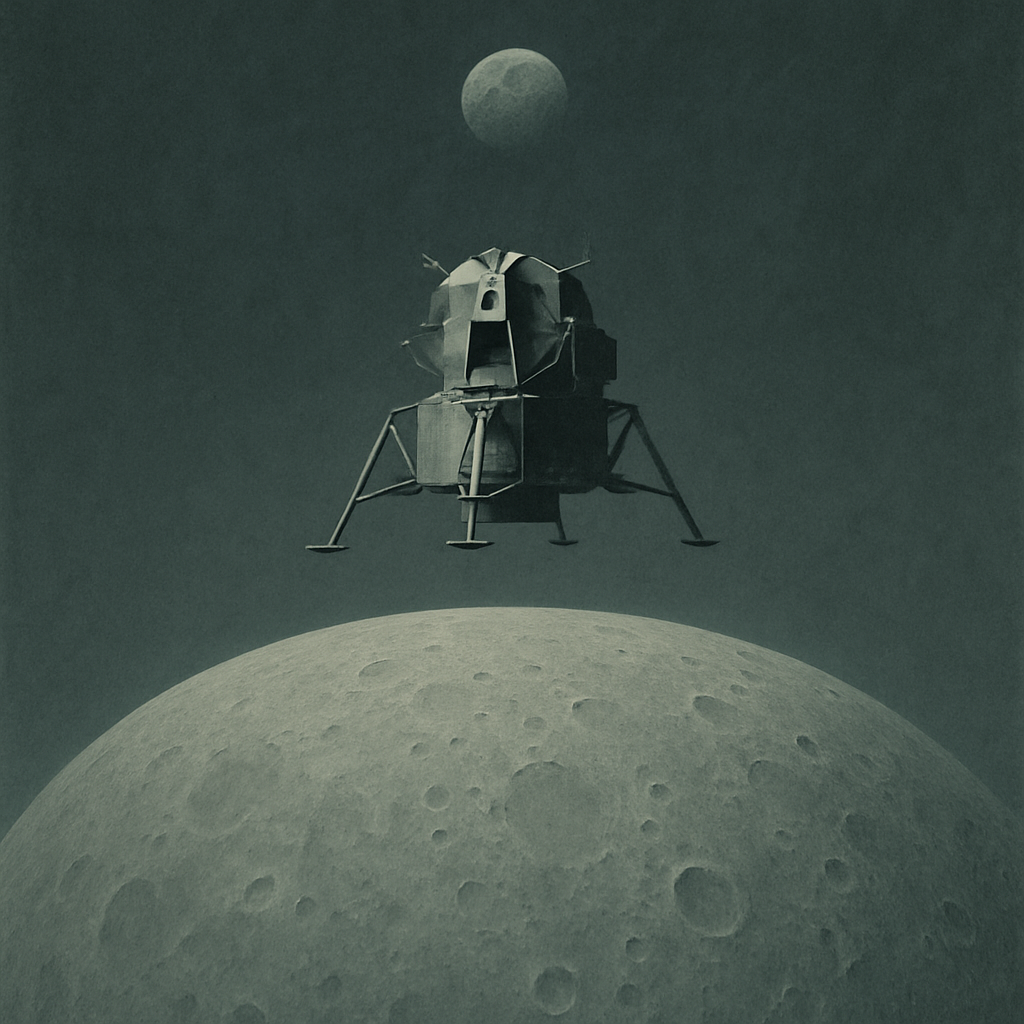
The Starting Block: Kennedy's Impossible Challenge
Building the Behemoth: Engineering the Saturn V
The Crew: Three Men in a Tin Can
The Invisible Network: Mission Control
The Long Road: From Liftoff to Lunar Orbit
The Eagle Has Landed: The Final Descent
One Giant Leap: Exploring the Surface
The Return and the Legacy of Apollo

Transcript
SPEAKER_1: Alright, so last time we were right there in the descent — computer alarms, boulder fields, 25 seconds of fuel. Armstrong kept flying when the systems were failing. And now we're at the other end of the story: getting home, and what it all meant. SPEAKER_2: And the return is where the mission's full weight really lands. Eagle lifted off after 21.6 hours on the surface, the flag knocked flat by the exhaust blast on the way up. Then came the rendezvous — which is its own remarkable piece of engineering. SPEAKER_1: Walk our listener through that. Collins had been orbiting alone for all that time — what was the actual mechanics of getting back together? SPEAKER_2: Collins was tracking Eagle's ascent stage from Columbia, ready to execute a rescue maneuver if needed. He'd been alone for 21-plus hours, out of radio contact with Earth for 48 minutes of every orbit. The docking went cleanly. Armstrong and Aldrin transferred back, Eagle's ascent stage was jettisoned, and the crew fired the Service Module engine to break out of lunar orbit and head home. SPEAKER_1: Collins had a real contingency hanging over him, though — if Eagle hadn't made it back up, he was flying home alone. SPEAKER_2: That was the explicit plan. NASA had prepared a statement for Nixon to read if the crew was stranded. Collins knew it. He said later he felt not dread but a kind of focused acceptance. That's the test pilot psychology we've seen throughout this crew — you acknowledge the worst case and keep working. SPEAKER_1: So how did re-entry actually work? Because coming back from the Moon isn't the same as coming back from Earth orbit. SPEAKER_2: The Command Module hit the atmosphere at roughly 40,000 kilometers per hour — significantly faster than a low-Earth-orbit return. The heat shield had to absorb temperatures around 2,800 degrees Celsius. The entry corridor was extremely narrow; too steep and the capsule burns up, too shallow and it skips off the atmosphere into deep space. Columbia threaded that corridor precisely, splashing down July 24 southwest of Hawaii, recovered by USS Hornet. SPEAKER_1: And then straight into quarantine. Our listener might be wondering — why 21 days specifically? SPEAKER_2: It matched the incubation period scientists considered plausible for any hypothetical lunar pathogen. The crew went directly into a mobile quarantine facility — a converted Airstream trailer — aboard Hornet, then transferred to Pearl Harbor, then to Houston. Three weeks total. No lunar microbes were found, but the caution was scientifically legitimate. Nobody actually knew. SPEAKER_1: After quarantine — ticker-tape parades, a world tour, the Presidential Medal of Freedom. But let's explore the broader implications and long-term impacts of Apollo 11, beyond its immediate scientific legacy. SPEAKER_2: Right, and it's still compounding. The 21.5 kilograms of lunar material identified three previously unrecognized minerals. Analysis confirmed the giant impact hypothesis — the Moon formed from debris when a Mars-sized body struck early Earth. The Laser Ranging Retroreflector, a lasting legacy of Apollo 11, continues to provide valuable data on the Moon's drift and gravitational constants. Research on Apollo 11 materials continues in 2026. SPEAKER_1: That retroreflector detail is striking — an instrument placed in 1969 still returning data nearly six decades later. SPEAKER_2: It's one of the longest-running active experiments in history. And the seismic data from the Passive Seismic Experiment ran for years after the mission. Apollo 11 wasn't a one-time event scientifically — it was the opening of a data stream that's never fully closed. SPEAKER_1: Apollo 11's success paved the way for future space exploration. How did it influence subsequent missions and public perception? SPEAKER_2: Ten additional astronauts walked on the Moon across those missions. Apollo 17 was the last, in 1972. Commander Gene Cernan's final words on the surface were: 'We leave as we came and, God willing, as we shall return, with peace, and hope for all mankind.' Then the program ended — not from failure, but from cancelled funding, despite built hardware and selected crews waiting. That's a complicated legacy. SPEAKER_1: Complicated how? Because from the outside it looks like a triumph. SPEAKER_2: It was a triumph — and then a retreat. The geopolitical context of the Cold War fueled Apollo's urgency. Once the Moon was reached, the geopolitical focus shifted, leading to reduced funding and canceled missions. The Saturn V, the most powerful machine ever built, was never flown again after Apollo 17. That gap between what was achieved and what was abandoned is part of the honest story. SPEAKER_1: And the hardware that survived — Columbia is at the National Air and Space Museum. Eagle's descent stage is still on the Moon. SPEAKER_2: Sitting in the Sea of Tranquility right now. The descent stage will outlast every institution that built it. There's something in that — the most consequential machine humanity ever landed somewhere is just... there. Quietly. In the dust. SPEAKER_1: So for Alina and everyone who's followed this course from Kennedy's speech to the Sea of Tranquility — what's the thing to carry forward from all of it? SPEAKER_2: Apollo 11 traveled 953,054 miles in just over eight days and proved something that no political speech could assert on its own: that human ingenuity, when given absolute commitment and matched resources, has no obvious ceiling. But it also gave everyone on Earth a new way to see themselves — a pale circle in black space, fragile and singular. That image didn't come from a philosophy. It came from three people who actually went there and looked back. That's the legacy that doesn't expire.