The Starting Block: Kennedy's Impossible Challenge
Building the Behemoth: Engineering the Saturn V
The Crew: Three Men in a Tin Can
The Invisible Network: Mission Control
The Long Road: From Liftoff to Lunar Orbit
The Eagle Has Landed: The Final Descent
One Giant Leap: Exploring the Surface
The Return and the Legacy of Apollo

Transcript
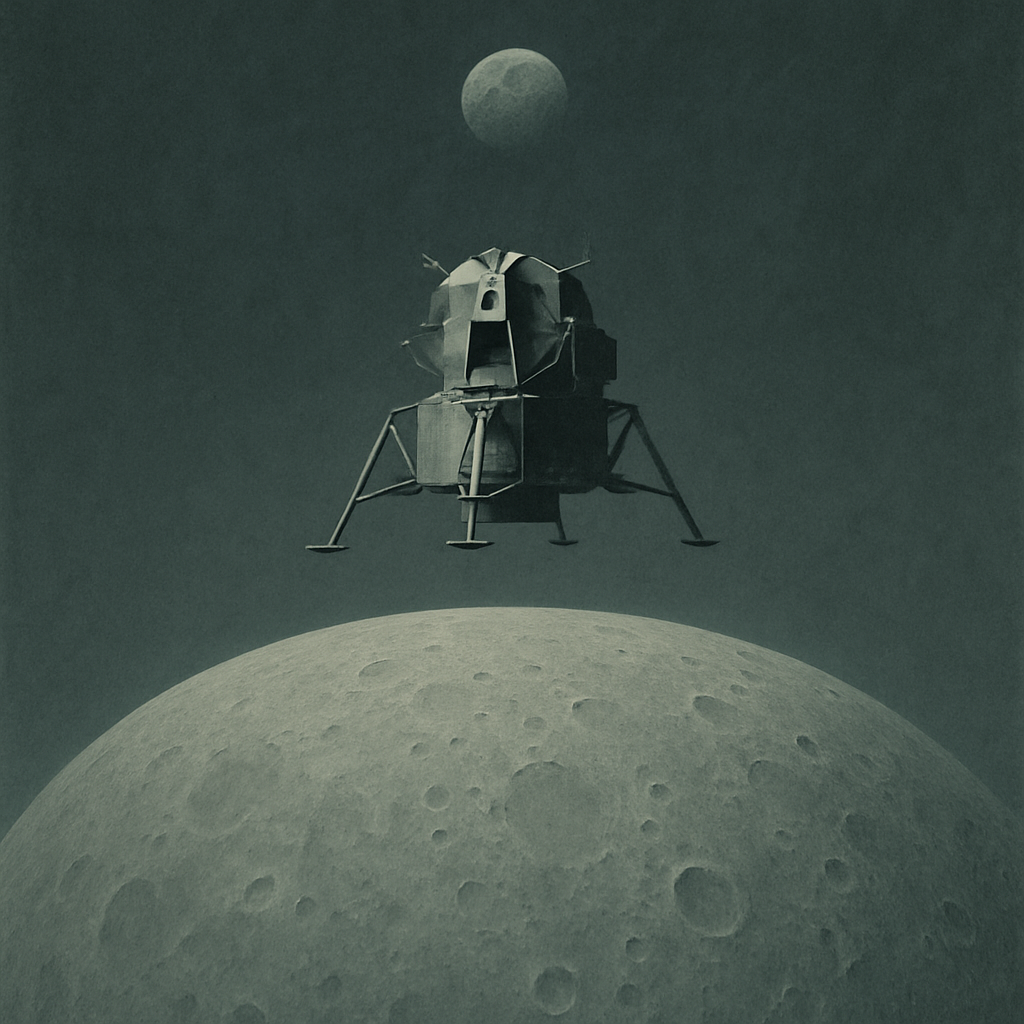
At exactly 13.2 seconds into flight, Saturn V AS-506 rolled onto a precise azimuth, highlighting the mission's narrow margin for error. Aerospace historian Roger Launius, who spent decades analyzing Apollo trajectory data at the Smithsonian, has noted that the launch sequence was not a single dramatic event but a chain of interlocking burns, each one irreversible. Miss any link, and the Moon stays out of reach. July 16, 1969. The chain began. Last time, we established that Mission Control was the nervous system of Apollo 11 — a ground architecture built for rapid decisions under extreme pressure. That system was tested from the first second of flight. Two minutes and 42 seconds after liftoff, the first-stage engines shut down, and the second stage ignited, continuing the journey to orbit. Twelve minutes in, Apollo 11 settled into a near-circular Earth parking orbit: 100.4 by 98.9 nautical miles altitude. That parking orbit was not a pause, Alina. It was a checkout phase. The crew and Mission Control verified all systems, ensuring the spacecraft was ready for the journey to the Moon. One and a half orbits later, at 16:22:13 UTC, the S-IVB third stage fired again. Trans-lunar injection propelled Apollo 11 towards the Moon, marking the transition from Earth's orbit. About 30 minutes after TLI, Collins executed the transposition, docking, and extraction maneuver. He separated the Command Module, rotated it 180 degrees, docked nose-to-nose with the Lunar Module still housed in the spent S-IVB, and pulled Eagle free. The S-IVB was then steered on a slingshot trajectory around the Moon and into solar orbit — cleared from any collision risk. This maneuver, Alina, is why the spacecraft had three distinct components: the Command Module housed the crew and was the only piece returning to Earth; the Service Module supplied propulsion, power, oxygen, and water throughout; the Lunar Module carried its own descent engine for landing and a separate ascent stage for the return to lunar orbit. The three-day transit to the Moon was not passive. The crew monitored systems continuously, performed course corrections, and managed the slow rotation of the spacecraft — a barbecue roll — to distribute solar heat evenly across the hull. On July 19, 1969, Apollo 11 reached the Moon. Lunar orbit insertion involved precise burns to achieve a stable orbit, setting the stage for Eagle's descent. That second burn is easy to understate. Fire the engine too long, you crash into the Moon. Too short, you skip off into deep space. There is no correction available. The Service Module engine had to perform perfectly on the far side of the Moon, completely out of radio contact with Earth, with no one watching except the crew. It did. Every phase of this journey — the roll maneuver at 13 seconds, the parking orbit checkout, TLI, transposition, the insertion burns — was a sequential commitment, each one locking in the next. Here is what to carry forward: the journey to the Moon was not a single bold leap. It was a precisely engineered sequence of orbital mechanics, each maneuver transitioning the spacecraft from Earth's gravitational grip to the Moon's influence. The crew didn't just ride a rocket — they flew a machine through a series of irreversible gates, each one requiring perfect execution before the next could open. That is the architecture of the long road to lunar orbit, and it is why every number in this mission was exact.