The Starting Block: Kennedy's Impossible Challenge
Building the Behemoth: Engineering the Saturn V
The Crew: Three Men in a Tin Can
The Invisible Network: Mission Control
The Long Road: From Liftoff to Lunar Orbit
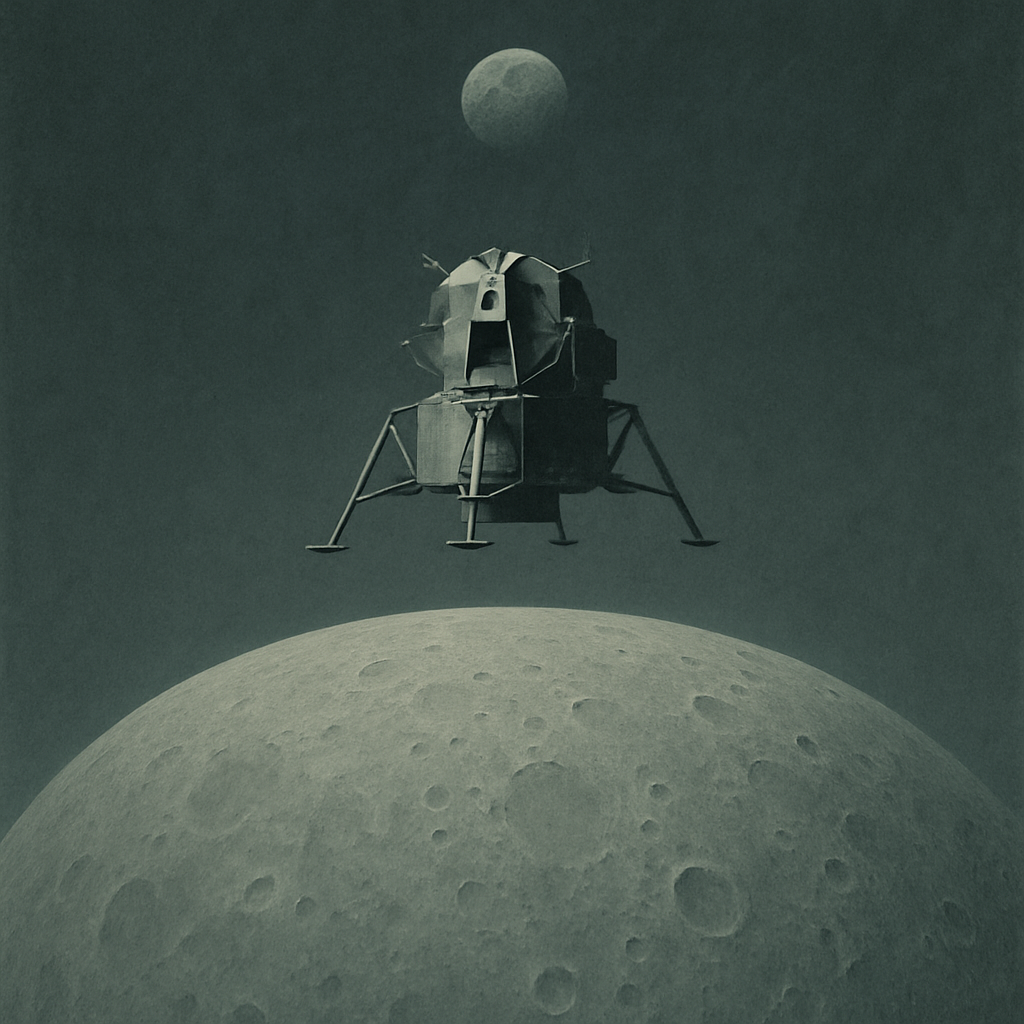
The Eagle Has Landed: The Final Descent
One Giant Leap: Exploring the Surface
The Return and the Legacy of Apollo

Transcript
SPEAKER_1: Alright, so last time we established that Apollo 11 was fundamentally a political instrument — Kennedy's gamble, Cold War pressure, the whole thing. But I keep coming back to the hardware. Because none of that political will matters if the rocket doesn't work. SPEAKER_2: Exactly right, and that's the bridge we need to cross. The Saturn V is where the political ambition had to become physical reality. And it remains, to this day, the most powerful machine ever built by human hands. SPEAKER_1: Most powerful ever — that's a big claim. What does that actually mean in concrete terms? SPEAKER_2: The five F-1 engines in the first stage burned through roughly 13 metric tons of fuel per second at liftoff. Combined thrust was 34.5 million newtons. To put that in perspective, it generated more power than 85 Hoover Dams simultaneously. Over a million spectators came to watch it launch on July 16, 1969 — including Vice President Spiro Agnew and former President Lyndon Johnson — and they felt it in their chests from miles away. SPEAKER_1: So how did engineers even approach designing something at that scale? Where do you start? SPEAKER_2: You start with the destination and work backwards. NASA announced in July 1962 that the Apollo spacecraft would consist of three major components — the command module, the service module, and the lunar module — all launched by a single Saturn V. That single-rocket solution was a deliberate choice. Multiple launches meant multiple docking attempts in orbit, multiple failure points. One rocket, one shot. SPEAKER_1: Walk me through those three components, because our listener might be picturing just a capsule on top of a rocket. SPEAKER_2: It's much more layered than that. The command module was a conical pressure vessel housing the three astronauts — the only piece that returned to Earth. Below it, the service module supplied propulsion, electrical power, oxygen, and water throughout the mission. Then there's the lunar module, which had two stages: a heavy descent stage with large engines for landing on the Moon, and a lighter ascent stage designed specifically to lift the crew back into lunar orbit. Three very different machines, stacked together, launched as one. SPEAKER_1: And the Saturn V itself had stages too, right? Why was that necessary? SPEAKER_2: Dead weight is the enemy of spaceflight. The Saturn V had three stages. The first stage burned for about two and a half minutes, then was jettisoned. The second stage carried the spacecraft most of the way out of the atmosphere. The third stage — the S-IVB — first pushed Apollo 11 into a near-circular Earth orbit at roughly 100 nautical miles altitude, about twelve minutes after launch. Then, after one and a half orbits, it fired again for the trans-lunar injection burn at 16:22 UTC, sending the crew toward the Moon. You shed mass at every step so you're not hauling dead engines across space. SPEAKER_1: What happened to that spent third stage after it released the spacecraft? SPEAKER_2: This is a detail most people miss. The crew performed a transposition and docking maneuver — they separated the command module, turned it around, and docked with the lunar module, extracting it from the spent stage. Then the S-IVB was deliberately steered on a trajectory past the Moon, using a slingshot effect around it to fling the stage into a long orbit around the Sun — away from any collision risk with the spacecraft, Earth, or the Moon. SPEAKER_1: That's elegant. But I want to push on the engineering challenges, because this couldn't have been smooth. What nearly broke the Saturn V during development? SPEAKER_2: The most dangerous problem was called Pogo oscillation — a rhythmic, longitudinal vibration caused by fuel combustion interacting with the rocket's own structure. Imagine a jackhammer effect running through the entire vehicle at resonant frequency. During tests it threatened to tear the rocket apart from the inside. Engineers had to redesign fuel feed systems and add dampeners to break the oscillation cycle before it became catastrophic. SPEAKER_1: So who was actually driving all of this? Someone had to be the chief architect. SPEAKER_2: Wernher von Braun led the Saturn V development at NASA's Marshall Space Flight Center. He'd been building large rockets since the German V-2 program in World War II. But here's what's crucial — von Braun couldn't do this alone. The Saturn V was built by over 400,000 Americans across hundreds of contractors. Boeing, North American Aviation, Douglas Aircraft, Rocketdyne — each responsible for different stages and systems. The management challenge of coordinating that distributed workforce was almost as hard as the engineering itself. SPEAKER_1: That's the part that gets lost, isn't it — it's as much an industrial achievement as a scientific one. SPEAKER_2: Completely. The total cost of Apollo 11 alone reached $25 billion. The Saturn V wasn't invented in a lab by a handful of geniuses. It was manufactured, tested, and assembled across an entire national industrial ecosystem. Precision at every node — one failed component anywhere in that chain and the mission fails. SPEAKER_1: So for Alina and everyone following this course, what's the single thing to carry forward from the Saturn V story? SPEAKER_2: That the Saturn V represents a triumph of distributed precision — not just one breakthrough, but hundreds of thousands of people solving interlocking problems simultaneously, at a scale never attempted before or since. It remains the most powerful machine ever built, and no nation has matched it in the nearly six decades since. That's the foundation everything else in Apollo 11 rests on.