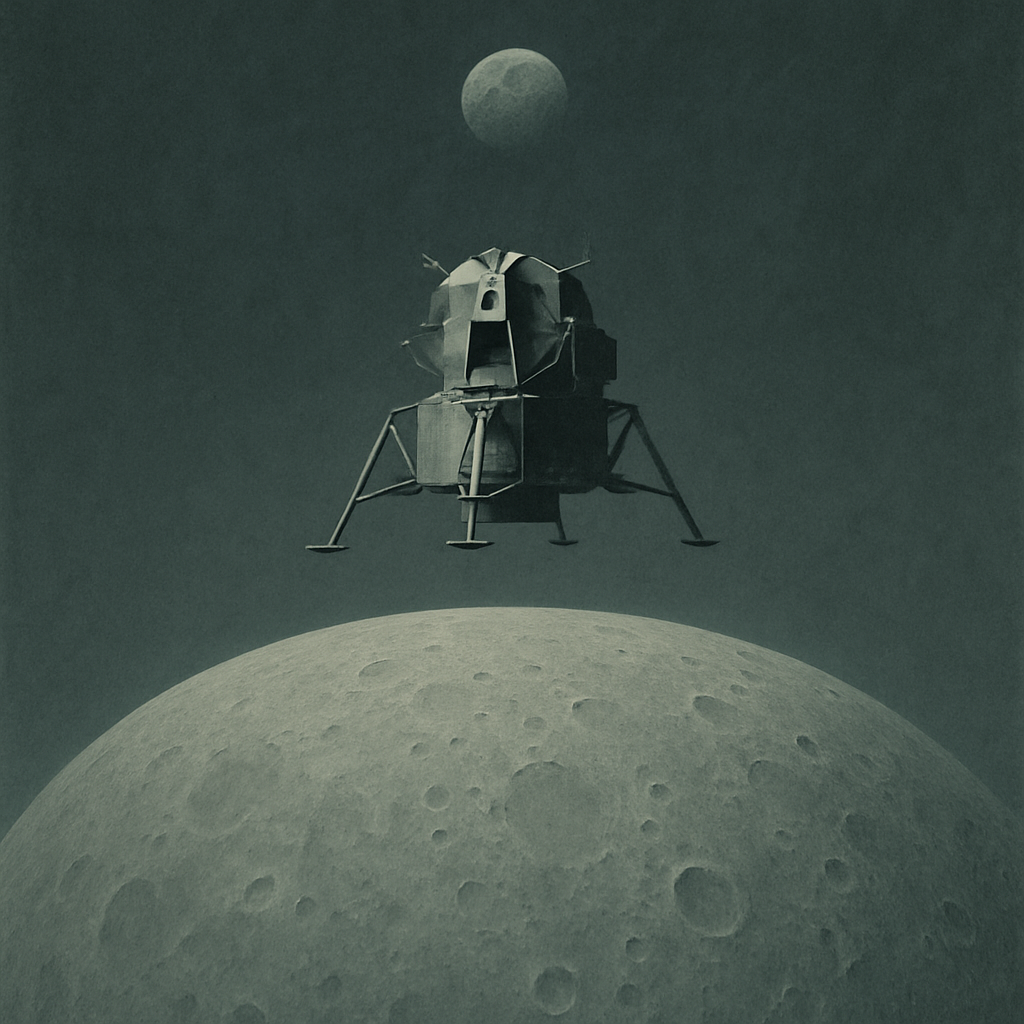
The Starting Block: Kennedy's Impossible Challenge
Building the Behemoth: Engineering the Saturn V
The Crew: Three Men in a Tin Can
The Invisible Network: Mission Control
The Long Road: From Liftoff to Lunar Orbit
The Eagle Has Landed: The Final Descent
One Giant Leap: Exploring the Surface
The Return and the Legacy of Apollo

Transcript
SPEAKER_1: Alright, so last time we mapped the whole journey from liftoff through lunar orbit — every burn irreversible, every gate requiring perfect execution. And now we're at the moment everything was built for. SPEAKER_2: Right, and this is where it almost fell apart. On July 20, 1969, Armstrong and Aldrin sealed themselves inside Eagle and undocked from Columbia. The powered descent began from about 14.5 kilometers above the Sea of Tranquility. Everything that came before was prologue. SPEAKER_1: So for our listener, the question is — what could possibly go wrong at this point? They've made it to lunar orbit. Surely the hard part is done? SPEAKER_2: That's exactly the wrong assumption. The descent was arguably the most dangerous twelve minutes of the entire mission. And the problems started almost immediately. SPEAKER_1: The computer alarms — those are the 1202 and 1201 codes we touched on in the Mission Control lecture. But how did they actually hit during the descent? SPEAKER_2: The crew had left a rendezvous radar running alongside the landing radar — a precaution in case they needed to abort quickly. That overloaded the guidance computer. Alarms the crew had never seen in simulation started firing. Armstrong and Aldrin didn't know if it meant stop. Mission Control cleared them to continue, but those seconds of uncertainty were real. SPEAKER_1: And then, on top of the alarms, the terrain problem hit. SPEAKER_2: Simultaneously. A navigation error had placed Eagle about seven kilometers beyond the planned landing site — a flat area surveyed by Apollo 10. Instead, the computer was guiding them straight toward West Crater, which was surrounded by a boulder field the size of a house. Armstrong recognized it and took semi-manual control. SPEAKER_1: How much did that decision actually change the outcome? SPEAKER_2: It changed everything. The computer would have set them down in rocks. Armstrong flew past West Crater, then spotted another crater at 250 feet — maneuvered around that too. He and Aldrin finally cleared a smaller feature called Little West Crater and found level ground. Every second of that maneuvering burned fuel. SPEAKER_1: Which brings us to the fuel calls. What were the 'bingo' calls, and why did they matter so much? SPEAKER_2: Armstrong's decision-making was further tested by critical fuel levels. With 'bingo' calls indicating the point of no return, he continued searching for a safe landing spot, ultimately touching down with mere seconds of fuel remaining. SPEAKER_1: 25 seconds. That's not a margin — that's a near-miss. SPEAKER_2: It is. And what makes it more striking is that Armstrong's composure through all of it was almost clinical. He'd survived a training accident in 1966 — the lunar landing simulator spinning out of control, ejecting with less than a second to spare. That kind of experience either breaks a pilot or hardens their response to crisis. For Armstrong, it hardened. SPEAKER_1: So when the contact light finally glowed — when touchdown actually happened — what was the global reaction? SPEAKER_2: Touchdown was at 20:17 UTC. Armstrong's call — 'The Eagle has landed' — was heard by roughly 530 million people. Mission Control erupted. Controllers who had been rigid with focus for twelve minutes were suddenly out of their seats. And then Kranz's voice cut through: 'Alright, everybody settle down.' Because the mission wasn't over. They were on the surface, but they still had to get off it. SPEAKER_1: That's a detail that gets lost — the landing was the midpoint, not the finish line. SPEAKER_2: Exactly. They had 21.6 hours on the surface ahead of them. Armstrong stepped out at 02:56 UTC on July 21 — that's the famous line, 'one small step for man, one giant leap for mankind.' Aldrin followed. They deployed a seismometer and a laser retroreflector, collected 21.6 kilograms of lunar rock and soil, set up the flag, spoke with Nixon. SPEAKER_1: Armstrong also walked out to Little West Crater rim for photographs — that's not something most people know about. SPEAKER_2: 196 feet from the lander, alone, to get a proper look at the crater they'd just flown over. Meanwhile Aldrin was trying to hammer core sample tubes into the surface — the lunar soil stopped him at six inches. The Moon pushed back even on the small things. SPEAKER_1: And Collins was orbiting the whole time, completely alone. SPEAKER_2: 48 minutes of every orbit out of radio contact with Earth. His job was to keep Columbia alive and execute a precise rendezvous when Eagle's ascent stage came back up. Eagle lifted off after 21.6 hours on the surface, rendezvoused with Columbia, and the crew began the journey home — splashing down July 24, southwest of Hawaii, recovered by USS Hornet. SPEAKER_1: So for Alina and everyone following this course — what's the single thing to hold onto from the descent? SPEAKER_2: That the landing was a harrowing manual operation performed under simultaneous crises — computer overload, wrong terrain, a boulder field, and a fuel clock running out. Armstrong didn't land Eagle because the systems worked perfectly. He landed it because he kept flying when the systems were failing. That's the difference between a mission that succeeded and one that didn't come home.