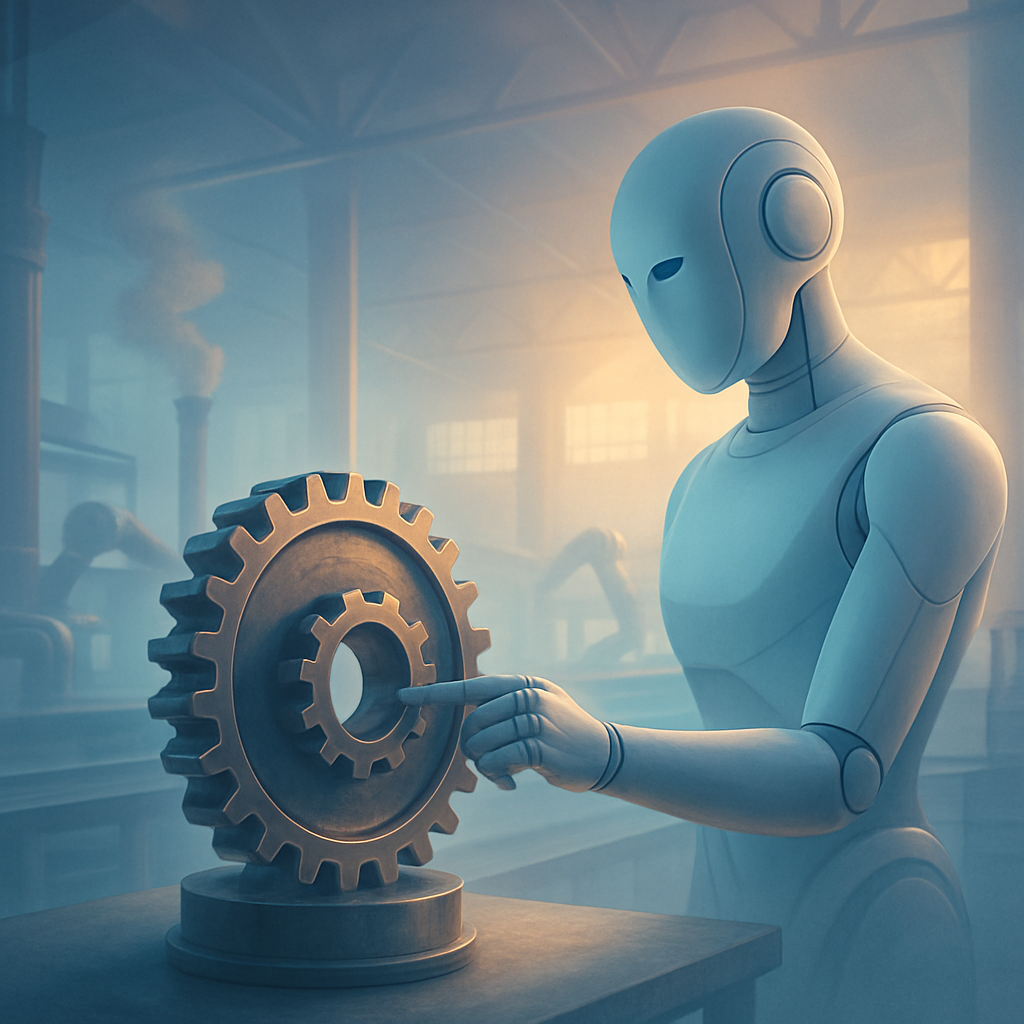
The Intelligent Factory: From Automation to Autonomy
The Intelligent Factory: AI and the Fourth Industrial Revolution
The Intelligent Factory: From Automation to Autonomy
Predictive Maintenance: Hearing the Whisper Before the Break
The Eyes of Production: Computer Vision and Quality Control
Cobots and Characters: The Human-Robot Synergy
Digital Twins: Mirroring the Physical World
The New Industrialist: Skills, Ethics, and the Path Ahead

Transcript
A factory floor goes silent without warning. Not because of a power cut. Because a bearing failed, a conveyor jammed, and a production line worth millions stopped cold. That single unplanned outage can cost more than a week of planned maintenance ever would. Now consider this: the global smart manufacturing market was valued at approximately $254 billion in 2022 and is projected to surpass $750 billion by 2030. That is not a technology trend. That is an economic verdict. The World Economic Forum estimates that Industry 4.0 technologies, led by AI, could generate up to $3.7 trillion in value for global manufacturing by 2025. The factories capturing that value are not simply running faster machines. They are running smarter ones. So what actually separates a smart factory from a traditional one? Think of a thermostat. It follows a rule: if temperature drops below a threshold, turn on the heat. That is classical automation. It is reactive, rigid, and blind to anything outside its programmed conditions. An AI-driven system is fundamentally different. It does not wait for a threshold to be crossed. It reads thousands of data streams simultaneously, finds patterns invisible to any human operator, and acts before a problem materializes. The key idea here is the shift from rule-following to pattern-learning. Traditional automation executes instructions. AI-driven autonomy generates its own instructions from data. That distinction changes everything about how a factory operates. Data is the raw material that makes this possible, Sahana. Every sensor, every motor, every weld on a modern factory floor produces a continuous stream of information. Temperature fluctuations. Vibration signatures. Energy consumption curves. Individually, these signals look like noise. Collectively, they form a precise portrait of machine health. For example, a CNC machine running slightly hotter than its baseline, combined with a subtle shift in its vibration frequency, might mean nothing to a human technician on a Tuesday morning. To a trained machine learning model, that combination is a recognizable fingerprint of bearing wear, weeks before failure. According to McKinsey's research on predictive maintenance, AI-driven systems can reduce machine downtime by up to 50 percent and extend the remaining useful life of machinery by 20 to 40 percent. That is not incremental improvement. That is a structural change in how factories manage risk. This is where the reactive-to-proactive shift becomes concrete. A reactive factory repairs what breaks. A proactive factory schedules maintenance during planned downtime, orders replacement parts in advance, and never loses a production shift to a surprise failure. The machine learning model running in the background is continuously updating its predictions as new data arrives. It is not static. It learns. And this capability extends far beyond maintenance. The same logic applies to quality control, where AI vision systems catch defects at speeds no human inspector can match. It applies to supply chain scheduling, where demand forecasts adjust in real time. Sahana, the factory floor is no longer just a physical space. It is a living data environment that senses, interprets, and responds. The takeaway from all of this is precise and worth holding onto. AI in manufacturing is not an upgrade to existing automation. It is a different category of capability entirely. Rule-based systems are powerful but brittle. They do exactly what they are told, and nothing more. AI systems are adaptive. They improve with experience, anticipate failure, and optimize outcomes that no engineer could manually program. That is the shift from automation to autonomy. And for manufacturers competing in a global market where margins are thin and downtime is catastrophic, this is not a future consideration. It is the defining competitive advantage of the present. The factories that treat data as a strategic raw material, and AI as the engine that refines it, are the ones building durable leads. Every other factory is simply reacting to a world that has already moved on.