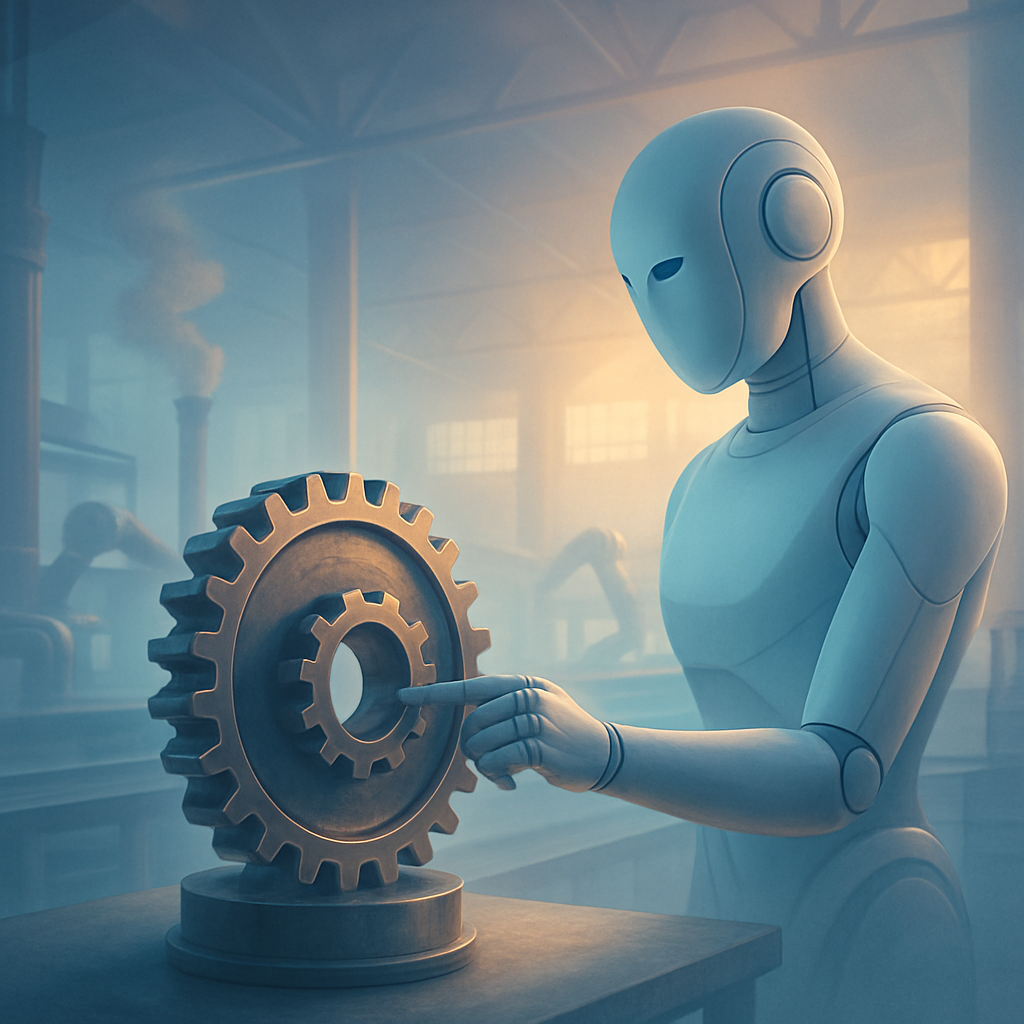
Predictive Maintenance: Hearing the Whisper Before the Break
The Intelligent Factory: AI and the Fourth Industrial Revolution
The Intelligent Factory: From Automation to Autonomy
Predictive Maintenance: Hearing the Whisper Before the Break
The Eyes of Production: Computer Vision and Quality Control
Cobots and Characters: The Human-Robot Synergy
Digital Twins: Mirroring the Physical World
The New Industrialist: Skills, Ethics, and the Path Ahead

Transcript
SPEAKER_1: Last time we landed on this idea that AI doesn't follow rules—it learns patterns. Now I want to follow that into something concrete: predictive maintenance. SPEAKER_2: Good place to start. The key idea is that predictive maintenance uses sensor data and analytics to estimate when equipment is likely to fail—so you intervene before the breakdown, not after. SPEAKER_1: How is that different from just scheduling maintenance windows? Most factories already do that. SPEAKER_2: That's preventive maintenance—fixed schedule, regardless of actual machine condition. Predictive is more data-driven. It combines historical patterns with real-time monitoring, so you act when the data indicates maintenance is needed. Fundamentally different logic. SPEAKER_1: So what are the machines actually telling us? What data streams are we talking about? SPEAKER_2: Quite a lot. Vibration, temperature, acoustics, oil condition, electrical signatures—all machine telemetry. IoT sensors make continuous collection possible. They run constantly, feeding streams no human team could monitor manually at that scale. SPEAKER_1: Vibration keeps coming up. Why is that one so central? SPEAKER_2: Because rotating machinery talks through vibration. Think of a bearing starting to wear—it develops a tiny imbalance, which creates a frequency signature. Vibration analysis catches those early faults, like bearing wear or shaft imbalance, long before they escalate. It's one of the most widely used techniques for exactly that reason. SPEAKER_1: And the machine learning model connects those signals to an actual prediction? SPEAKER_2: Precisely. The model learns a machine's normal baseline. When behavior deviates, it generates an alert. The sophisticated part is distinguishing a normal operational spike from a genuine warning. Deep learning finds patterns in the noise that rule-based systems miss entirely. SPEAKER_1: Can someone listening picture what that looks like on the floor? SPEAKER_2: Sure. Suppose a motor's electrical signature shows subtle current fluctuations—nothing that trips an alarm. But the model has seen that pattern in historical data and knows it precedes winding degradation. It flags the motor for the next planned downtime. A component gets swapped. Unplanned downtime is reduced. Emergency repairs become scheduled ones. SPEAKER_1: That's a real cost difference. What's the economic argument for justifying the investment? SPEAKER_2: The math is stark in high-volume environments. In an automotive plant, a single hour of unplanned downtime can cost hundreds of thousands of dollars—idle labor, missed targets, supply chain ripple effects. Predictive maintenance also lowers overall costs because parts and labor are used selectively, and it extends equipment life by improving intervention timing. SPEAKER_1: So why don't more factories do this? There must be real barriers. SPEAKER_2: Several. Data quality is one—if sensor data is poor, incomplete, or poorly labeled, the model fails. Legacy hardware is another; older factories weren't built with embedded telemetry. And then there's operator adoption. A successful program needs reliable data pipelines, maintenance workflows, and people who actually trust and act on the alerts. SPEAKER_1: The human side being a barrier—not just the technology. That's the part that surprises me. SPEAKER_2: It's often the decisive factor. That's why the practical wisdom is to start on a handful of high-value machines first, not across an entire plant at once. Prove the value where downtime is most expensive, build trust with the maintenance team, then expand. That sequencing matters enormously. SPEAKER_1: There's also a less obvious benefit—spare parts planning? SPEAKER_2: Yes, and it's underappreciated. When you can forecast when a component will fail, you can forecast when you'll need the replacement. That improves spare-parts demand forecasts, reduces emergency procurement costs, and cuts excess inventory. The system connects to enterprise maintenance software—CMMS or EAM platforms—so predictions feed directly into work orders. SPEAKER_1: And some of this processing happens right at the machine, not in a central cloud? SPEAKER_2: Increasingly, yes. Edge computing means analysis happens near the machine itself. For a critical alert that needs to fire in milliseconds, you can't afford a round trip to a remote server. Now, remember—predictive maintenance isn't one technology. It's a layered system: sensors, models, edge or cloud processing, and the human workflows that act on what the system learns. SPEAKER_1: So the machine is essentially narrating its own health in real time. SPEAKER_2: That's precise. And the takeaway for everyone following along: this extends beyond mechanical equipment now—electronic systems, anything with embedded telemetry is a candidate. Factories that treat that continuous narration as strategic information stop reacting to failures and start preventing them. That's the permanent shift predictive maintenance makes.