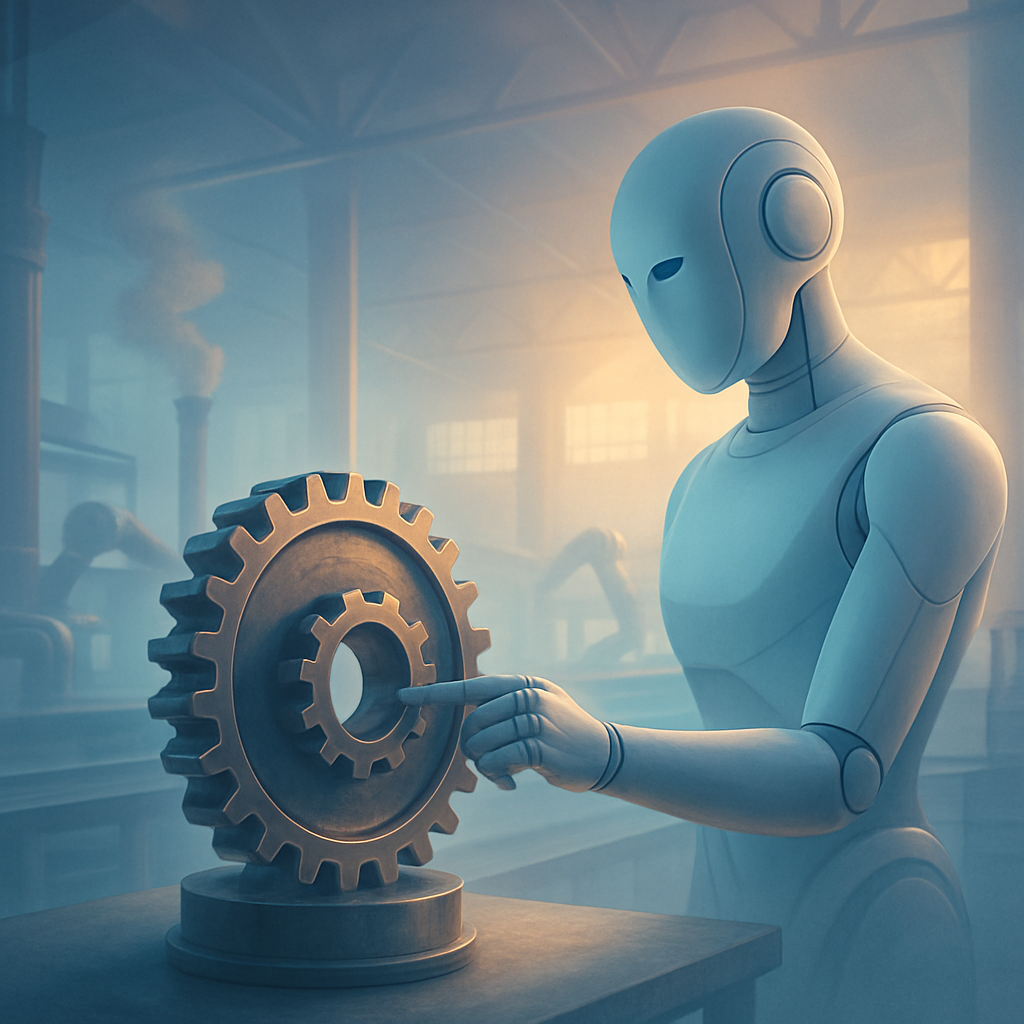
Cobots and Characters: The Human-Robot Synergy
The Intelligent Factory: AI and the Fourth Industrial Revolution
The Intelligent Factory: From Automation to Autonomy
Predictive Maintenance: Hearing the Whisper Before the Break
The Eyes of Production: Computer Vision and Quality Control
Cobots and Characters: The Human-Robot Synergy
Digital Twins: Mirroring the Physical World
The New Industrialist: Skills, Ethics, and the Path Ahead

Transcript
SPEAKER_1: Let's delve into the unique aspects of cobots, focusing on their safety features, ergonomic benefits, and economic advantages. SPEAKER_2: Good pivot. Cobots are designed to work safely alongside humans, offering ergonomic benefits and reducing injury risks by handling repetitive and heavy tasks. SPEAKER_1: When did that idea actually emerge? SPEAKER_2: The concept was first formally introduced in the mid-1990s—robots that don't just operate near humans but physically interact with them. It took decades of safety engineering to make that practical at scale. SPEAKER_1: So what actually makes a cobot safe to stand next to? For someone listening, that's probably the first question. SPEAKER_2: force and torque limits, speed caps, power limitations, safety-rated monitored stops. The robot continuously senses how much pressure it's applying. International standards—ISO 10218 and ISO/TS 15066—actually define permissible contact forces between robots and humans. SPEAKER_1: There's a regulatory framework, not just engineering best practice. But beyond safety—what are cobots actually doing on the floor? SPEAKER_2: Think of assembly, pick-and-place, packaging, palletizing, machine tending. Repetitive, high-precision operations. The human alongside handles variable, judgment-heavy work. The cobot absorbs the monotonous part. That division is where the productivity and ergonomic gains come from. SPEAKER_1: The ergonomic angle may not be the first thing people mention when they hear 'robot on the factory floor.' SPEAKER_2: It should be. Ergonomic studies in industrial settings have found that appropriately deployed cobots reduce musculoskeletal load significantly—by taking over heavy lifting, awkward postures, repetitive motions. Those are the tasks that accumulate injury risk over years. The cobot absorbs that load; the worker's body doesn't. SPEAKER_1: Now, how does the cobot know where the human is? Suppose someone steps into the robot's path unexpectedly. SPEAKER_2: That's where advanced perception comes in. Collaborative workcells use 3D cameras, lidar, depth sensors—the cobot continuously maps its environment. When a human enters the zone, it dynamically adjusts speed or trajectory. It's anticipating and rerouting before contact happens, not reacting after. SPEAKER_1: And AI is interpreting all that sensor data in real time. There's also a learning dimension—these aren't just pre-programmed machines. SPEAKER_2: Right. AI-driven cobots can use reinforcement learning or learning from demonstration—a worker physically guides the robot through a motion, and the system refines it over time. For example, in bin-picking tasks, AI figures out each part's orientation before the arm moves. That used to require rigid fixtures and pre-sorted parts. SPEAKER_1: That also lowers the barrier for smaller manufacturers. What's the economic case? SPEAKER_2: Cobots offer economic advantages with shorter payback periods due to minimal safety infrastructure needs and flexibility in redeployment. They're also easier to redeploy to new tasks. Market research projects the global cobot market will grow substantially, driven specifically by small and medium-sized enterprises and high-mix, low-volume production. SPEAKER_1: But there's a human resistance factor too. Not everyone on the floor welcomes a robot next to them. SPEAKER_2: That's real and often underestimated. Research shows successful deployment requires organizational changes—training, workflow redesign, and critically, involving workers in how the interaction is designed. When workers have some control over cobot behavior, like adjusting speed or interaction distance, their sense of agency increases and acceptance improves. The hardware purchase is the easy part. SPEAKER_1: There's also something almost social happening—studies suggesting people attribute personality to these machines? SPEAKER_2: And it's not trivial. People attribute social characteristics to cobots even when the systems are relatively simple. When robots use gestures or motion cues to signal intent, coordination errors drop and cooperation improves. Remember—some research platforms have shown that robots moving with more deliberate, 'legible' trajectories make humans more comfortable and reduce mental workload. The robot's behavior communicates. SPEAKER_1: So the takeaway for everyone following this course: cobots aren't a replacement story. They're a division-of-labor story. SPEAKER_2: Exactly. Precision and endurance from the machine; judgment and adaptability from the human. When that allocation is right—and when workers are genuinely involved in designing it—the result is higher productivity, better ergonomics, and a workforce that's more capable, not less necessary.