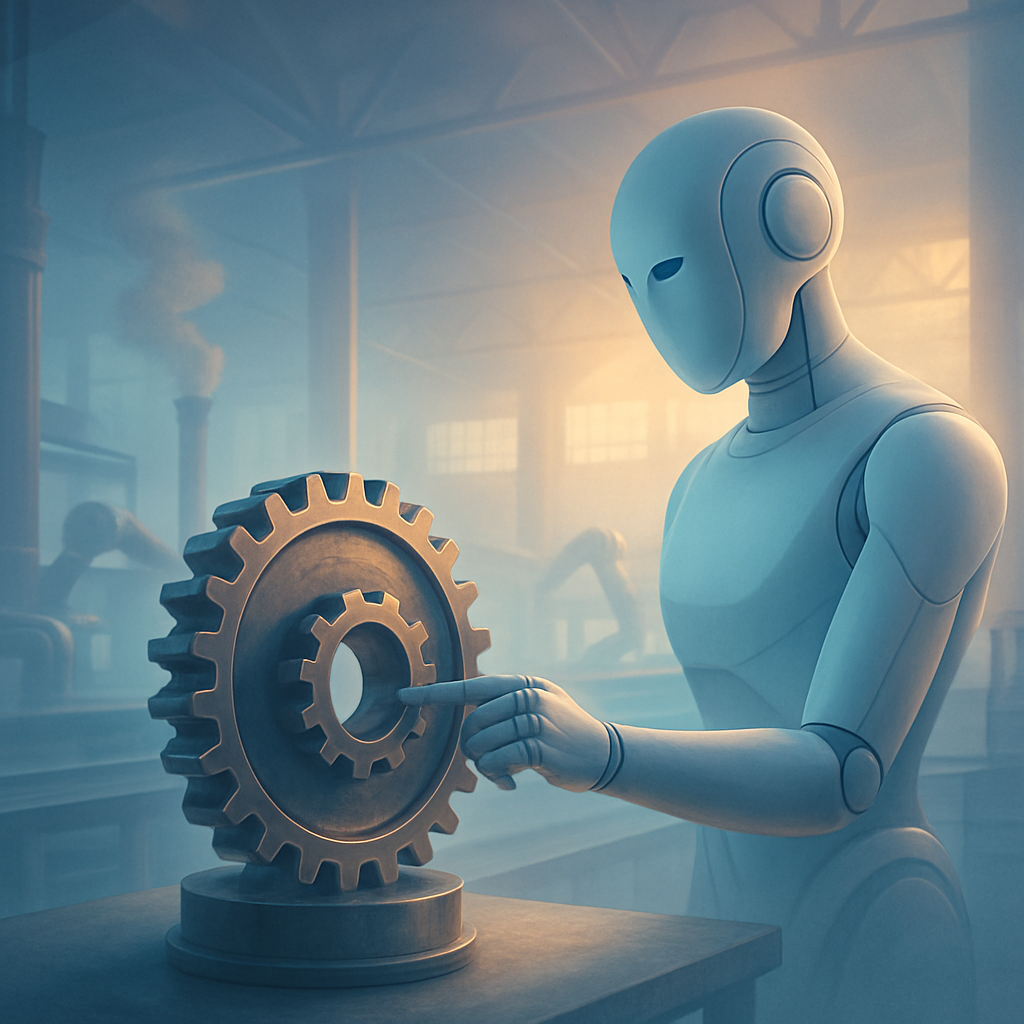
The New Industrialist: Skills, Ethics, and the Path Ahead
The Intelligent Factory: AI and the Fourth Industrial Revolution
The Intelligent Factory: From Automation to Autonomy
Predictive Maintenance: Hearing the Whisper Before the Break
The Eyes of Production: Computer Vision and Quality Control
Cobots and Characters: The Human-Robot Synergy
Digital Twins: Mirroring the Physical World
The New Industrialist: Skills, Ethics, and the Path Ahead

Transcript
A maintenance technician with twenty years of experience walks onto a floor that has changed. The machines are the same. The alerts are different. A dashboard is flagging a motor anomaly. The AI has already diagnosed it. His job now is not to find the problem. His job is to decide whether to trust the recommendation and act on it. That is a fundamentally different skill. And here is the tension, Sahana: the technology moved fast. The training did not. Operators are increasingly interfacing with AI-powered systems and recommendations on the shop floor. They enter data. They supervise autonomous processes. They combine AI suggestions with their own judgment. But if no one explained what the model is actually doing, that judgment has no foundation. Last time, we established that a digital twin is a living system — one that tests, predicts, and feeds back into the physical world. Now the question becomes: who operates that system responsibly? Predictive maintenance is already widely deployed, yielding double-digit reductions in downtime and maintenance costs. The technology works, but the gap is human readiness, particularly in understanding and integrating AI-driven insights into daily operations. Think of the new factory worker as operating on three layers. One layer is AI literacy — understanding what AI can and cannot do, so you don't blindly follow a bad alert or dismiss a valid one. The second is data interpretation. Workers must read AI-generated dashboards, understand key performance metrics, and translate model outputs into concrete process adjustments. The third is domain-specific AI skill. For maintenance roles, that means using AI diagnostic tools, interpreting alerts, and planning interventions before failures occur. For quality roles, it means understanding AI-driven quality metrics and ensuring they align with production standards. For process roles, it means reconciling optimization recommendations with safety constraints. These are not abstract competencies. They are daily tasks on a modern floor. For example, The Manufacturing Institute, with support from Google.org, developed programs called AI 101 for Manufacturing and AI for Advanced Manufacturing Technicians — built specifically to upskill frontline workers at scale. That is a direct response to the readiness gap. Beyond formal programs, AI itself is powering the training. Personalized learning paths, AR and VR simulations, gamified modules, and real-time feedback systems help workers adapt continuously. AI-driven simulations are now being used as training environments — allowing workers to practice complex scenarios in a low-risk virtual setting before engaging with live equipment. Immersive AR and VR training can significantly reduce training time and improve skill retention, particularly for high-risk or infrequent tasks. Now, skills alone are not enough. The other half of this is ethics — and it is where many companies move too fast. When AI systems influence scheduling, performance scoring, or pace of work, they affect worker dignity. Models trained on skewed data can systematically disadvantage certain workers in evaluation or promotion decisions. That is algorithmic bias, and it is not hypothetical. Surveillance is a parallel concern. AI monitors workers and production in fine detail. The question of proportional monitoring and consent is not resolved by deploying the technology. Trustworthy AI requires transparency, clear accountability, and audit trails — logs of model inputs, decisions, and overrides — so that when something goes wrong, responsibility can be assigned. [emphasis] Organizations are urged to involve workers in the design and oversight of these systems. Not as an afterthought. From the start. The key idea to carry forward is this: AI-driven manufacturing is more sustainable when the humans inside it are equipped and protected. That means workers who can read, question, and override AI recommendations. It means governance frameworks that make ethical trade-offs explicit — between cost optimization and environmental impact, between efficiency and labor conditions. It means fair systems that promote equality in scheduling, resource allocation, and performance analytics. The factories that get this right are not just more productive. They are more resilient, more trusted, and more capable of attracting the workforce they need. Transitioning to AI-driven manufacturing requires a focus on workforce upskilling and a commitment to ethical, transparent data practices. That is not a soft principle. That is the operating condition for everything else in this course to actually work.