
Transcript
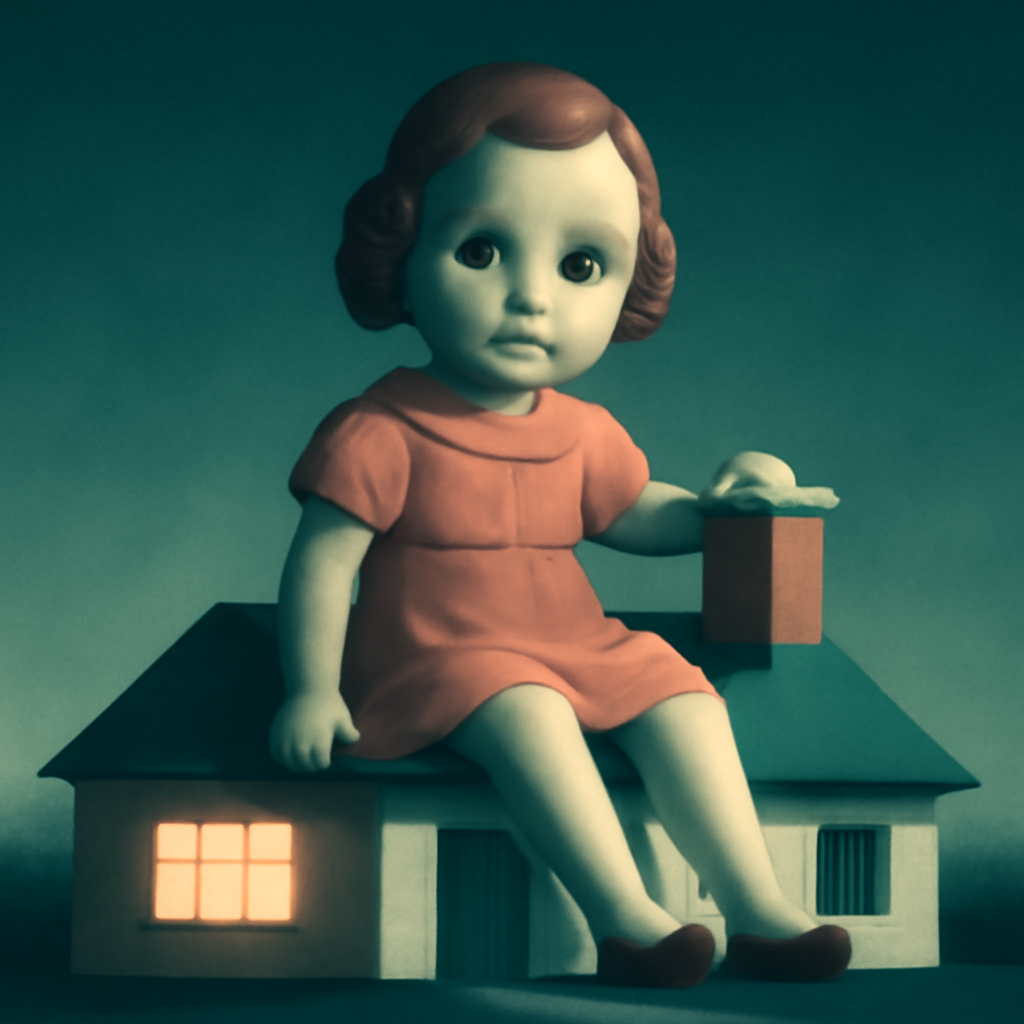
The camera, if you can call it that in your mind's ear, has been moving through the house this whole time. Past Erich's resentment, past Annabelle's careful silences, past Christie's unanswered reaching. And now it stops. It lands on the doll. Not on what the doll does. On what the doll is. The body came from a real product. A doll called Brikette, made in the late fifties, marketed with an impish grin and red hair. She was not a talking doll. She had no mechanism, no voice. For the episode, she was given a wind-up motor and a wig, and June Foray was brought in to supply the voice. If that name means something to you, it should. Foray was also the actual voice of Chatty Cathy — the real-world talking doll that Tina was modeled after. The same voice that made a toy feel alive in living rooms across America was now being asked to make that aliveness feel like a threat. That is not a trivia footnote. That is the engine. Here is what it means in practice. When you hear Tina speak, your ear has already been trained by the culture to receive that cadence as safe. The bright, slightly sing-song register of a talking toy. The clean declaration of identity followed by a simple feeling. It is the sound of a product demonstration. And that is exactly what makes the threat land without any warning at all. The content changes, but the register does not. For example, it is not the words that unsettle you first — it is the fact that the cheerful demonstration cadence is still fully intact when the words become a verdict. The toy voice does not drop into menace. It stays bright. It stays helpful. It sounds like it is still telling you what the doll can do for you. That is a very specific kind of horror, and it depends entirely on the face. Think about what a moving face would give you. A sneer, a narrowing of the eyes, a lip that curls — any of those would be somewhere to put your fear. The face would be performing the threat, and you could track it, brace against it, locate it in the room. But Tina's face does not move. The smile is painted. It was painted before the episode began and it will be painted after it ends, and it does not register any of what the voice is saying. That stability is not neutral. It is its own kind of statement. A face that moves is a face that is still negotiating with you. A face that stays fixed has already decided. The smile is not hiding the threat. The smile is the verdict, rendered in enamel, and the voice is simply reading it aloud. This is what the production crew understood, whether they articulated it this way or not. The doll barely needs to do anything. The less it moves, the more room the voice has to work. Every scene where Tina sits still while her voice shifts register is a scene where the face is doing the heavier argument. You cannot appeal to it. You cannot soften it. Erich tries, in his way — he argues with her, he demands she explain herself, he treats her like a malfunction that can be corrected. But you cannot negotiate with a painted smile. It was not made to respond to you. It was made to be looked at. And that is the thing about a product demonstration. It does not care whether you agree. It just keeps running.