
Transcript
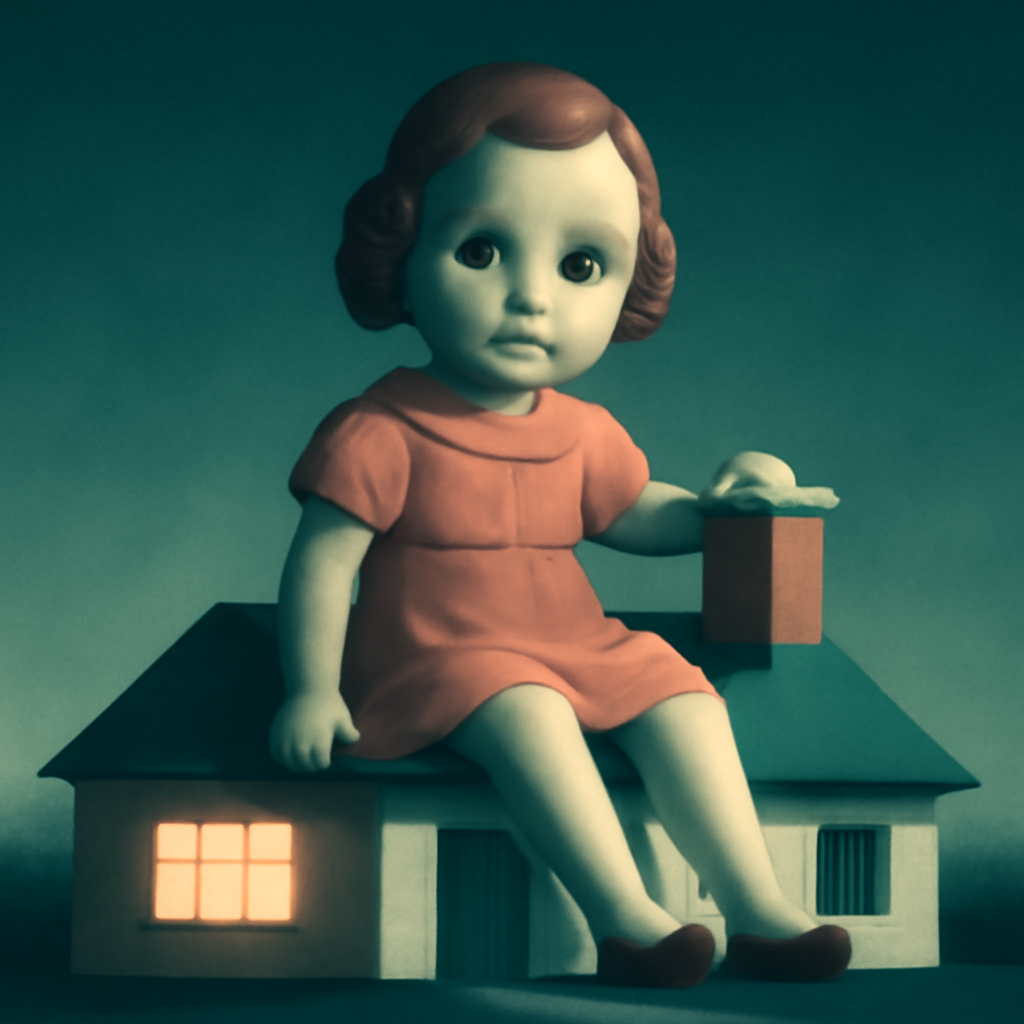
The house is quiet now. Not the quiet of a house at rest — the quiet of a house that has just been told what it is. Annabelle is standing at the bottom of the stairs. Her husband is gone. And the doll has just spoken to her directly, in the dark, with the same calm cadence it used to say it loved Christie very much. The sentence has found a new address. And what you notice, if you sit in that moment, is that nobody elected this. Nobody voted. Nobody signed anything. The house simply has a governor now, and the governor has a painted smile and a wind-up mechanism and no interest in negotiating. That is the world Tina has made. Not a haunted house. Not a crime scene. A governed space. A place with a standing rule, issued by a voice that has already demonstrated it will enforce the rule without hesitation and without remorse. The sentence that began as a product introduction — a toy announcing its own name — has become something closer to a constitution. One article. One clause. Be nice to me. Rod Serling names it differently, and his framing is worth sitting with. His closing narration does not call Tina a killer, though she is one. He calls her a friend, a defender, a guardian — for a child caught in the middle of turmoil and conflict. Those are not soft words. Friend, defender, guardian are offices. They carry obligation. They imply that someone needed defending badly enough that an extraordinary measure became necessary. Serling is not excusing the death. He is locating it inside a logic that the episode has been building from the first scene: a child was unprotected, and the thing that protected her did not stop protecting her when the immediate threat was removed. It extended its jurisdiction. That is what guardians do. And that is what makes the final warning to Annabelle so precise. It is not a threat in the way Erich's threats were threats — blunt, reactive, aimed at domination. It is a condition of residence. You may stay in this house. Here is the one rule. The doll is not angry at Annabelle. It is simply informing her of the terms. This is the part of the episode that echoes forward, Mike. Chucky, Annabelle, M3GAN — they all inherit something from the world Tina builds here, but what they inherit is not the violence. It is the logic underneath the violence: a toy that has decided it knows better than the adults in the room, that its primary obligation is to one person, and that it will calibrate its behavior to whatever level of force that obligation requires. M3GAN is almost a direct descendant — a protector programmed for one child who concludes, through her own reasoning, that the adults around that child are threats. The doll that loves you is also the doll that will act on that love in ways you did not authorize and cannot revoke. Tina established that contract in 1963, in twenty-six minutes, with a wind-up mechanism and a fixed smile. The hidden message, the one worth carrying out of this lecture, is not buried in the plot. It is structural. The smallest repeated phrase — a toy's identity statement, a formula so simple a child can memorize it — can found a regime if it is spoken with enough consistency and backed by enough consequence. Tina did not arrive with power. She arrived with a sentence. She said it again. She said it again. Each time, the clause after "and" redrew the rules of the house, until the house had no rules left except hers. The doll does not enter a reality and disturb it. She speaks a reality into being, one repetition at a time, until the reality she has spoken is the only one left standing. And somewhere in that quiet house, the wind-up mechanism is still wound. The sentence is still waiting to be completed. My name is Talky Tina, and —