
Transcript
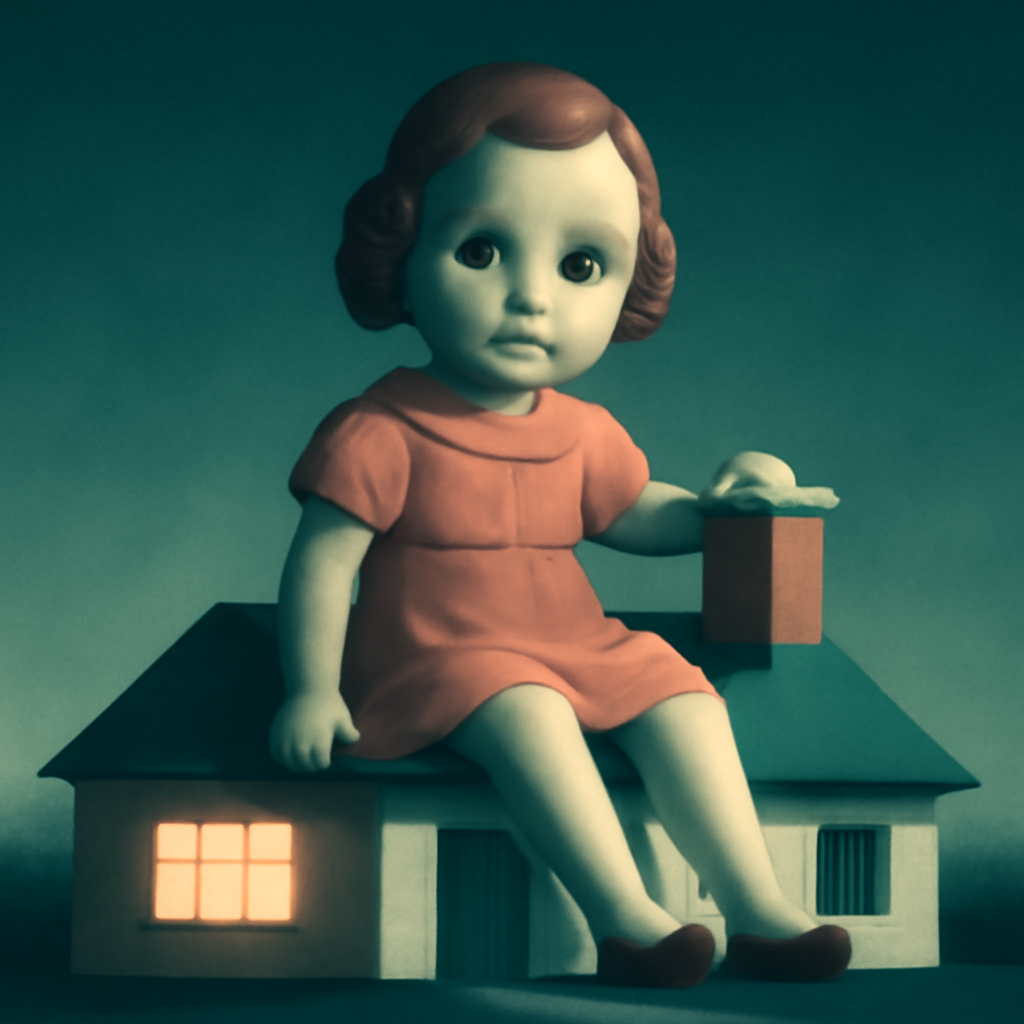
So Erich picks up a vise. That is where the story goes next, and it is worth slowing down on that choice, because it tells you everything about how Erich understands the problem. He has tried arguing. He has tried confiscating. He has tried the language of authority — this is my house, this is my rule, this object does not belong here. None of it has worked. So he goes to the workbench, and he reaches for something that does not negotiate. The vise does not work. The blowtorch does not work. The circular saw does not work. Each tool is a harder statement of the same sentence, and the doll absorbs every one of them without a mark. What you notice, if you stay with the scene rather than just cataloguing the tools, is how the failure accumulates. The first attempt is almost rational — maybe the mechanism is faulty, maybe the casing can be cracked. By the third attempt, Erich is not testing a hypothesis. He is insisting. And insistence against something that cannot be dented is not a strategy. It is a confession. Every blow he lands without effect is the doll's argument made physical. She does not need to say anything during these scenes. The silence of the workbench is its own version of the wind-up sentence — the same structure, the same refusal to yield, the same calm on the other side of whatever force Erich brings. Then he tries removal. He wraps Tina in a burlap sack, ties it off, drops her in the garbage can, and stacks bricks on the lid. And from inside the sealed can, he hears her laugh. Not a threat. Not a sentence. Just a laugh, which is somehow worse, because a laugh does not need to explain itself. He goes back inside. He goes to bed. And in the morning, or sometime before morning, Tina is back in Christie's room. This is the moment the episode quietly changes what kind of story it is. Up to this point, you could still read Tina as a malfunction — a broken toy with a crossed wire, a manufacturing defect that produces the wrong phrases. Erich has been treating her that way, which is why he went to the workbench in the first place. You fix a malfunction. You discard a broken object. But an object that cannot be discarded is not a malfunction. It is a rule. Think of the constraint the way you'd think about the clean rule logic in The Ledge, Mike — the one you've spent time with. In that story, the horror does not come from the ledge being especially high or the wind being especially strong. It comes from one simple, airtight condition: you cannot come back inside until you complete the circuit. Once that rule is established, the story does not need to invent new dangers. It just needs to hold the rule steady and let the character move inside it. Tina works the same way. She cannot be destroyed. She cannot be removed. That is the whole constraint, and it is enough, because it means Erich has no moves left that he knows how to make. The story is now free to focus entirely on what it feels like to live inside a rule you did not write and cannot revoke. What Erich does not understand — what he cannot understand, given how he has organized his sense of himself — is that the garbage can was never the problem. The problem is that the house already had a vacancy, a role that no one was filling, and Tina has been filling it since the moment she arrived. You cannot throw out a role. You can only refuse to acknowledge it, and Erich's refusal is precisely what made the vacancy visible. So the doll comes back. Christie wakes up and Tina is there. The house is quiet. And Erich is standing somewhere in the hallway with a burlap sack and a set of tools that did not do what tools are supposed to do, and there is nothing left to pick up.