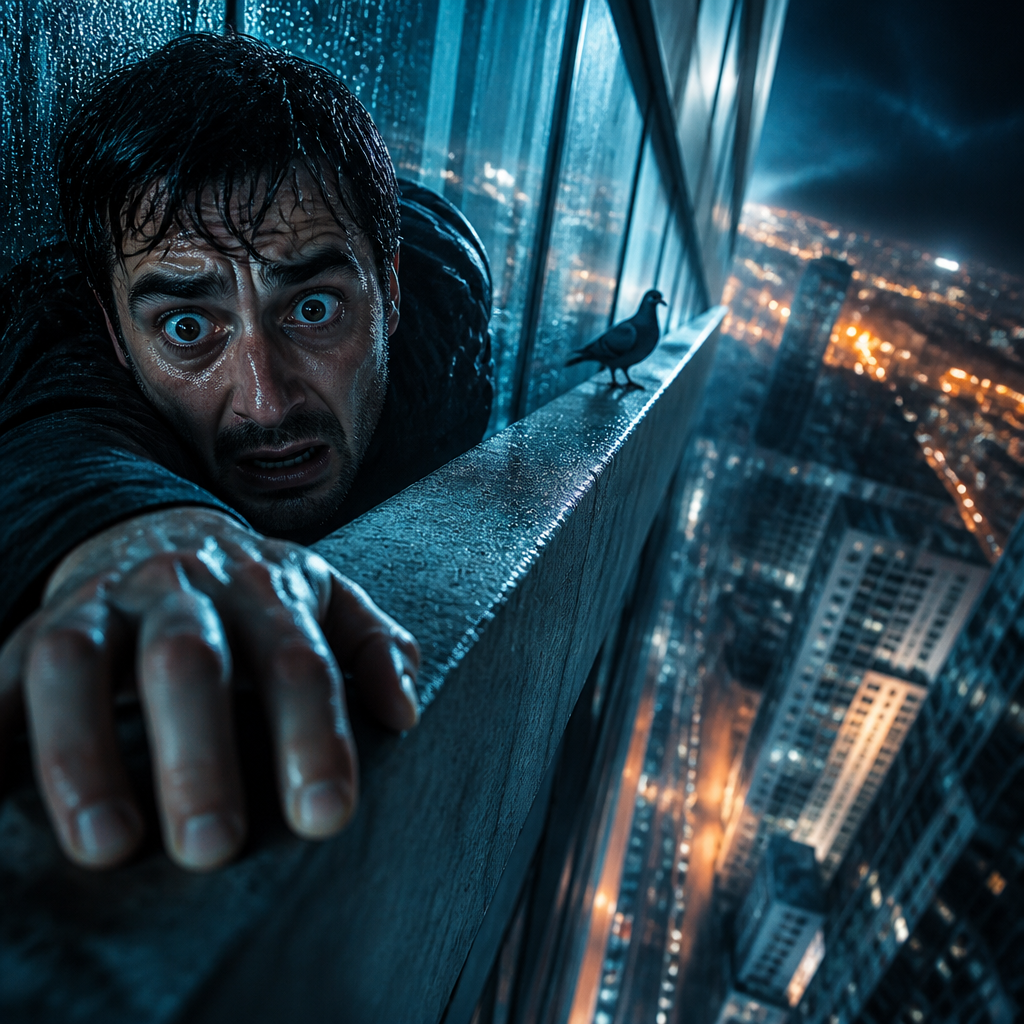
Five Inches
The Penthouse Trap
The Wager
Cressner’s Game
Onto the Wind
Pressure by Inches
The Mind Outside
The Return Inside
The Open Edge
How Fear Works

Transcript
SPEAKER_1: [short pause] There's a low city hum under all of this. You can almost hear it now — the same sound the episode started with. Wind at height. The sense of open air just past a pane of glass. SPEAKER_2: And we're back where we began. Except now the five-inch strip means something different than it did at the top of the hour. SPEAKER_1: That's the thing about a well-built premise. It doesn't just set up the story — it accumulates meaning as the story moves through it. The ledge starts as a place. Then it becomes a rule. Then a stage. Then a measuring tape for how much fear a person can carry without losing their footing. And by the end, it's a moral test — for Stan, for Cressner, and honestly, for you as the reader. SPEAKER_2: So what does that tell us about how the story actually works? Because I think there's a temptation to look at something this compact and say — well, it's simple. One location, one threat, one rule. Almost too simple. SPEAKER_1: And that's exactly the wrong read. The simplicity isn't a limitation. It's the engine. SPEAKER_2: Say more about that. SPEAKER_1: Think about what the story actually asks you to hold in your head at any given moment. It's not a lot. Five inches. Forty-three stories. One man outside, one man inside. That's it. And because the rule is that simple, every single thing that happens on the ledge — a gust, a bird, a sound from inside — lands with full weight. Nothing is competing for your attention. The story has cleared the field. SPEAKER_2: The simplicity creates the bandwidth for the fear to actually register. SPEAKER_1: Right. And that's a real craft principle. When a story gives you too many variables, too many characters, too many moving parts, the danger gets diluted. You can't feel the drop if you're also tracking a subplot. But here, there's nothing else. The ledge is the whole world. SPEAKER_2: Which is also why the antagonist has to be doing something more than just waiting. If Cressner sat in his chair and watched, the story would plateau. The fear would become static. SPEAKER_1: And that's where the information gap does its work. Cressner holds things back — the cold, the coat, the noisemaker, the fact that Marcia is already dead. Each one of those is a piece of information Stan doesn't have. And the reader doesn't have it either. So the suspense isn't just about whether Stan falls. It's about what else Cressner knows that Stan doesn't. SPEAKER_2: That's the layer that makes it more than a physical ordeal. The body is in danger, yes. But so is Stan's understanding of the situation. He thinks he's in a wager. He's actually in a performance. SPEAKER_1: And the moment he comes back inside and finds out the prize was never real — that's when the information gap closes all at once. Everything Cressner withheld lands simultaneously. The cold wasn't an oversight. The noisemaker wasn't cruelty in the moment. It was all part of a system that was running before Stan ever stepped outside. SPEAKER_2: So the reversal isn't just a plot twist. It's a retroactive reframe of every scene that came before it. SPEAKER_1: Which is why it hits so hard in such a short space. You don't need three hundred pages to build that effect. You need one clear rule, one antagonist who controls the information, and a reveal that makes you re-read the whole thing in your head in about ten seconds. SPEAKER_2: And then the story doesn't let you rest after the reveal. It immediately puts Cressner on the ledge. The pressure doesn't drop — it redirects. SPEAKER_1: That's the move that keeps the story alive past its own ending. A lot of thrillers release all the tension at the climax. The danger resolves, the antagonist is dealt with, and you close the book feeling satisfied but empty. This one does something different. It preserves a pressure point. Stan is inside. Cressner is outside. And the story stops before you find out what happens. SPEAKER_2: So the reader ends up in the same position Stan was in for the entire ledge walk — waiting, uncertain, holding something unresolved. SPEAKER_1: The story transfers the suspense to you on the way out. That's not an accident. That's a design choice. SPEAKER_2: And it's a choice that works because the rule is still running. The ledge is still five inches wide. The height is still forty-three stories. Nothing about the physical reality has changed. Only the person standing on it. SPEAKER_1: Which is the other thing this story teaches, if you're thinking about how to build something like it. The rule has to be physical. Not metaphorical, not abstract — physical. Something the reader can feel in their body. For example, a locked room works the same way. So does a staircase in the dark, or a doll that won't stay where you put it. The moment you make the arena rule-bound and spatial, the reader's nervous system starts doing half the work for you. SPEAKER_2: Because the body understands the geometry before the mind has finished processing it. SPEAKER_1: Exactly. And that's what separates this kind of survival horror from the kind that relies on atmosphere alone. Atmosphere can unsettle you. But a physical rule — a five-inch strip, a locked door, a stair that shouldn't creak — that puts you inside the danger rather than beside it. SPEAKER_2: So when you look back at everything this story does — the coerced wager, the intimate first-person view, the micro-obstacles, the sabotage, the withheld information, the reversal, the open ending — none of it requires anything beyond one man, one building, and one very narrow strip of concrete. SPEAKER_1: That's the whole machine. And it runs on a single rule that anyone can understand in one sentence. Walk around the building or lose everything. That's it. The rest is just King turning the pressure up by degrees — never letting the rule change, only letting the conditions around it get worse. SPEAKER_2: And the fear stays credible because the rule stays honest. The ledge never becomes something else. It doesn't transform. It doesn't acquire supernatural properties. It's just concrete and wind and the distance to the street below. SPEAKER_1: Which is, in the end, more than enough. The city is still down there. The wind is still moving. And somewhere outside a penthouse window, forty-three stories above the street, there is a strip of concrete exactly five inches wide — and the question of what it means to survive by standing on it is still, quietly, unresolved. SPEAKER_2: That's where the story leaves you, Mike. Not with an answer. With the ledge itself — as a place, as a rule, and as a question about what fear costs the person who makes it through.