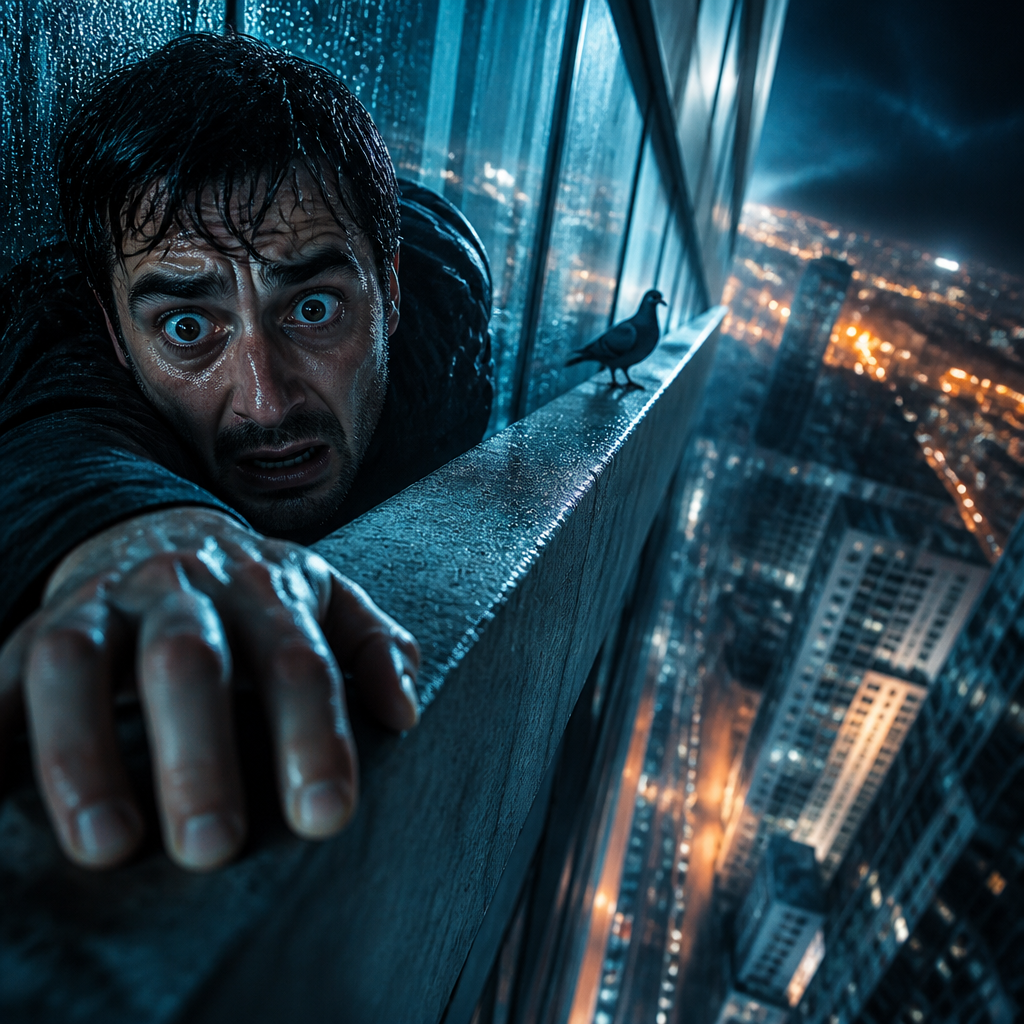
Five Inches
The Penthouse Trap
The Wager
Cressner’s Game
Onto the Wind
Pressure by Inches
The Mind Outside
The Return Inside
The Open Edge
How Fear Works

Transcript
SPEAKER_1: So Stan steps through the window. And the moment he does, the story changes register entirely. SPEAKER_2: That threshold is everything. Inside, the danger was social — a man with power, a room he controlled, a wager with poisoned terms. The second Stan's foot finds the ledge, the danger becomes physical. Immediate. Gravity doesn't negotiate. SPEAKER_1: And the ledge itself — that five-inch strip we've been circling since the beginning of this episode — it stops being an abstraction the instant it's under him. It's cold concrete. It's narrower than a paperback book is wide. And there is nothing between him and the street forty-three stories below. SPEAKER_2: No railing. That detail is worth sitting with for a second. A railing would give you something to grip, something to lean into, a psychological anchor even if it couldn't hold your full weight. Without one, the only thing keeping Stan on the building is Stan. SPEAKER_1: Which is where his tennis background enters — but not in the way you might expect. It's not that Stan is fearless, or that his athletic training makes the ledge manageable. It's something more specific than that. SPEAKER_2: Go on. SPEAKER_1: Think of what a professional tennis player actually trains. Not just strength or speed — those matter, but they're not the thing. What you train, over years of competitive play, is the ability to narrow your attention under pressure. You learn to read the wind on a serve without consciously thinking about it. You learn not to look at the crowd when the match is close, because the crowd is noise and noise costs you the point. SPEAKER_2: And on the ledge, the crowd is the street below. SPEAKER_1: Exactly. The drop is always there. It's pulling at his attention the way a hostile crowd pulls at a player's focus. Stan's training doesn't make the drop disappear — it gives him a practiced reflex for not looking at it. For keeping his eyes on the next few inches of concrete instead of the forty-three stories of open air beneath him. SPEAKER_2: That's a real distinction. It's not courage in the heroic sense. It's a kind of disciplined tunnel vision. The ability to make your world very small, very deliberately, when everything around you is trying to make it enormous. SPEAKER_1: Think of suspense that way, actually — because King is doing the same thing to the reader that Stan is doing to himself. The story shrinks your available attention until the whole universe is hand placement, foot placement, wind, and the next few inches. Nothing else exists. The affair, the wager, Cressner's warm apartment — all of it recedes. There's only the ledge. SPEAKER_2: And the cold. The cold is doing real work here. Stan wasn't dressed for this. The air outside a penthouse forty-three stories up on a winter night is not the same air as the street below. It's sharper. It moves differently. It finds the gaps in whatever you're wearing. SPEAKER_1: Which starts to matter almost immediately, because cold affects the hands. And the hands are what Stan is using to keep contact with the building's exterior wall as he edges along. His palms against the stone — that's his only anchor point besides his feet. The moment his grip starts to go numb, the margin for error shrinks again. SPEAKER_2: [short pause] There's something almost unbearable about that image. The cold concrete under his palms, the wall rough against his back, and the ledge — that same five-inch strip — pressing up through the soles of his shoes. The whole story is suddenly tactile in a way the penthouse scene never was. SPEAKER_1: Because inside, the danger was in the words. In the terms of the wager, in what Cressner said and didn't say. Out here, the danger is in the body. In the specific weight of a human being balanced on a strip of concrete in the dark. SPEAKER_2: And King keeps us inside Stan's perceptions the whole time. First-person narration earns its keep in a story like this. We're not watching Stan from a distance — we're behind his eyes, feeling what he feels, noticing what he notices. When his attention snags on something, ours does too. SPEAKER_1: Which is why even small things become enormous out there. A shift in the wind isn't background detail — it's a plot event. It changes the calculation. It demands a response. Stan has to adjust his weight, recalibrate his grip, decide whether to pause or keep moving. SPEAKER_2: And every decision costs something. Attention, energy, time. The ledge doesn't get easier as he goes. It accumulates. SPEAKER_1: That accumulation is the engine of this section of the story. Stan isn't sprinting across a short distance. He's circumnavigating the entire exterior of the building — inching around corners, crossing each face of the penthouse, with no shortcut and no rest point. The distance is real. The fatigue is real. SPEAKER_2: And the city is below him the whole time. Not abstract. Specific. Lights, streets, the scale of everything that is not the ledge. That contrast — the enormous living city versus the five inches Stan is allowed to occupy — is part of what makes the premise so viscerally effective. SPEAKER_1: It's a story about reduction. About how much of the world gets stripped away when survival becomes the only available task. Stan Norris came into that penthouse as a man with a history, a career, a relationship, a future he was trying to protect. Out on the ledge, none of that exists. He's just a body, a pair of hands, and a strip of concrete. SPEAKER_2: And somewhere behind the glass, Cressner is watching all of it. Warm. Comfortable. Holding information Stan doesn't have yet. The ledge is cold and exposed and honest — and the room behind it is none of those things. SPEAKER_1: Stan is mid-circuit now. The wind is moving. The concrete under him hasn't changed by a single inch. And the next obstacle is already forming — because out here, even the smallest thing the world throws at him has to be treated like a crisis.