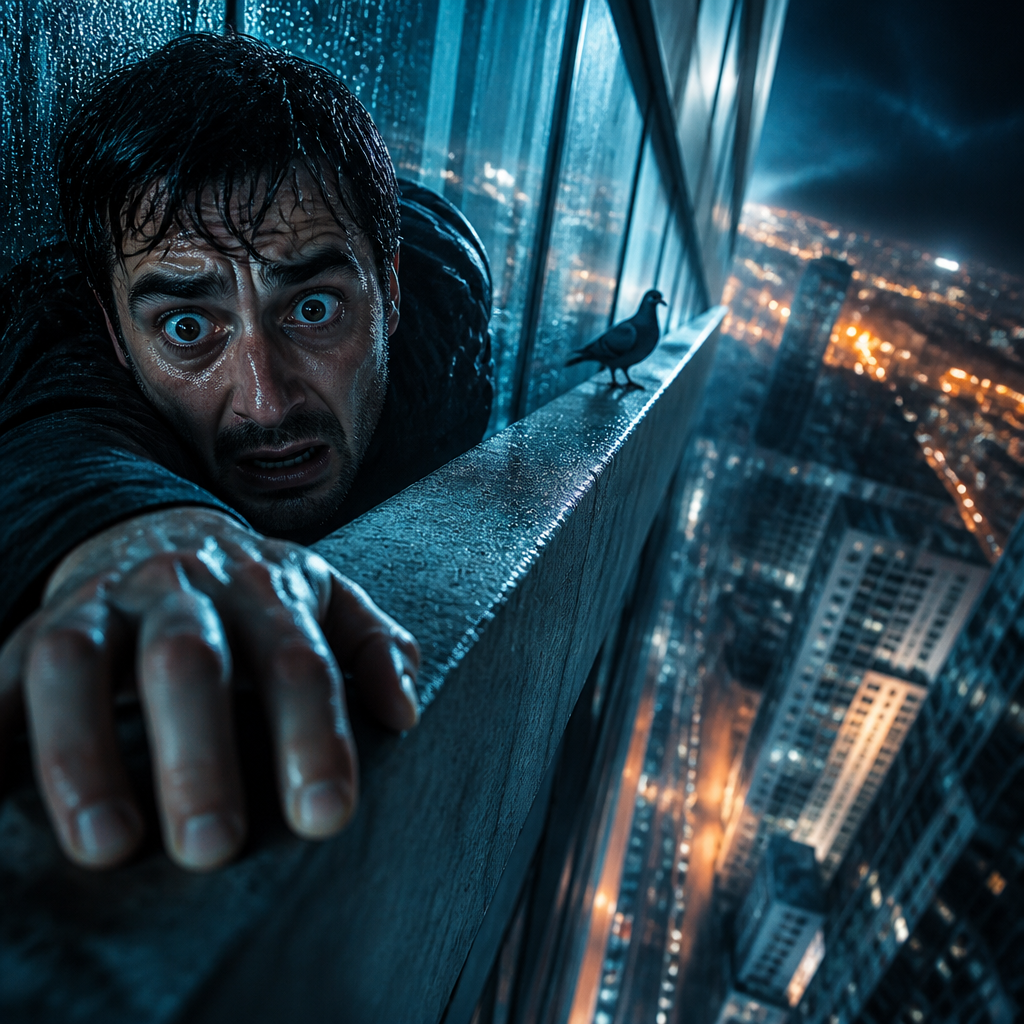
Five Inches
The Penthouse Trap
The Wager
Cressner’s Game
Onto the Wind
Pressure by Inches
The Mind Outside
The Return Inside
The Open Edge
How Fear Works

Transcript
SPEAKER_2: And the story asks something it hasn't asked before. Because Stan is inside now. Warm. Holding all the power. And Cressner is out there on five inches of concrete, forty-three stories above the street. And the question isn't whether the ledge is dangerous. We already know the answer to that. The question is what Stan has become by putting him there. SPEAKER_1: That's the discomfort the ending leaves you with. And it's deliberate. Stan doesn't walk away clean. He survives, yes. He gets justice of a kind. But the mechanism he uses to get it is the same mechanism Cressner used on him. The coerced wager. The asymmetry of who holds the information. The person inside watching the person outside. SPEAKER_2: He's adopted the rule. SPEAKER_1: Exactly. And the story doesn't tell you how to feel about that. It just leaves you at the window with Stan, listening for what's happening outside. Cressner is on the ledge. The story ends. And you're the one left holding the judgment. SPEAKER_2: That's the Twilight Zone quality you'd recognize immediately, Mike. The best episodes of that show don't hand you a verdict. They hand you a situation and then they stop. The camera holds on a face, or a door, or a staircase — and the discomfort is yours to carry. This ending works the same way. The five-inch strip is still out there. Still the same width it always was. But now it belongs to neither man cleanly. It's just a fact of the building. A rule that keeps running even after the story stops. SPEAKER_1: And that's what makes it linger. Suppose the story had ended with Cressner falling. Or with Stan walking away free and clear, Cressner arrested, everything resolved. You'd feel satisfied for about thirty seconds and then forget it entirely. SPEAKER_2: Because the pressure would be gone. SPEAKER_1: Right. But by leaving it open — by making Stan wait, and making you wait with him — the story keeps the pressure alive past its own ending. You're still in the subjunctive. Still in the zone of what might happen. What you hope happens. What you're not sure you're allowed to hope for. SPEAKER_2: And that unresolved moral weight is part of why the premise translated so well to film. In 1985, the story was adapted as the second segment of Cat's Eye, directed by Lewis Teague and written by King himself. Robert Hays plays the Norris role — renamed Johnny in the film — and Kenneth McMillan plays Cressner. SPEAKER_1: McMillan's Cressner is worth noting because the character is so precisely drawn in the source material that casting him wrong would collapse the whole thing. You need someone who reads as genuinely comfortable with cruelty — not theatrical about it, just at ease with it. And by most accounts, McMillan delivers that. SPEAKER_2: The segment holds up as evidence of something important about the premise: it has a strong visual engine. The ledge is not a literary abstraction. It's a physical thing you can put a camera on. You can show the drop. You can show the hands. You can show the five inches. The story's fear is already cinematic before anyone adapts it. SPEAKER_1: [short pause] And that's a sign of how well the original is constructed. When a premise translates directly to a different medium without needing to be rebuilt from scratch, it usually means the core rule is genuinely simple and genuinely physical. Not a metaphor dressed up as a plot. An actual spatial problem with actual consequences. SPEAKER_2: As of now, there's no significant new adaptation or reassessment of the story in recent circulation. Cat's Eye remains the one grounded screen version. But the story doesn't feel like it's waiting to be rediscovered — it feels like it's been quietly doing its work all along, in the collection, on the page, in the hands of anyone who picks up Night Shift and gets to it. SPEAKER_1: Because the premise doesn't age. The ledge is still five inches wide. The height is still forty-three stories. The wager is still coercion dressed as a game. None of that requires updating. SPEAKER_2: And the ending is still unresolved. Stan is still at the window. Cressner is still outside. And you're still being asked to decide what you think about a man who survived by becoming, for one moment, the thing that almost killed him. SPEAKER_1: That question — what the story asks you to carry out of it — is exactly where the craft becomes visible. Because the ending isn't a flaw or an evasion. It's a design choice. And understanding why King made it that way tells you something precise about how fear is built to last.