Five Inches
The Penthouse Trap
The Wager
Cressner’s Game
Onto the Wind
Pressure by Inches
The Mind Outside
The Return Inside
The Open Edge
How Fear Works

Transcript
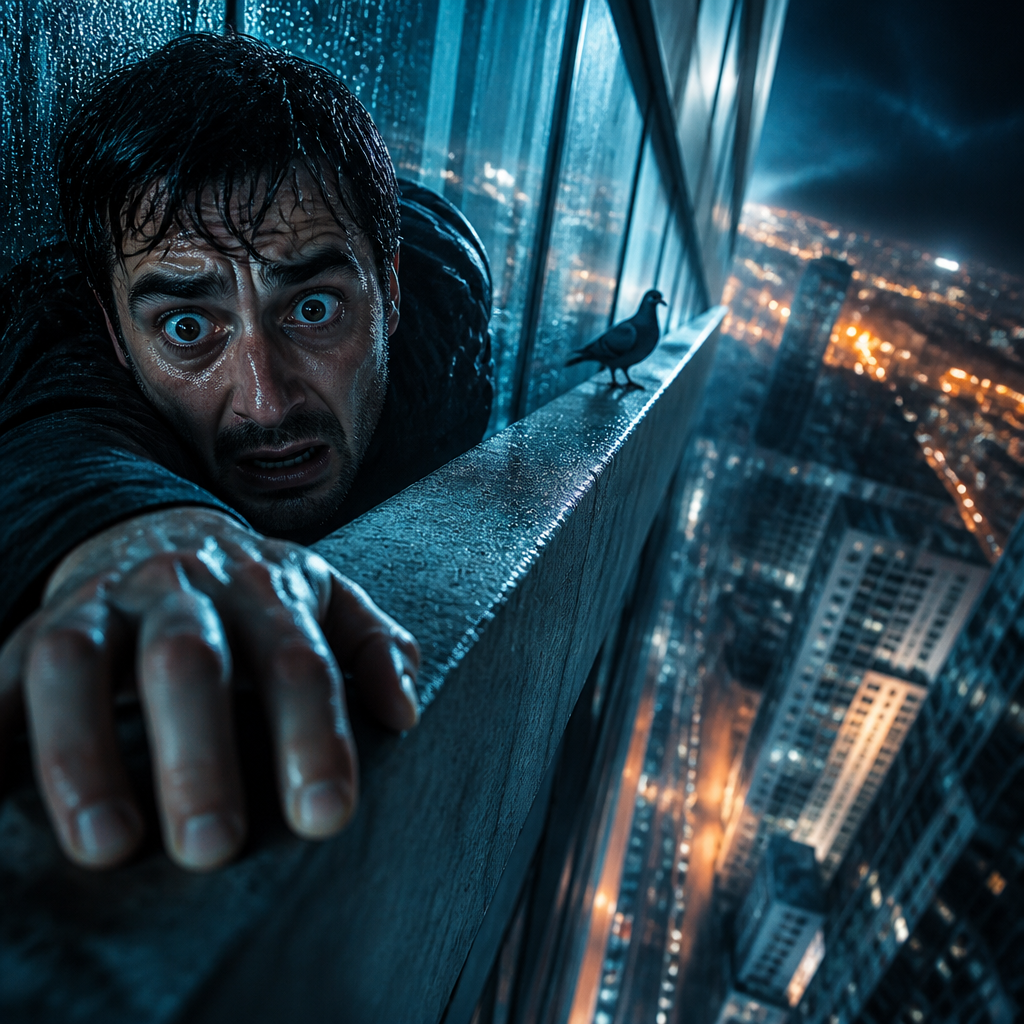
SPEAKER_2: Every decision costs something. That's where we left Stan — mid-circuit, accumulating. And that word, accumulating, is worth pressing on. Because the ledge doesn't reset. There's no moment where Stan gets to put the fear down, shake out his hands, and start fresh. Whatever he's spent getting this far, he carries into the next inch. SPEAKER_1: And that's a specific kind of pressure that's easy to miss if you're only watching for the obvious danger. The drop is always there. But the drop doesn't change. What changes is Stan's capacity to manage it. SPEAKER_2: Right — and that's the thing about duration as a threat. There's no clock on the wall. No countdown. The story doesn't tell you how long Stan has been out there. But you feel time passing because you feel him running down. Attention is a resource. Concentration is a resource. And both of them have a ceiling. SPEAKER_1: Think of it like a battery that can't be recharged mid-use. Every gust he absorbs, every micro-adjustment he makes, every second he holds his body still against the pull of the wind — that's a draw on the same reserve. And the reserve is finite. SPEAKER_2: So the longer the ordeal runs, the smaller his margin gets. Not because the ledge narrows — it's still five inches, same as when he stepped out. But because the person standing on it is incrementally less capable of managing those five inches than he was ten minutes ago. SPEAKER_1: Which is a genuinely unsettling design choice. Most survival stories give you escalation in the environment — the monster gets closer, the water rises, the walls move in. King does something quieter here. The environment stays roughly constant. The erosion is internal. SPEAKER_2: And then — just when you might think the story has found its rhythm, that Stan has settled into the ordeal — something completely ordinary interrupts it. SPEAKER_1: The pigeon. SPEAKER_2: a bird lands on the ledge ahead of Stan and refuses to move. That's it. That's the whole event. A pigeon doing what pigeons do — occupying a surface, indifferent to everything around it. SPEAKER_1: And in any other context, that's nothing. You wave your hand, the bird goes. You don't even break stride. SPEAKER_2: But Stan can't wave his hand. He can't lunge forward. He can't do anything that disrupts the precise, controlled distribution of his weight. So this bird — this completely unremarkable urban bird — becomes a negotiation. A problem that has to be solved with the same care you'd give a structural engineering question. SPEAKER_1: And what that moment does, mechanically, is refresh the reader's attention. The danger hasn't escalated. The drop is the same drop. But the pigeon forces you to re-engage, because now there's a new variable and Stan has to respond to it in real time. SPEAKER_2: That's the design insight, isn't it. King isn't raising the stakes with each obstacle — he's resetting the focus. The threat stays constant, but the specific demand on Stan's attention keeps changing. Wind, then cold, then a corner to navigate, then a bird. Each one pulls concentration back to the present moment. SPEAKER_1: Which is actually how sustained fear works in the body, too. Pure, unvarying dread eventually numbs. The nervous system starts to adapt. But introduce a new specific demand — something that requires an active response — and the fear sharpens again immediately. SPEAKER_2: So the pigeon isn't comic relief. It's not a quirky King detail dropped in for texture. It's doing structural work. It's the story saying: Stan's attention was starting to find a groove, and we can't allow that. SPEAKER_1: And if you're thinking about how fear gets engineered in a story, Mike, that's the pattern worth naming. It's not one enormous threat that keeps building. It's a simple, fixed rule — the ledge, the height, the five inches — combined with an environment that keeps producing small, unpredictable demands. The macro-threat is stable. The micro-threats are what keep the reader's nervous system from settling. SPEAKER_2: Limited agency is the other piece of it. Stan can't solve any of these problems decisively. He can't fight the wind. He can't remove the pigeon with force. He can't speed up to get it over with faster. Every response has to be minimal, controlled, and careful — which means every response costs more than it would in any other situation. SPEAKER_1: And the near-failures accumulate alongside the fatigue. Each moment where he almost loses it — a foot that shifts a fraction too far, a gust that arrives at the wrong second — each of those leaves a residue. He gets through it, but he gets through it slightly more depleted than before. SPEAKER_2: So by the time Stan is deep into the circuit, the ledge hasn't changed at all. The city is still below him. The concrete is still five inches wide. But the man on it is not the same man who stepped out. He's the same body carrying a significantly heavier load. SPEAKER_1: And here's what's remarkable about that as a horror premise: the world hasn't done anything extraordinary. No supernatural force. No escalating catastrophe. Just wind, cold, a bird, and time. The ordinary world, doing ordinary things, in a context where ordinary things are enough to kill you. SPEAKER_2: The five-inch strip is the rule that makes the ordinary world lethal. Everything else — the pigeon, the gust, the cold — those are just Tuesday. The ledge is what turns Tuesday into a survival problem. SPEAKER_1: Which means, in theory, if Stan can hold his concentration and his body together long enough, the natural world alone might not be enough to stop him. He's depleted, but he's still moving. He's still on the ledge. SPEAKER_2: And Cressner, watching from inside, warm and comfortable, has apparently come to the same conclusion. Because gravity and pigeons and cold air — it turns out he's not willing to leave it entirely to those.