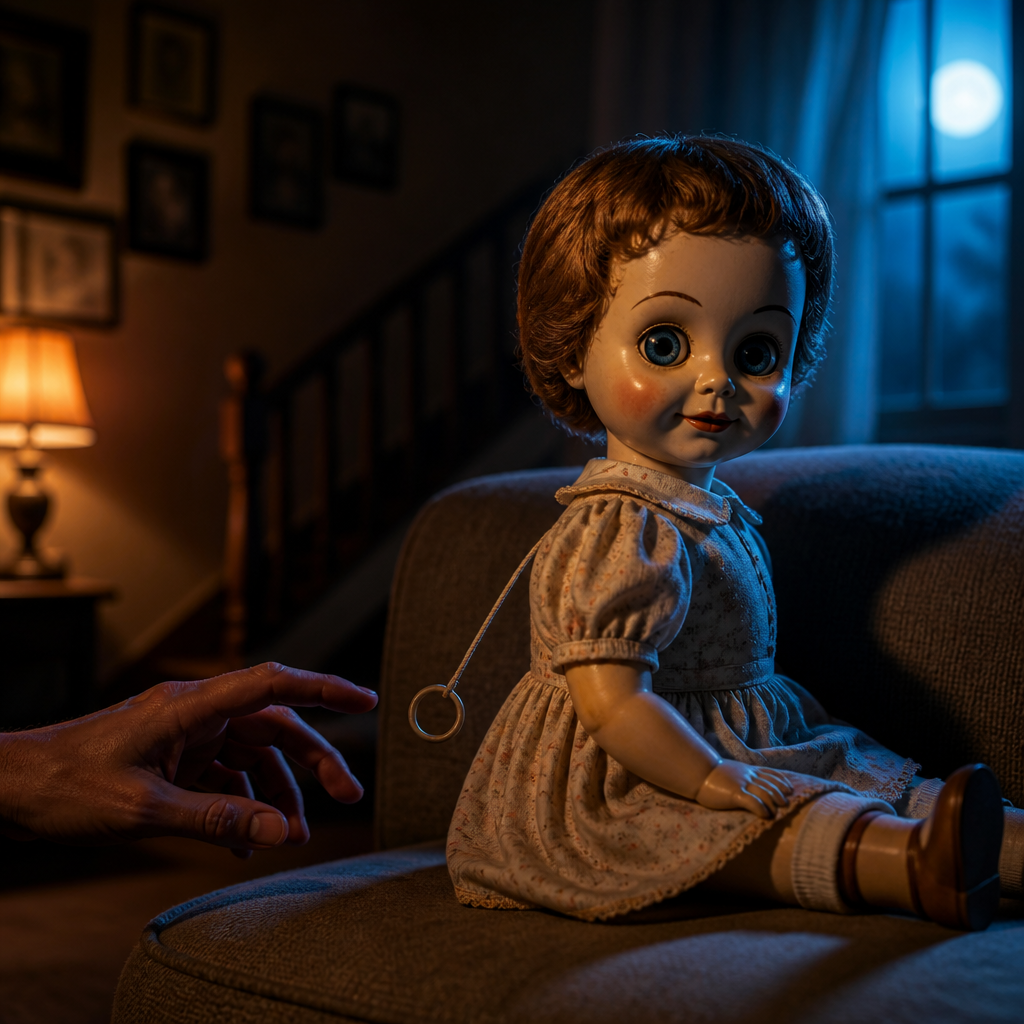
The Doll That Judges
Why a Doll? The Uncanny Toy
The Pressure Chamber Plot
Erich at the Center of the Trap
Suburbia in Shadow
The Voice That Repeats
Monster, Protector, or Symptom?
Before Chucky: Tina's Horror Lineage
The System Turns Back
How Fear Hides in Plain Sight

Transcript
A living room. Nineteen sixty-three. A child's toy sits on a shelf, painted smile fixed, plastic hands folded. Nothing moves. Nothing threatens. And yet something in that room is already wrong. Rod Serling described Talky Tina as a lifelike creation of plastic springs and painted smile. That contrast — cheerful surface, lethal interior — is the entire engine of the episode. The horror isn't arriving. It's already there. Think of the episode's opening as a perfectly ordinary domestic scene. A mother brings home a doll for her daughter Christie. Tina's standard greeting is warm: my name is Talky Tina, and I love you very much. That's the toy. She seems like an innocent children's toy — until Erich Streator handles her. Erich resents the expense. He resents Christie. He resents anything in that house he cannot control. And the doll, Mike, notices. Now, here is the key idea. Tina doesn't threaten randomly. She responds specifically to Erich. When he handles her, she tells him she hates him. She escalates to a direct death threat. No one else hears the worst of it. That means Erich is trapped in a subjective nightmare — judged by the doll, disbelieved by every adult around him. This is a classic Twilight Zone structure: a character forced to inhabit the consequences of their own cruelty. Erich tries to destroy her. He fails every time. She reappears. She calls him on the telephone. At the climax, he trips over her at the top of the stairs and dies. Tina's final line to his wife — you'd better be nice to me — makes clear she isn't finished judging. Researchers have framed this as a story about childism: the systemic dismissal of children's inner lives. Erich assumed he could dominate Christie and her doll. The story punishes exactly that assumption. The takeaway, Mike, is this. [short pause] Talky Tina's deepest horror isn't supernatural. It's moral. She is a harmless children's doll that becomes a witness against Erich's cruelty — turning the family home into a courtroom. Some analysts read her as a conduit for Christie's buried anger. Others see her as an instrument of justice. Either way, the monster the episode reveals isn't the doll. It's what was already living inside that house.