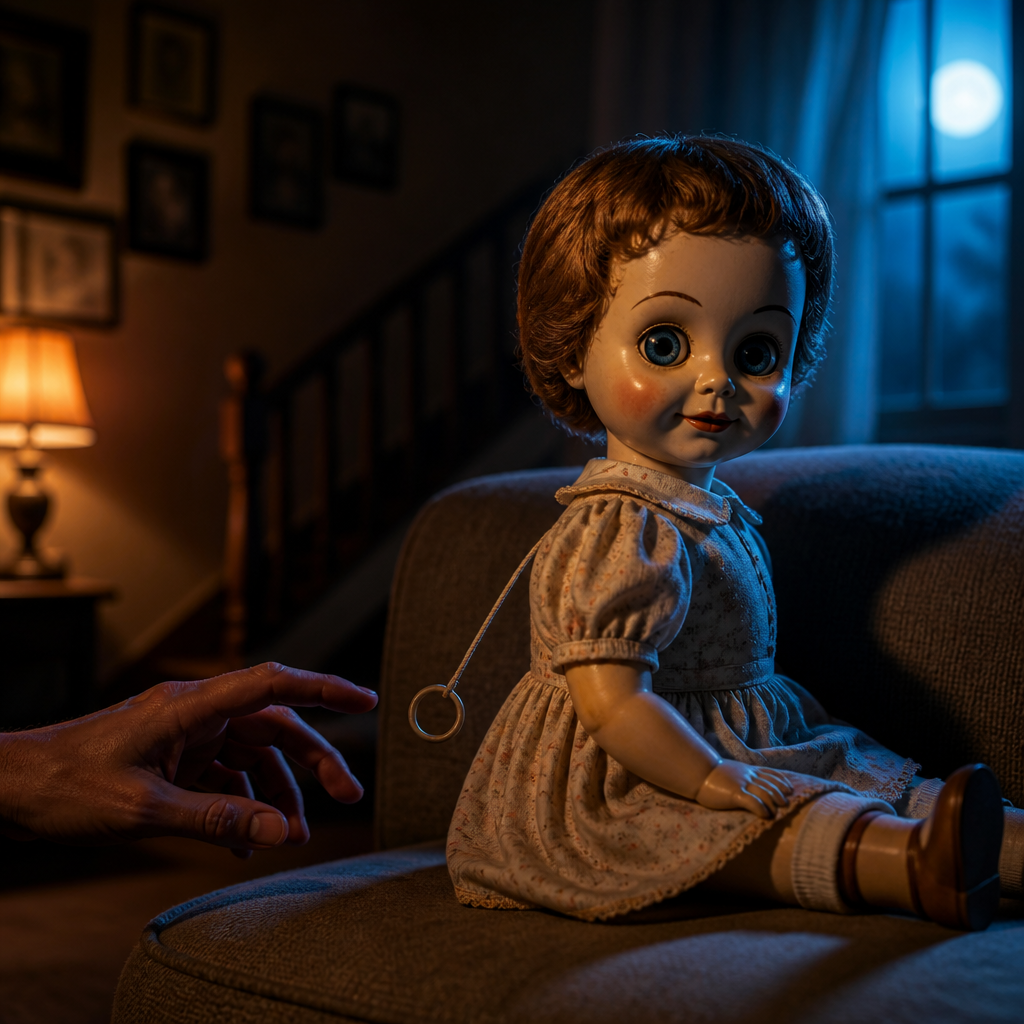
The Doll That Judges
Why a Doll? The Uncanny Toy
The Pressure Chamber Plot
Erich at the Center of the Trap
Suburbia in Shadow
The Voice That Repeats
Monster, Protector, or Symptom?
Before Chucky: Tina's Horror Lineage
The System Turns Back
How Fear Hides in Plain Sight

Transcript
SPEAKER_1: Tina isn't the horror — she's the judgment already inside the house. But now I keep asking — why a doll specifically? SPEAKER_2: The key idea is that dolls arrive pre-loaded. Archaeological findings put miniature human figures back to the Paleolithic era — used for play, ritual, mourning. That symbolic weight exists before the story even starts. SPEAKER_1: So the object carries history. SPEAKER_2: And horror exploits it. Roboticist Masahiro Mori theorized in 1970 that emotional affinity rises as something becomes more humanlike — until a threshold where near-human appearance produces a sharp drop into eeriness. Lifelike dolls sit right in that valley. SPEAKER_1: Because they look human but clearly aren't alive. SPEAKER_2: Right — and face-perception research adds another layer. The brain first detects a face, then evaluates whether that face suggests a mind. A doll's face passes the first test and fails the second. That mismatch is cognitively unsettling in a way a ghost simply isn't. SPEAKER_1: Wait — so not a monster, but something that looks like it should be safe? SPEAKER_2: [short pause] Precisely. Other horror dolls often make their aggression more visible and direct. Annabelle is staged as a passive vessel for external evil. Tina does almost nothing visible — one wink, a voice. Her activity is mostly implied. That restraint is what makes her more disturbing. SPEAKER_1: Because the listener's imagination fills the gap. SPEAKER_2: And fills it personally. Now, the deeper contradiction — Tina is a child’s toy and an agent of retribution simultaneously. She can't be both things. That cognitive conflict is exactly where the horror lives. SPEAKER_1: And her connection to Christie changes the moral stakes entirely. SPEAKER_2: It does. Erich's hostility toward the doll is inseparable from his hostility toward his stepdaughter. So when Tina responds to him — choosing words that feel targeted rather than preprogrammed — she's not a malfunctioning toy. The takeaway is this: her innocence doesn't soften the threat. It sharpens it.