The Doll That Judges
Why a Doll? The Uncanny Toy
The Pressure Chamber Plot
Erich at the Center of the Trap
Suburbia in Shadow
The Voice That Repeats
Monster, Protector, or Symptom?
Before Chucky: Tina's Horror Lineage
The System Turns Back
How Fear Hides in Plain Sight

Transcript
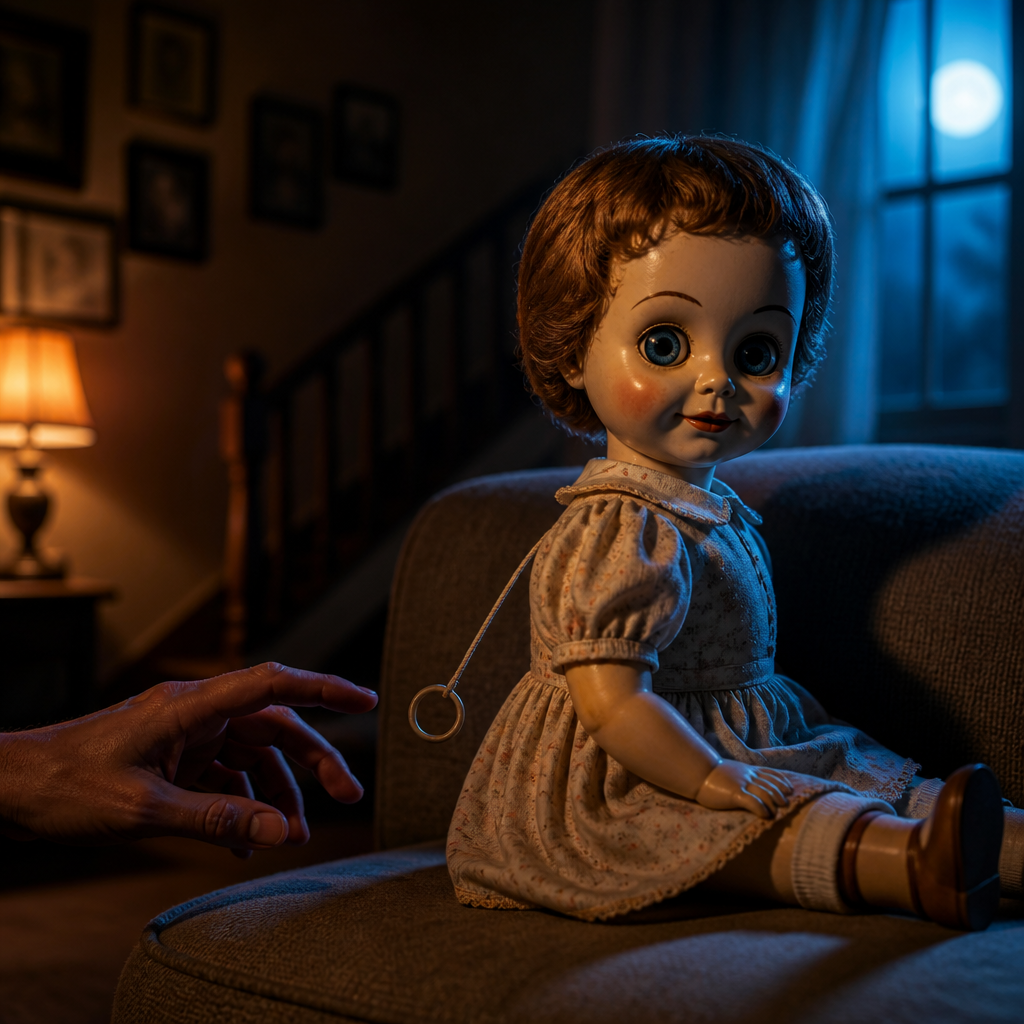
A living room. Nineteen sixty-three. This room feels familiar now. Nine lectures inside it. [short pause] But something has shifted. Every object feels readable. The shelf. The staircase. The painted smile. Researchers note that the uncanny arises when something familiar becomes strange — when a slight deviation inside a normal environment makes fear possible. That is the room. That is Tina. The power struggle reveals how ordinary objects, like Tina, can become vessels for hidden fears, reflecting the psychological mechanisms at play. Scholars analyzing Living Doll describe it as a power struggle where symbolic violence against a child's toy exposes hidden anxieties about authority and vulnerability. Horror narratives use ordinary objects to reflect hidden fears, creating a subtle yet powerful psychological impact. Tina was more than just a toy; she was a mirror reflecting the hidden fears within the household. Think of how a fire alarm works. One sound. Immediate body response. Research on fear stimuli shows that ordinary environments contain hidden triggers — novelty, intensity, conditioned association. A doll qualifies on all three. Mass-produced dolls became more realistic across the twentieth century, and that lifelike quality transformed them into objects where innocence and threat coexist quietly. Ordinary objects like Tina absorb and reflect hidden fears, concentrating them into a single, unsettling presence. Horror narratives often use ordinary objects to compress complex fears into simple, memorable forms, as seen with Tina's minimal actions. Scholars of horror aesthetics note that partial concealment forces the viewer's mind to complete the unseen — tapping latent fears. Tina does almost nothing visible. Her terror is minimalist: few lines, strong implication, concentrated agency. That restraint is the craft. Less action creates more bandwidth for fear to register. Here is the method Tina teaches you, Mike. Identify the object. Find its normal meaning. Track its distortion. Note its repeated behavior. Then ask: what conflict is it absorbing? Fear of the unknown hides in everyday cognitive patterns, not in overt threats. Rational and irrational fears quietly drive behavior without being recognized as fear at all. Tina endures because she proves the core rule: when one ordinary object absorbs a story's buried conflict, fear becomes simple, memorable, and unavoidable. Horror often begins when the ordinary world finally tells the truth.