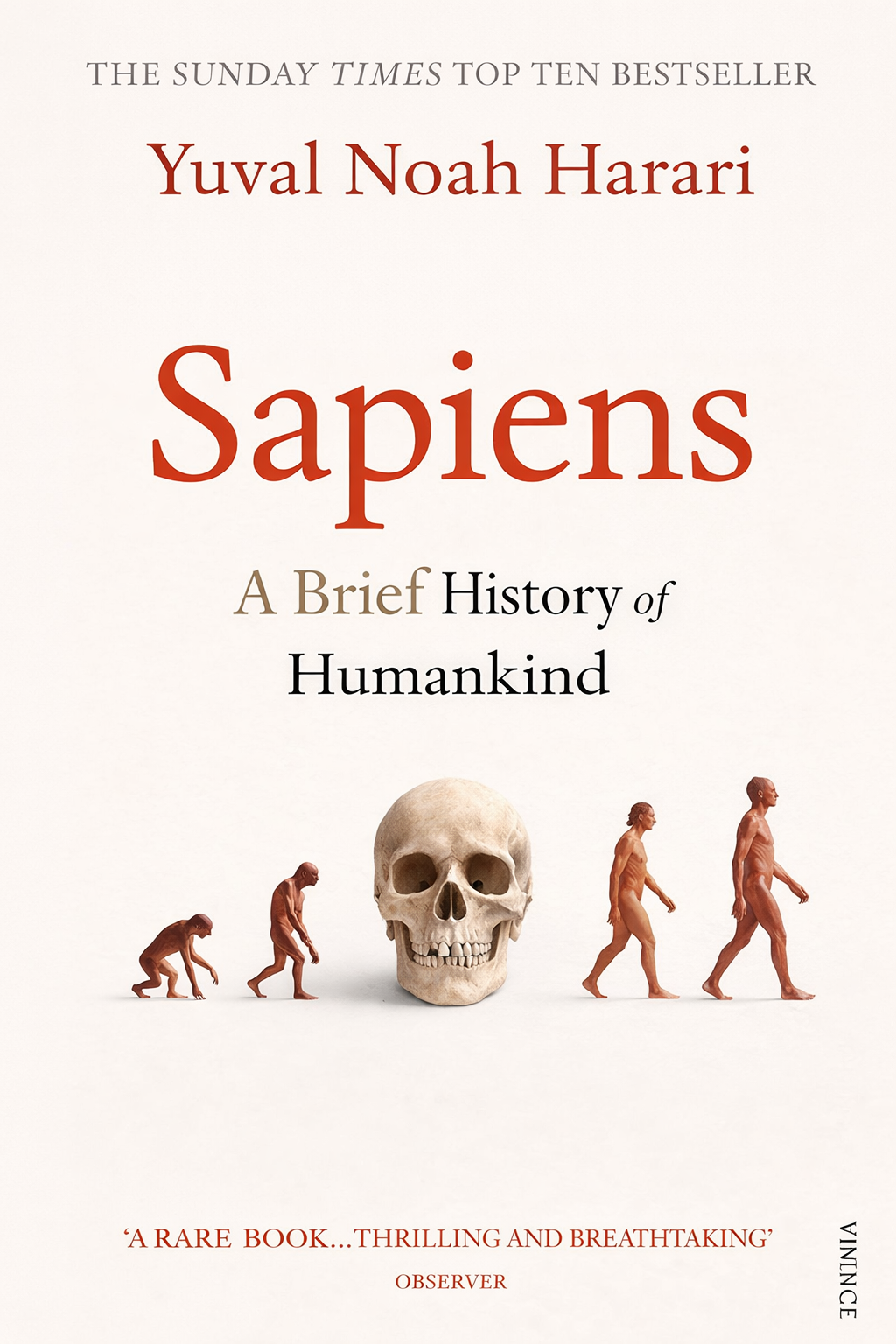
Sapiens: A Brief History of Humankind by Yuval Noah Harari
109 min • 23 lectures
For most of human history, members of the genus Homo were biologically ordinary creatures with no more impact on their environment than other mammals. This course traces the transformation of Sapiens from insignificant apes to the masters of the planet. The journey begins with the Cognitive Revolution, where the development of language allowed humans to communicate about things that do not exist. These shared myths, such as legends, gods, and eventually laws, provided the social glue necessary for large groups of strangers to cooperate. You will examine how the transition from hunting and gathering to agriculture reshaped human health, labor, and social structures. While farming provided food surpluses, it also introduced permanent hierarchies and organized inequality. The narrative continues by analyzing the powerful imagined realities that sustain global civilizations: money, religion, and empire. These institutions allowed human societies to expand far beyond the biological limit of small bands. The course then explores the Scientific Revolution, a period defined by the admission of ignorance which sparked rapid technological growth. You will see how the alliance between science, empire, and capitalism drove global expansion and the Industrial Revolution, fundamentally altering the natural world. Finally, the series looks toward the future of the species. As bio-engineering and artificial intelligence advance, humans are gaining the ability to design life and potentially replace themselves. This overview provides a clear look at the forces that created our world and the technologies that might end the history of Homo Sapiens as we know it.
From Irrelevance to Dominance
The Birth of Shared Myths
Extending the Tree of Knowledge
Everyday Life of the First Humans
The Flood Narrative
History’s Biggest Fraud
Monuments of Power
The Brain’s Burden of Information
Outsourcing Human Memory
Injustice in the Past
The Arrow of History
The Scent of Money
Imperial Visions
Foundations of the Law of Religion
The Institutionalization of Faith
The Secret of Success
The Discovery of Ignorance
Science Meets Empire
The Capitalist Creed
The Wheels of Industry
A Permanent Revolution
Utopian Dreams and Dark Realities
The End of Homo Sapiens
