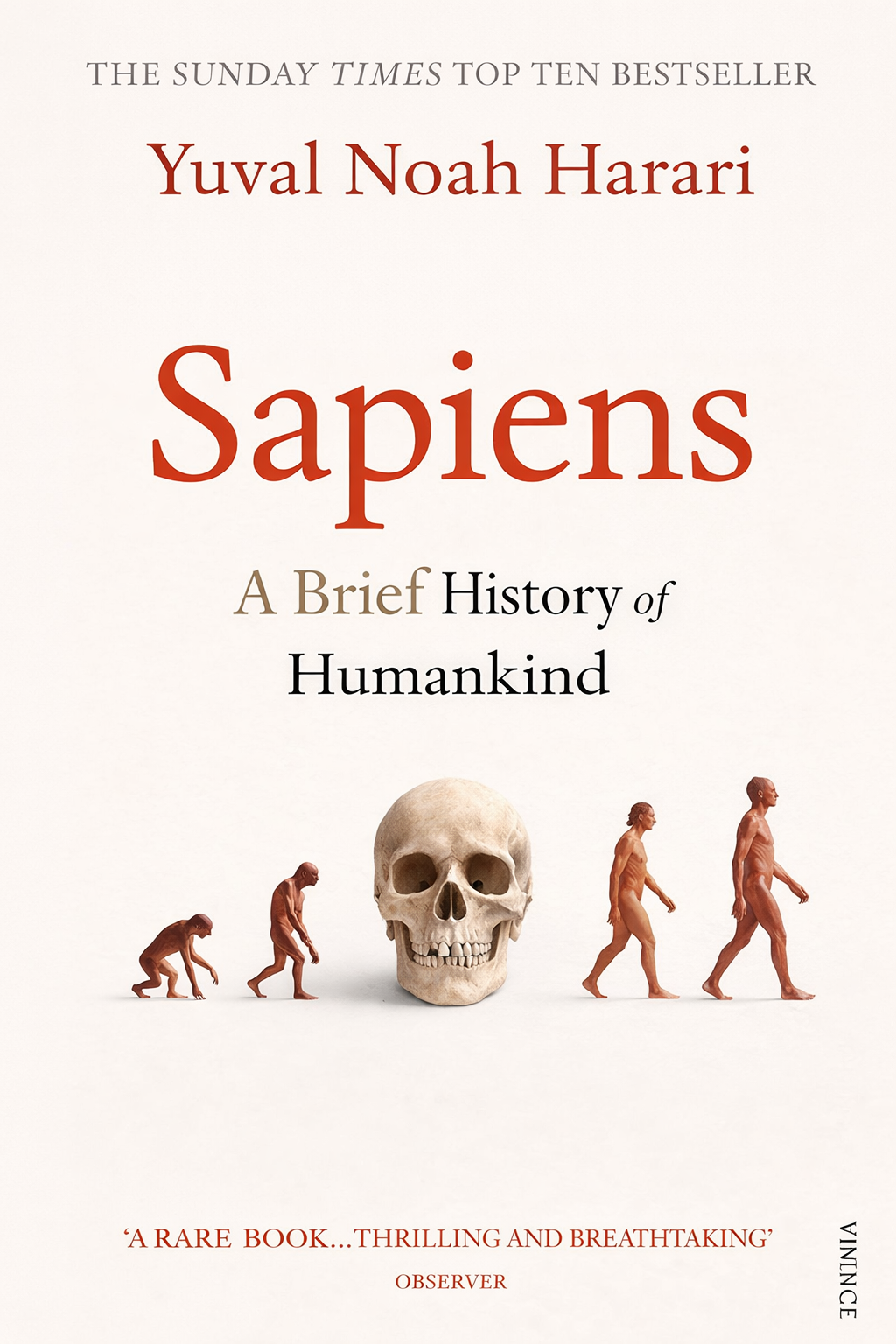
From Irrelevance to Dominance
The Birth of Shared Myths
Extending the Tree of Knowledge
Everyday Life of the First Humans
The Flood Narrative
History’s Biggest Fraud
Monuments of Power
The Brain’s Burden of Information
Outsourcing Human Memory
Injustice in the Past
The Arrow of History
The Scent of Money
Imperial Visions
Foundations of the Law of Religion
The Institutionalization of Faith
The Secret of Success
The Discovery of Ignorance
Science Meets Empire
The Capitalist Creed
The Wheels of Industry
A Permanent Revolution
Utopian Dreams and Dark Realities
The End of Homo Sapiens

Transcript
SPEAKER_1: Alright, last time we explored how capitalism became a belief system as powerful as any religion, promising salvation through perpetual growth. Now the author's claiming the Industrial Revolution fundamentally changed human consciousness itself. That sounds like hyperbole. SPEAKER_2: It does sound dramatic, but they're making a precise argument about temporal consciousness. Pre-industrial societies operated according to natural rhythms—seasonal cycles, solar patterns, organic processes. The factory system shattered that by making precise time measurement essential to production. SPEAKER_1: But people always measured time. Sundials, water clocks... what's fundamentally different? SPEAKER_2: The difference is synchronization as a production requirement. Workers had to arrive at exact times, perform tasks at specific speeds, coordinate with machines and other workers. The author shows this was a radical psychological shift, not just technological. SPEAKER_1: Okay, but the book says 'time is money' encapsulates this. Isn't that just a metaphor? SPEAKER_2: Actually, the author argues it's literal. Time became a commodity to be measured, bought, and sold. This temporal discipline extended beyond the workplace into schools, entertainment, family life. Even time zones globally represent the triumph of industrial time over natural, local variations. SPEAKER_1: Wait, so industrialization promised efficiency gains that would reduce working hours. Did that happen? SPEAKER_2: Here's the paradox they identify: modern workers may work fewer hours than medieval peasants, but they experience time as more compressed and pressured. Expectations of constant availability and immediate response became normalized. SPEAKER_1: Alright, shifting to the physical transformation. The book must address how factories changed landscapes and cities. SPEAKER_2: Absolutely. The author shows how industrial production required concentrating workers near power sources—initially water, then coal. This created unprecedented urbanization as millions migrated from rural areas to factory towns, fundamentally altering human settlement patterns. SPEAKER_1: But didn't that create horrific living conditions? Overcrowding, pollution, disease? SPEAKER_2: Exactly the author's point. Early industrial cities were catastrophic for human health. Life expectancy in Manchester was lower than in rural areas. Yet people kept coming because agricultural changes made rural survival impossible for many. SPEAKER_1: So the wheels of industry literally ground people down? SPEAKER_2: The author documents brutal working conditions: twelve to sixteen hour days, child labor, dangerous machinery, no safety regulations. The human cost was staggering, yet the system expanded because it generated unprecedented wealth for owners and investors. SPEAKER_1: That sounds like exploitation, not progress. How does the book justify calling this a revolution rather than a catastrophe? SPEAKER_2: They don't justify it morally. The author's point is that it was revolutionary in transforming production capacity and social organization, not in improving individual welfare. The revolution was in scale and speed, not in human happiness. SPEAKER_1: Alright, but the book must address how this connects to the energy revolution we discussed before. SPEAKER_2: Precisely. The author shows how coal-powered steam engines broke the biological energy ceiling. Factories could operate continuously, independent of human or animal muscle power. This created positive-sum economics where production could expand indefinitely. SPEAKER_1: So the wheels of industry were literally powered by fossil fuels? SPEAKER_2: Exactly. The author argues this energy transition was the Industrial Revolution's foundation. Without coal, factories would have remained limited by available water power or muscle energy. Fossil fuels enabled the scale that defined industrial capitalism. SPEAKER_1: But didn't this also create the environmental crisis we're living with now? SPEAKER_2: The author connects those dots explicitly. The Industrial Revolution began humanity's massive carbon emissions, fundamentally altering Earth's atmosphere and climate. The wheels of industry that generated unprecedented wealth also set in motion ecological catastrophe. SPEAKER_1: So for our listener, the takeaway is that the Industrial Revolution transformed human consciousness, social organization, and the planet itself—all through the mechanization of production? SPEAKER_2: Exactly. The author's argument is that understanding the wheels of industry means recognizing how deeply they reshaped human existence, from our experience of time to our relationship with nature, creating the modern world with all its wealth and all its crises.