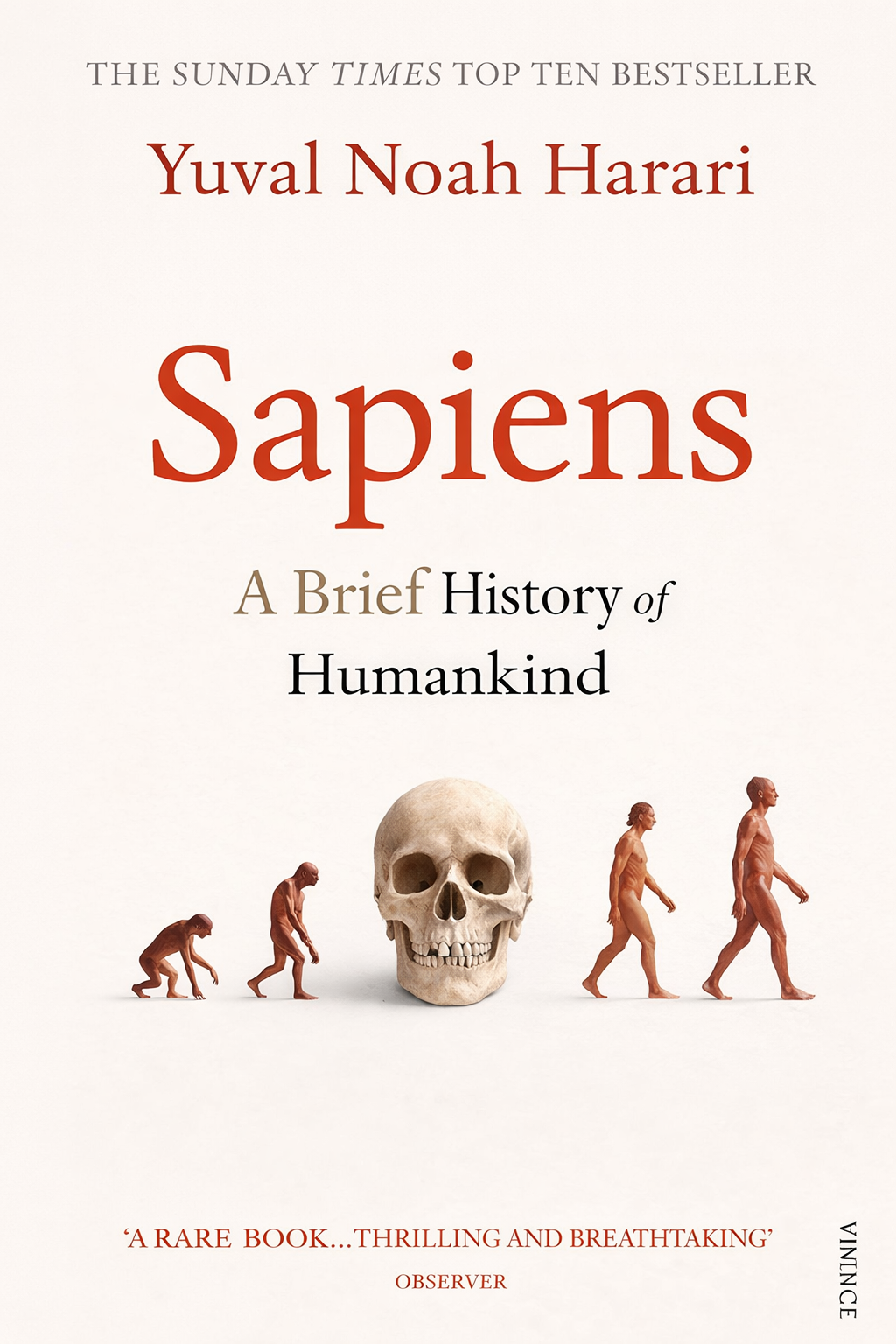
From Irrelevance to Dominance
The Birth of Shared Myths
Extending the Tree of Knowledge
Everyday Life of the First Humans
The Flood Narrative
History’s Biggest Fraud
Monuments of Power
The Brain’s Burden of Information
Outsourcing Human Memory
Injustice in the Past
The Arrow of History
The Scent of Money
Imperial Visions
Foundations of the Law of Religion
The Institutionalization of Faith
The Secret of Success
The Discovery of Ignorance
Science Meets Empire
The Capitalist Creed
The Wheels of Industry
A Permanent Revolution
Utopian Dreams and Dark Realities
The End of Homo Sapiens

Transcript
SPEAKER_1: Alright, last time we explored how religions transformed into powerful institutions with hierarchies and economic systems. Now the author's circling back to the very beginning—what made Homo sapiens successful in the first place. Haven't we already covered this? SPEAKER_2: We touched on it, but the author's making a specific synthesis here. After examining agriculture, empires, science, and capitalism, they're asking: what underlying capacity enabled all these revolutions? The answer is language, but not just any language. SPEAKER_1: But lots of animals communicate. What makes human language fundamentally different? SPEAKER_2: The author argues it's our ability to transmit information about things that don't exist. A monkey can warn others about a lion, but humans can discuss spirits, nations, corporations—entire imagined realities that coordinate millions of strangers. SPEAKER_1: Wait, so the book's saying our success comes from lying? SPEAKER_2: Not lying—creating shared fictions. The author shows these aren't deceptions but collective agreements. Money works because everyone believes in it. Laws function because societies accept them. Human rights exist because we collectively affirm them. SPEAKER_1: That sounds circular. How does believing in something make it real? SPEAKER_2: Because the belief itself creates the reality. The author explains that a dollar bill has value only through collective trust. The moment that trust collapses, the paper becomes worthless. The fiction generates real-world consequences. SPEAKER_1: Okay, but the book must explain why this capacity emerged in Homo sapiens specifically. What triggered it? SPEAKER_2: The Cognitive Revolution around seventy thousand years ago. The author argues this is when Sapiens developed the neurological capacity to imagine and communicate complex abstractions, enabling cultural evolution to outpace genetic evolution. SPEAKER_1: So we could change our social structures by revising stories instead of waiting for DNA to mutate? SPEAKER_2: Exactly. The author shows this allowed unprecedented flexibility. Foragers could reorganize their bands, farmers could create new hierarchies, empires could integrate diverse peoples—all through shared narratives rather than biological adaptation. SPEAKER_1: But didn't this also enable all the problems we've discussed? Inequality, exploitation, environmental destruction? SPEAKER_2: Absolutely. The author's point is that language gave us power without wisdom. We could coordinate massive projects—pyramids, empires, industrial economies—but the same capacity created systems that trapped us in cycles of suffering. SPEAKER_1: Give me a concrete example of that trap. SPEAKER_2: The Agricultural Revolution. The author argues farmers used language to create concepts like private property and debt, which enabled larger populations but made individuals worse off. The shared fictions locked people into systems they couldn't escape. SPEAKER_1: So language is both our greatest strength and our fundamental vulnerability? SPEAKER_2: Precisely. The author shows it enabled cooperation that conquered the planet, but also created imagined orders that constrain us. We're the only species that can be enslaved by our own collective beliefs. SPEAKER_1: Alright, but the book must address whether we can use this capacity differently. Are we stuck with the systems we've created? SPEAKER_2: That's the crucial question the author leaves open. If we created these fictions through language, we can theoretically revise them. But the challenge is that they're embedded in institutions, economies, and our own desires. SPEAKER_1: So changing the story isn't enough if the material structures remain? SPEAKER_2: Exactly. The author argues that's why revolutions often fail. You can change the narrative, but if the underlying economic systems and power structures persist, the new story gets absorbed into the old reality. SPEAKER_1: That's pretty pessimistic. Is the author saying we're trapped by our own success? SPEAKER_2: Not trapped, but constrained by path dependency. The author shows that each revolution—cognitive, agricultural, scientific—opened new possibilities while closing others. We can't simply return to foraging, but we can recognize that our current systems aren't inevitable. SPEAKER_1: So for our listener, the takeaway is that understanding language as the foundation of human power helps explain both our achievements and our predicaments? SPEAKER_2: Exactly. The author's argument is that Homo sapiens conquered the world not through physical strength or individual intelligence, but through our unique ability to create and believe in shared fictions. That capacity enabled everything from ancient empires to modern capitalism, but it also means we're living in worlds of our own making—which means we bear responsibility for the consequences.