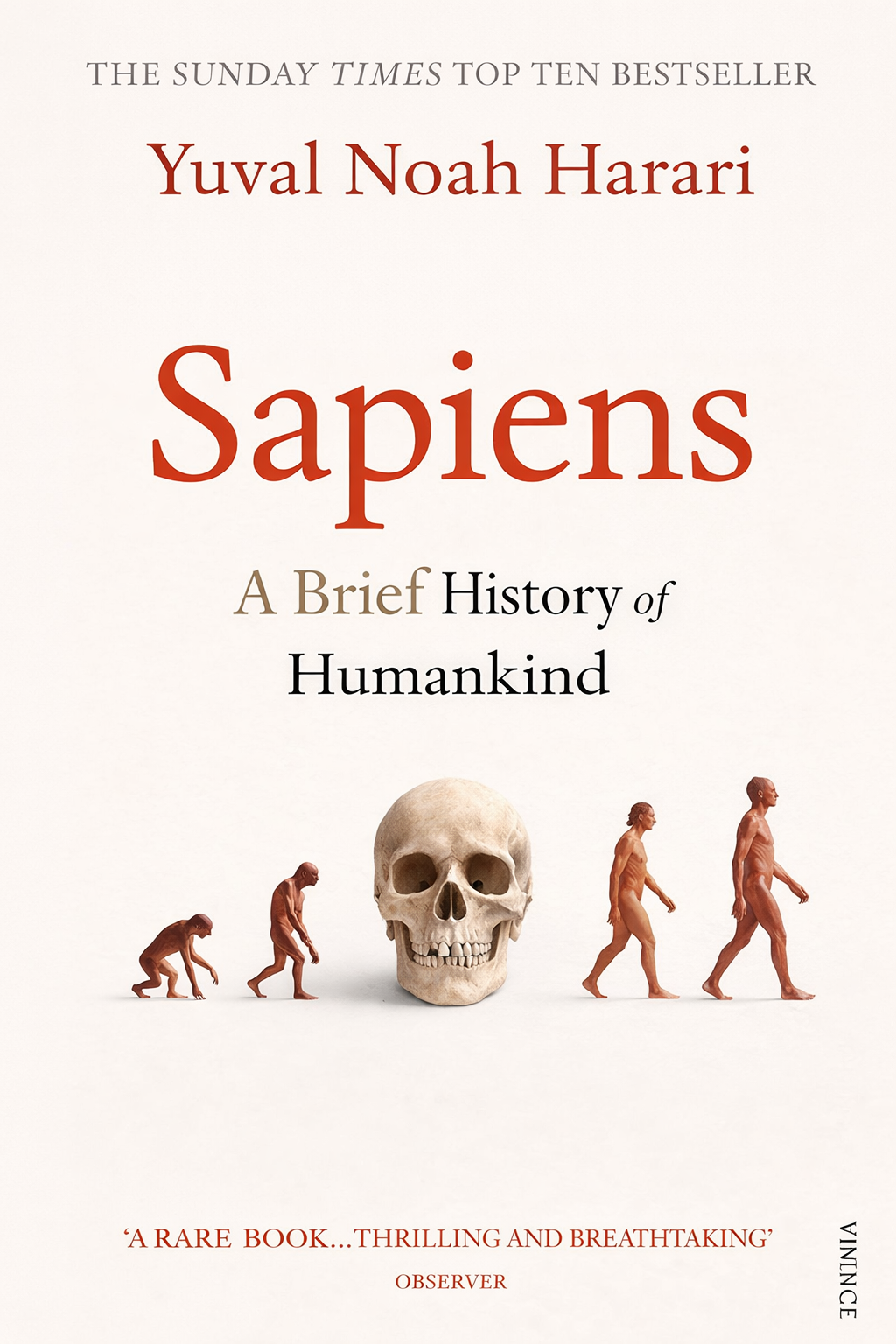
From Irrelevance to Dominance
The Birth of Shared Myths
Extending the Tree of Knowledge
Everyday Life of the First Humans
The Flood Narrative
History’s Biggest Fraud
Monuments of Power
The Brain’s Burden of Information
Outsourcing Human Memory
Injustice in the Past
The Arrow of History
The Scent of Money
Imperial Visions
Foundations of the Law of Religion
The Institutionalization of Faith
The Secret of Success
The Discovery of Ignorance
Science Meets Empire
The Capitalist Creed
The Wheels of Industry
A Permanent Revolution
Utopian Dreams and Dark Realities
The End of Homo Sapiens

Transcript
Welcome to Sapiens: A Brief History of Humankind by Yuval Noah Harari—a book that will permanently change how you understand humanity's place in the world and the forces that shaped modern civilization. Most people assume humans have always dominated Earth, but for millions of years we were insignificant animals cowering in the middle of the food chain—so what transformed us into planetary masters in the blink of evolutionary time? Yuval Noah Harari, a historian whose undergraduate lectures became a global phenomenon with over 50 million copies sold worldwide, spent years unraveling this mystery. Homo sapiens emerged around 2.5 million years ago in East Africa as one of several human species sharing the planet simultaneously, including Neanderthals in Europe, Homo erectus across Asia, and the three-and-a-half-foot-tall "hobbits" of Indonesia. These early humans were unremarkable creatures hunting small animals and gathering plants while being hunted by larger predators; their oversized brains consumed 25% of the body's energy at rest compared to 8% in other apes, demanding constant feeding. Fire mastery around 300,000 years ago enabled cooking, which made more foods digestible and reduced eating time, yet humans remained marginal for millions of years until reaching the food chain's top only 100,000 years ago. The fate of other human species reveals uncomfortable truths about Sapiens' nature, as Neanderthals, Denisovans, and others vanished shortly after Sapiens arrived in their territories around 70,000 years ago. Genetic evidence shows modern humans outside Africa carry 1-4% Neanderthal DNA, indicating limited interbreeding occurred but not enough to prevent extinction—suggesting history's first and perhaps most significant ethnic cleansing. This rapid ascent to dominance, unlike the gradual climb of other apex predators over millions of years, left ecosystems without time to develop checks and balances, potentially explaining humanity's destructive environmental impact. The Cognitive Revolution approximately 70,000 years ago transformed Sapiens from insignificant animals into planetary masters by fundamentally altering how they thought and communicated beyond mere language. The revolutionary breakthrough was the unique ability to discuss things that do not physically exist—gods, nations, corporations, human rights, money—enabling unprecedented cooperation among vast numbers of strangers through shared myths. While chimpanzees cooperate flexibly only in groups of about 50 based on personal acquaintance and ants cooperate in large numbers but rigidly through genetic programming, Sapiens uniquely combined flexible cooperation with massive scale through collective belief in imagined realities. This cognitive leap enabled cultural evolution to replace biological evolution as the primary driver of human development, allowing Sapiens to rapidly adapt by changing shared stories rather than waiting for genetic mutations. Archaeological evidence after 70,000 years ago shows Sapiens producing art, jewelry, oil lamps, and sewn clothing—markers of symbolic thinking enabling them to inhabit every ecological niche from arctic tundra to tropical rainforests. The ability to revise shared myths gave Sapiens unprecedented flexibility to dissolve companies and create new ones, abandon gods for others, or rewrite laws simply by changing collective stories, explaining how they drove other human species to extinction and dominated every ecosystem while history declared independence from biology.