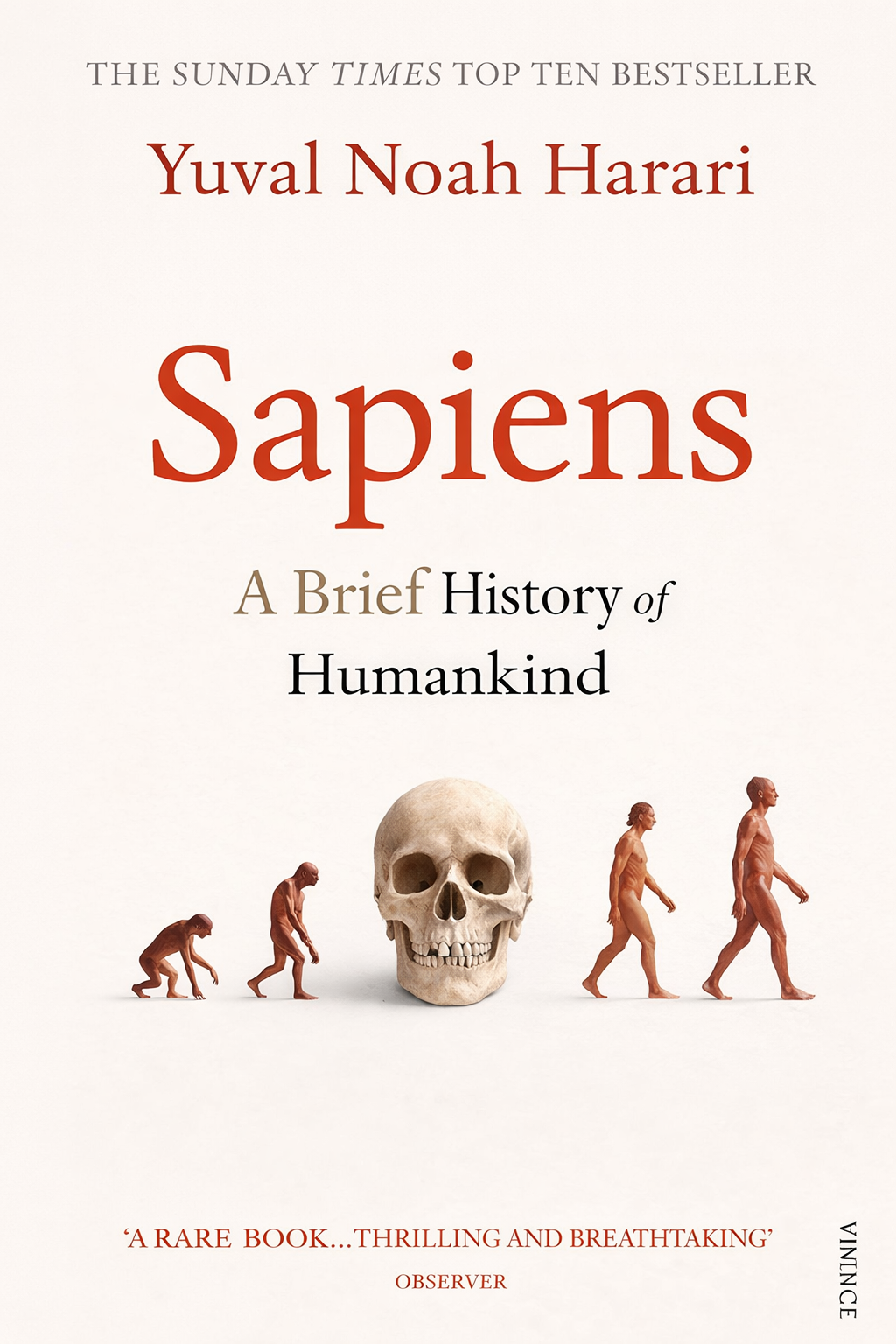
From Irrelevance to Dominance
The Birth of Shared Myths
Extending the Tree of Knowledge
Everyday Life of the First Humans
The Flood Narrative
History’s Biggest Fraud
Monuments of Power
The Brain’s Burden of Information
Outsourcing Human Memory
Injustice in the Past
The Arrow of History
The Scent of Money
Imperial Visions
Foundations of the Law of Religion
The Institutionalization of Faith
The Secret of Success
The Discovery of Ignorance
Science Meets Empire
The Capitalist Creed
The Wheels of Industry
A Permanent Revolution
Utopian Dreams and Dark Realities
The End of Homo Sapiens

Transcript
Last time we examined how the Industrial Revolution transformed human consciousness through mechanized production, reshaping temporal experience and social organization while setting in motion ecological catastrophe through fossil fuel dependence. Now we confront the author's central thesis: modernity represents a permanent revolution rather than a transition to stability, creating continuous flux that distinguishes contemporary life from all previous historical periods. The permanent revolution operates through self-reinforcing mechanisms where scientific discoveries generate new technologies, which produce economic growth and political power, which fund further research in an accelerating cycle that prevents equilibrium. Unlike agricultural or industrial revolutions that eventually stabilized into new social orders, the author argues that modern societies experience perpetual transformation as each generation inhabits a fundamentally different world from their parents, with someone born in 1900 witnessing airplanes, antibiotics, nuclear weapons, computers, and the internet within a single lifetime. This acceleration stems from science's admission of ignorance, which created an unprecedented feedback loop making change itself the only constant in contemporary civilization. The breakdown of traditional communities represents another dimension of this permanent revolution, as the state and market offered individuals a transformative deal: they would provide education, healthcare, welfare, employment, and protection in exchange for loyalty and market participation, liberating people from often oppressive family authority. The nuclear family replaced extended multi-generational households, with even nuclear family functions progressively outsourced to kindergartens raising children, retirement homes caring for the elderly, and the state providing pensions that once came from offspring. The author shows this was simultaneously liberating and alienating, granting unprecedented freedom from traditional constraints while leaving many feeling isolated despite living among millions, as connections became primarily commercial transactions and bureaucratic procedures rather than deep meaningful relationships. Consumerism emerged as the ideological foundation sustaining this permanent revolution by transforming values that had governed human societies for millennia, redefining self-indulgence and excessive consumption from vices into legitimate pursuits of happiness and economic necessities. For most of history frugality was universally considered virtuous, but capitalism's dependence on continuous growth demanded ever-increasing consumption, creating a paradox where the system needed disciplined producers while simultaneously creating indulgent consumers who defined themselves through brand choices and lifestyle purchases. The advertising industry became a massive force shaping human desires in self-perpetuating cycles where production creates income, which enables consumption, which drives demand for more production, representing a dramatic departure from traditional zero-sum economic assumptions. The author concludes that this permanent revolution has created unprecedented material abundance and individual freedom while simultaneously generating chronic dissatisfaction, environmental crisis, and social atomization that define contemporary existence. Understanding that we inhabit a state of continuous transformation rather than a stable civilization helps explain why traditional solutions fail to address modern problems, as the ground shifts beneath every proposed reform. The permanent revolution thus emerges not as a temporary disruption but as modernity's defining characteristic, making adaptation to perpetual change the fundamental challenge facing humanity as we navigate an uncertain future shaped by forces we have unleashed but cannot fully control.