The Brain’s Burden of Information
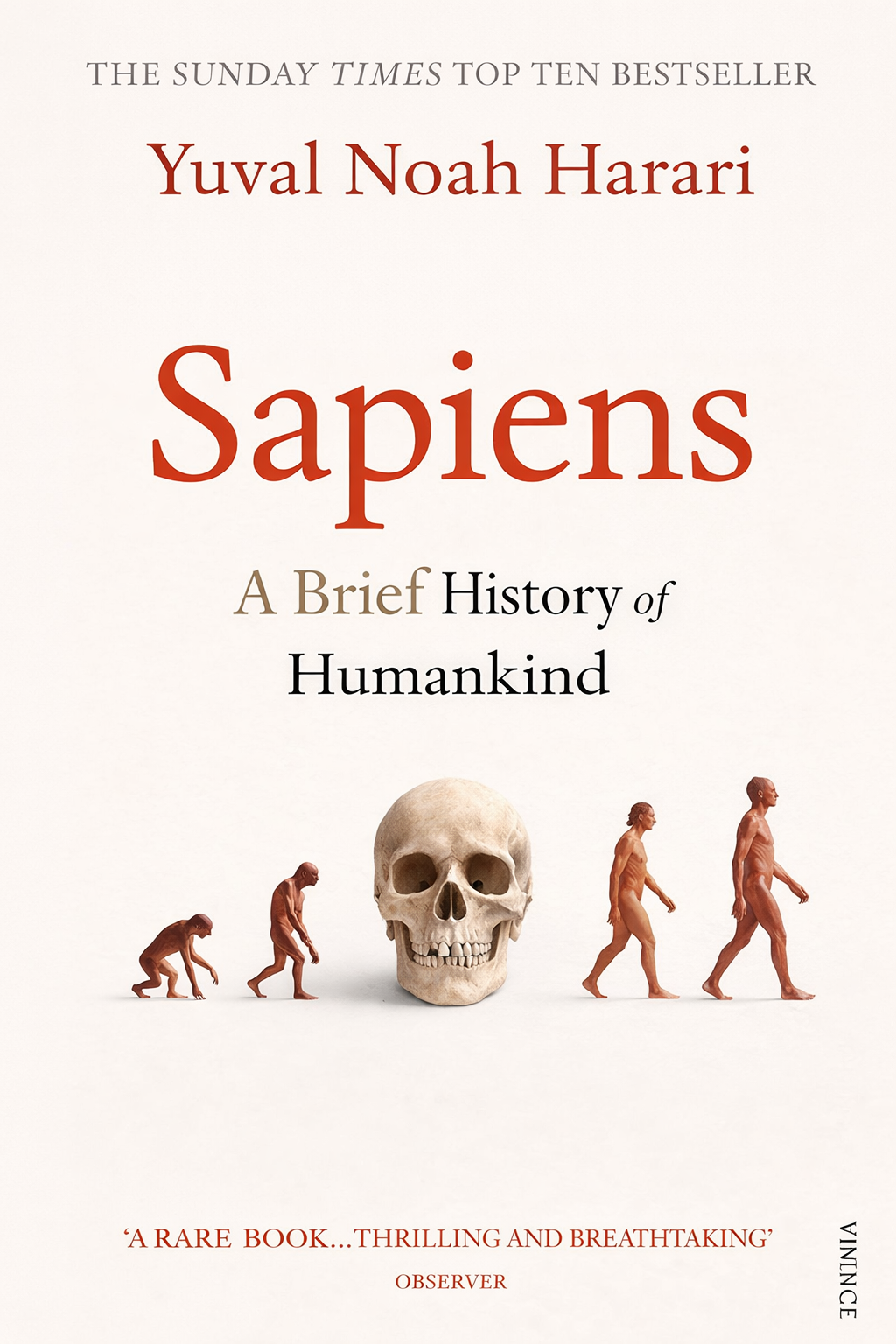
Sapiens: A Brief History of Humankind by Yuval Noah Harari
From Irrelevance to Dominance
The Birth of Shared Myths
Extending the Tree of Knowledge
Everyday Life of the First Humans
The Flood Narrative
History’s Biggest Fraud
Monuments of Power
The Brain’s Burden of Information
Outsourcing Human Memory
Injustice in the Past
The Arrow of History
The Scent of Money
Imperial Visions
Foundations of the Law of Religion
The Institutionalization of Faith
The Secret of Success
The Discovery of Ignorance
Science Meets Empire
The Capitalist Creed
The Wheels of Industry
A Permanent Revolution
Utopian Dreams and Dark Realities
The End of Homo Sapiens

Transcript
Last time we explored how history results from contingent choices rather than deterministic laws, affirming that human agency genuinely shapes civilization's trajectory. Now we confront the intellectual revolution that transformed humanity's relationship with knowledge itself: the Scientific Revolution beginning approximately five hundred years ago, characterized not by new discoveries but by the revolutionary admission of ignorance. Premodern knowledge traditions including Islam, Christianity, Buddhism, and Confucianism all assumed that everything important was already known and preserved in ancient texts or traditions left by great gods, wise men, or past civilizations. Modern science shattered this assumption by proposing that humans do not know the answers to the most important questions, embracing the Latin injunction 'ignoramus'—we do not know. This admission created a fundamentally different approach to knowledge acquisition based on mathematics and empirical observation rather than stories and ancient texts, with scientists describing natural phenomena using mathematical tools and testing theories through systematic experimentation. The Scientific Revolution transformed humanity's relationship with progress and power through the marriage of science, empire, and capitalism, creating an unprecedented feedback loop where scientific research required funding from empires and capitalists who expected practical returns in new technologies and economic growth. European imperial expansion became inextricably linked with scientific advancement, exemplified by Captain James Cook's Pacific voyages from 1768 to 1779, which were fundamentally different from earlier expeditions because they were explicitly scientific missions carrying astronomers, botanists, and other scientists whose primary purpose was gathering new knowledge. The author contrasts this with earlier Chinese expeditions under Admiral Zheng He from 1405 to 1433, which were massive displays of imperial power but generated little scientific knowledge because they operated under the assumption that China already possessed all important knowledge. This science-empire-capitalism nexus transformed global power structures in profound ways, with European imperial conquests justified and facilitated by scientific knowledge including better maps, understanding of winds and currents, knowledge of local diseases, and anthropological insights into indigenous societies. British control of India was built not just on military force but on extensive surveying, mapping, census-taking, and systematic study of Indian languages, religions, and social structures, representing a new form of imperialism where conquest and knowledge production were inseparable. Napoleon's 1798 invasion of Egypt included 165 scholars who produced the monumental 'Description de l'Égypte,' demonstrating how military conquest and scientific documentation were unified endeavors. The legacy of this scientific imperialism shaped modern global culture and knowledge systems in ways that persist today, with categories, classifications, and frameworks developed by European scientists studying colonized peoples and territories becoming the foundation for modern academic disciplines like anthropology, linguistics, and biology. Indigenous knowledge systems were often dismissed as superstition or primitive belief while European scientific frameworks were presented as objective and universal truth, establishing patterns of intellectual authority that persisted long after formal empires dissolved. The Scientific Revolution thus emerges not as a purely intellectual achievement but as a phenomenon inseparable from European imperial expansion, with each reinforcing and enabling the other in ways that fundamentally reshaped the modern world and established Western scientific paradigms as the dominant framework for understanding reality across all cultures.