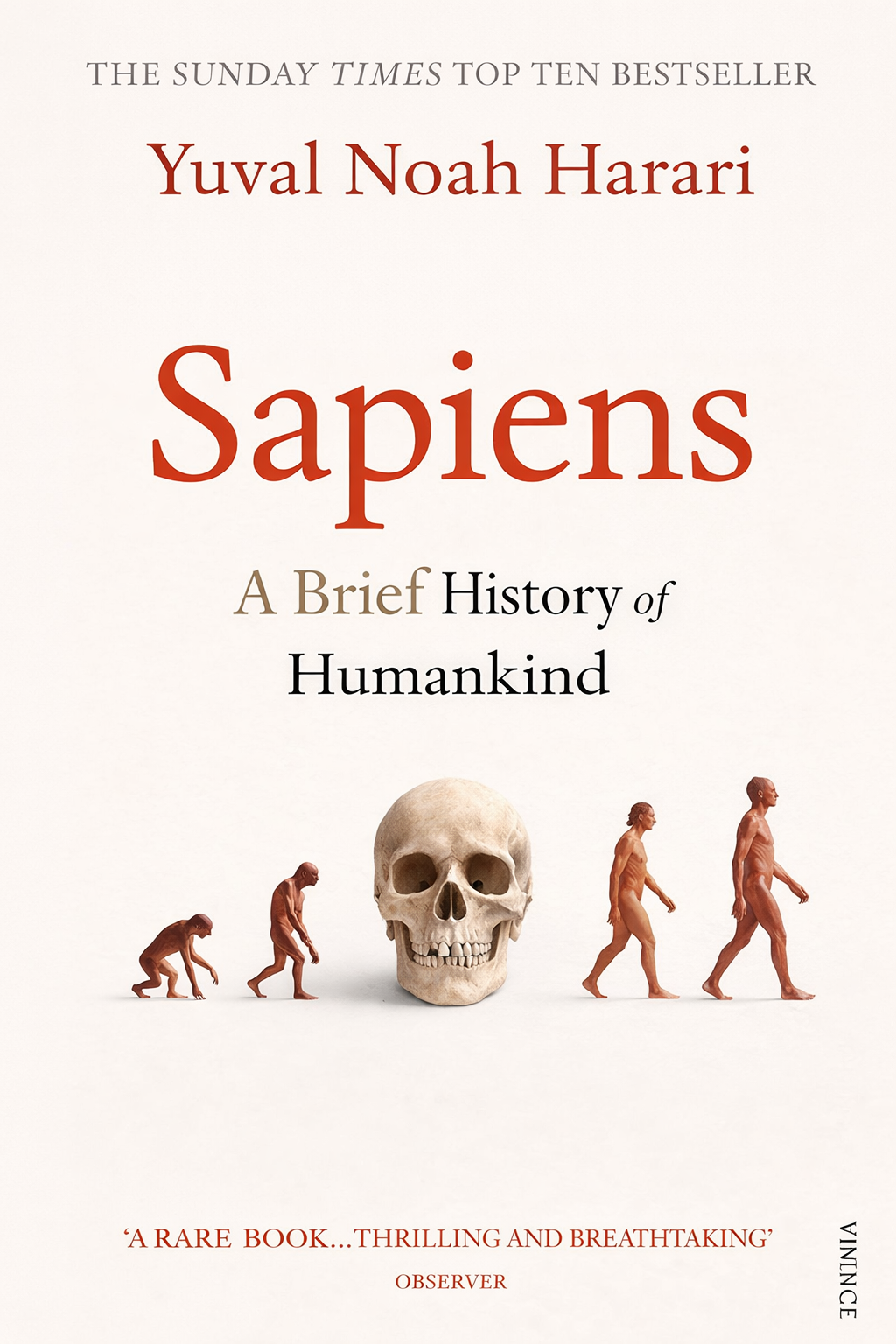
From Irrelevance to Dominance
The Birth of Shared Myths
Extending the Tree of Knowledge
Everyday Life of the First Humans
The Flood Narrative
History’s Biggest Fraud
Monuments of Power
The Brain’s Burden of Information
Outsourcing Human Memory
Injustice in the Past
The Arrow of History
The Scent of Money
Imperial Visions
Foundations of the Law of Religion
The Institutionalization of Faith
The Secret of Success
The Discovery of Ignorance
Science Meets Empire
The Capitalist Creed
The Wheels of Industry
A Permanent Revolution
Utopian Dreams and Dark Realities
The End of Homo Sapiens

Transcript
SPEAKER_1: Alright, so the author makes this wild claim that money, corporations, even human rights... they're all just collective fictions. That sounds like conspiracy theory territory. SPEAKER_2: I get why it sounds that way, but the author's actually making a precise distinction. These aren't lies or deceptions—they're what the book calls 'intersubjective realities.' They exist because we collectively agree they exist. SPEAKER_1: But that's the thing... how is a dollar bill a fiction when I can literally buy coffee with it? SPEAKER_2: Because the paper itself has no intrinsic value. A dollar works only because millions of strangers believe it has value. The moment that collective belief collapses—like in hyperinflation—the paper becomes worthless. The author's point is that this shared myth enables cooperation among people who've never met. SPEAKER_1: Okay, but ants cooperate in massive numbers without believing in anything. Why does the book claim humans are unique here? SPEAKER_2: Great catch. Ants cooperate through rigid genetic programming—they can't revise their social structure when conditions change. Chimpanzees cooperate flexibly, but only in groups of maybe 50 where everyone knows everyone. Humans broke both limits through imagination. SPEAKER_1: So the Cognitive Revolution gave us this superpower. But when did it actually happen? SPEAKER_2: Around 70,000 years ago. That's when Sapiens developed the capacity to create and transmit complex myths. The author argues this allowed cultural evolution to outpace genetic evolution—we could change our cooperation structures by revising stories, not waiting for DNA to mutate. SPEAKER_1: Wait, let's stop there. The book says these fictions shape our desires... like romantic love being a recent invention? That seems like a stretch. SPEAKER_2: It does sound counterintuitive, but the author provides evidence. The idea that romantic love should be the basis for marriage is maybe a few centuries old in most cultures. Before that, marriages were economic or political arrangements. Yet now it feels completely natural to us. SPEAKER_1: But how does that prove it's a fiction and not just... cultural progress? SPEAKER_2: Because the author shows these concepts have no objective existence outside our collective belief. They're embedded in laws, architecture, economic systems—making them self-reinforcing. Someone living in that system internalizes the values even without consciously choosing them. SPEAKER_1: Alright, shifting gears. The book spends a lot of time on ancient foragers. Why does that matter for understanding shared myths? SPEAKER_2: Because our bodies and minds evolved during that period—roughly 70,000 to 12,000 years ago. The author argues we're fundamentally adapted to hunter-gatherer lifestyles, not agricultural or industrial ones. Understanding foragers reveals what humans are actually designed for. SPEAKER_1: And the book claims they had it better than farmers? That sounds romanticized. SPEAKER_2: The author actually warns against romanticizing them. But the archaeological evidence is striking: foragers ate more varied diets, worked maybe 35-45 hours weekly, and were taller and healthier than early farmers. They had extensive ecological knowledge—thousands of species and their uses. SPEAKER_1: Then why did anyone switch to agriculture if it made life worse? SPEAKER_2: This is what the author calls 'history's biggest fraud.' The luxury trap: small improvements led to population growth, creating dependency. You can't abandon intensive farming without mass starvation. Wheat essentially domesticated humans, not the reverse. SPEAKER_1: That's a provocative way to put it. But didn't agriculture at least reduce violence? SPEAKER_2: Not according to the evidence the book presents. Some forager skeletal remains show violent death rates of 10-20%, higher than modern societies. But other sites show little violence. The author resists simple narratives either way. SPEAKER_1: So what did agriculture actually accomplish if it made individuals worse off? SPEAKER_2: It allowed more people to survive in worse conditions, increasing collective power. The author argues it also created a future-oriented mindset—farmers constantly planning for harvests, generating unprecedented anxiety. Foragers lived more in the present. SPEAKER_1: And this connects back to shared myths how? SPEAKER_2: Agriculture required new imagined orders: private property, social hierarchies, legal systems to manage surplus and trade. These fictions became necessary to coordinate sedentary populations. The author shows how women's status generally declined as childcare burdens increased. SPEAKER_1: One last thing—the book mentions mass extinctions following human expansion. Isn't that overstating our impact? SPEAKER_2: Australia lost 90% of its megafauna within millennia of human arrival 45,000 years ago. The author uses this to show that ecological catastrophe isn't a modern phenomenon—it's been part of Sapiens' story from the beginning. SPEAKER_1: So for anyone reading this, the takeaway is that our capacity for shared fictions gave us dominance... but locked us into systems that don't serve individual welfare? SPEAKER_2: Exactly. The author's argument is that we're living with the consequences of revolutions—cognitive and agricultural—that increased collective power while diminishing personal autonomy and health. Understanding that tension is crucial for making sense of modern life.