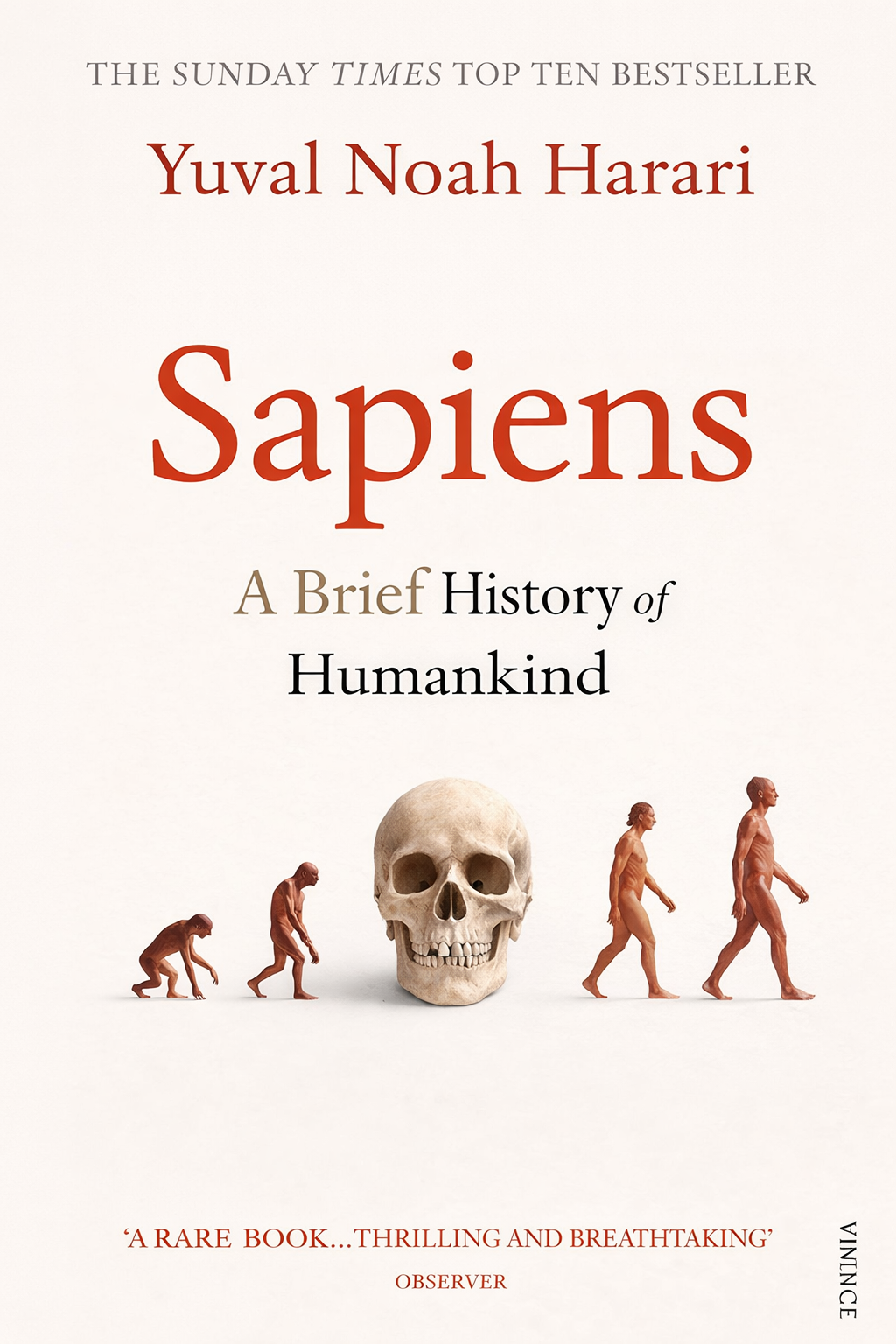
From Irrelevance to Dominance
The Birth of Shared Myths
Extending the Tree of Knowledge
Everyday Life of the First Humans
The Flood Narrative
History’s Biggest Fraud
Monuments of Power
The Brain’s Burden of Information
Outsourcing Human Memory
Injustice in the Past
The Arrow of History
The Scent of Money
Imperial Visions
Foundations of the Law of Religion
The Institutionalization of Faith
The Secret of Success
The Discovery of Ignorance
Science Meets Empire
The Capitalist Creed
The Wheels of Industry
A Permanent Revolution
Utopian Dreams and Dark Realities
The End of Homo Sapiens

Transcript
SPEAKER_1: Alright, last time we talked about how empires and religions created unified identities from diverse populations. Now the author's claiming that religion and science aren't actually opposed. That contradicts everything we're taught about the Enlightenment. SPEAKER_2: It does sound counterintuitive, but the author's making a precise distinction. Science describes how things work, establishing factual knowledge. Religion provides normative frameworks determining what should be valued and how people should behave. They address different questions. SPEAKER_1: But that's the thing... doesn't evolutionary biology directly contradict religious creation stories? SPEAKER_2: The author argues that's confusing factual description with ethical prescription. Modern societies can simultaneously embrace evolution as factual and human rights as a religious belief about human dignity. Science tells us how to achieve goals but not which goals are worth pursuing. SPEAKER_1: Wait, so the book's calling human rights a religion? SPEAKER_2: Exactly. The author contends that liberalism, communism, capitalism, nationalism... these function as religions even without supernatural beings. They establish comprehensive normative frameworks defining what is good and how society should be organized. SPEAKER_1: That seems like a semantic trick. What makes those ideologies religious? SPEAKER_2: They create shared values that millions believe in simultaneously, enabling cooperation across vast distances. Just like Buddhism or Christianity transcended local boundaries, modern ideologies unite strangers under common frameworks of laws and narratives. SPEAKER_1: Okay, but the book also claims universal religions were crucial for large-scale cooperation. How did that actually work? SPEAKER_2: Unlike animistic beliefs tied to specific places, universal religions created imagined orders that millions could believe in simultaneously. They established common rules, created trust between strangers, and legitimized political hierarchies through claims of superhuman authority. SPEAKER_1: So religion and empire reinforced each other? SPEAKER_2: Precisely. Christianity's alliance with Rome and Islam's connection to Arab conquests exemplify this symbiotic relationship. Religions provided ideological justification for imperial expansion while empires offered protection and resources for religious institutions. SPEAKER_1: But didn't religions preach universal brotherhood? That seems contradictory if they're reinforcing hierarchies. SPEAKER_2: The author emphasizes exactly that complexity. Even as religions preached universal brotherhood, they often reinforced existing social hierarchies. This reveals the contradictory role religion has played throughout history. SPEAKER_1: Alright, shifting gears. The book spends time on historical contingency versus determinism. Why does that matter? SPEAKER_2: Because the author challenges deterministic explanations for historical outcomes. They introduce second-order chaos, where history not only is unpredictable but reacts to predictions about it. Unlike weather systems that don't change based on forecasts, human societies make decisions based on expectations of the future. SPEAKER_1: Give me a concrete example of that. SPEAKER_2: The Persian invasion of Greece in 480 BCE. If the Persians had conquered Greece, Western philosophy and science might never have emerged. The Mongol withdrawal from Europe in 1241... if they'd continued, the continent's entire trajectory would have been altered. SPEAKER_1: But couldn't we say geography or technology made those outcomes likely? SPEAKER_2: The author acknowledges contributing factors that made certain outcomes more probable. But their interactions are so complex that precise prediction remains impossible. Small, seemingly insignificant factors can have enormous cascading effects on civilization's development. SPEAKER_1: What about the Manhattan Project? That seems like a case where technology determined the outcome. SPEAKER_2: Actually, the author uses it to show contingency. If Nazi Germany had developed nuclear weapons first, the war's outcome would have fundamentally changed. The race for atomic weapons demonstrates how unpredictable circumstances shape history. SPEAKER_1: So the book's saying history is just random accidents? SPEAKER_2: Not random, but contingent. History results from countless contingent choices, accidents, and unpredictable circumstances rather than deterministic laws or inevitable trajectories. This perspective is ultimately liberating because if history isn't predetermined, then human choices genuinely matter. SPEAKER_1: That's a pretty optimistic take. But doesn't it make studying history pointless if we can't predict anything? SPEAKER_2: The author argues the opposite. The real value of studying history lies not in discovering laws to predict the future, but in understanding the range of possibilities. Recognizing that things could be different than they are, and appreciating that the current state of affairs isn't natural or inevitable. SPEAKER_1: So for our listener, the takeaway is that we're not locked into any particular future? SPEAKER_2: Exactly. The author's argument is that this awareness should make everyone more thoughtful about decisions and more humble about our ability to control outcomes, while simultaneously affirming the profound significance of individual and collective agency in shaping civilization's trajectory.