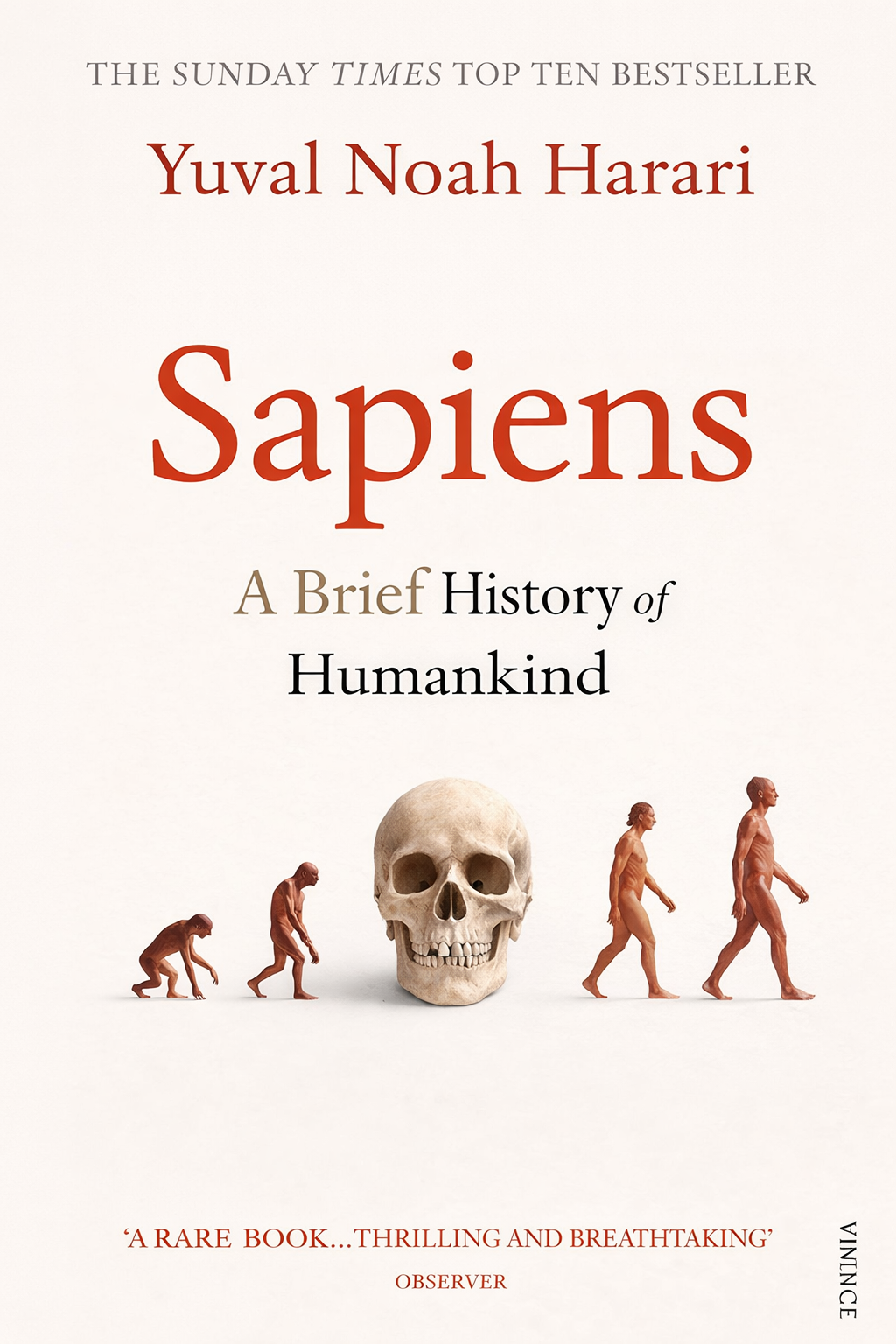
From Irrelevance to Dominance
The Birth of Shared Myths
Extending the Tree of Knowledge
Everyday Life of the First Humans
The Flood Narrative
History’s Biggest Fraud
Monuments of Power
The Brain’s Burden of Information
Outsourcing Human Memory
Injustice in the Past
The Arrow of History
The Scent of Money
Imperial Visions
Foundations of the Law of Religion
The Institutionalization of Faith
The Secret of Success
The Discovery of Ignorance
Science Meets Empire
The Capitalist Creed
The Wheels of Industry
A Permanent Revolution
Utopian Dreams and Dark Realities
The End of Homo Sapiens

Transcript
Last time we examined how the Scientific Revolution emerged from the revolutionary admission of ignorance, creating an unprecedented feedback loop between science, empire, and capitalism that fundamentally reshaped global power structures. Now we confront how this convergence manifested in European imperialism, where colonial expansion became inseparable from scientific knowledge production. Imperial powers invested enormous resources in mapping, cataloging, and studying their territories, creating a powerful feedback loop where knowledge enabled more effective control while imperial power provided resources and access for scientific advancement. The British Survey of India employed thousands to map the subcontinent with unprecedented precision, while Napoleon's 1798 Egyptian invasion included 165 scholars who produced the monumental Description de l'Égypte, demonstrating how military conquest and scientific documentation were unified endeavors. European museums, botanical gardens, and universities became repositories for materials extracted from colonies, establishing classification systems that reinforced imperial hierarchies and presented European frameworks as objective universal truth. The development of anthropology, linguistics, and archaeology occurred within colonial contexts, often producing scientific racism that justified domination as a civilizing mission. This marriage of science and empire fundamentally shaped modern knowledge systems in ways that persist today, from geographic naming conventions to academic disciplines and the assumptions underlying how non-European cultures are studied. The dominance of European languages in scientific discourse, the location of major collections in former imperial capitals, and the frameworks for understanding reality across cultures all reflect this legacy. Indigenous knowledge systems were dismissed as superstition while European scientific paradigms established patterns of intellectual authority that persisted long after formal empires dissolved. Capitalism emerged as the dominant modern economic system by introducing a revolutionary concept: perpetual economic growth through reinvestment of profits, shattering the static zero-sum mentality that had constrained economies for millennia. This belief system required faith that future production would exceed current production, making credit central to the capitalist model as banks lent money based on trust that future economic activity would generate enough wealth to repay loans with interest. The system worked through mechanisms like joint-stock companies, which pooled investor resources for massive undertakings previously impossible, with the Dutch East India Company exemplifying how this financial architecture could fund operations on unprecedented scales. The Industrial Revolution solved the fundamental energy problem that had constrained economic growth by learning to convert energy types, particularly harnessing fossil fuels through innovations like James Watt's steam engine in the 1770s. Coal mines supplied energy far exceeding any forest's capacity without requiring regeneration time, transforming the British textile industry from 3 million pounds of cotton cloth annually in 1700 using muscle power to 40 million pounds by 1850 using coal-powered machines. This energy revolution created genuine positive-sum economics where the pie itself could expand indefinitely, reinforcing capitalism as capitalists financed factories and mines that produced more goods and wealth, generating more capital for investment and creating unprecedented wealth disparities between industrialized and non-industrialized regions that would define global politics for the next two centuries.